







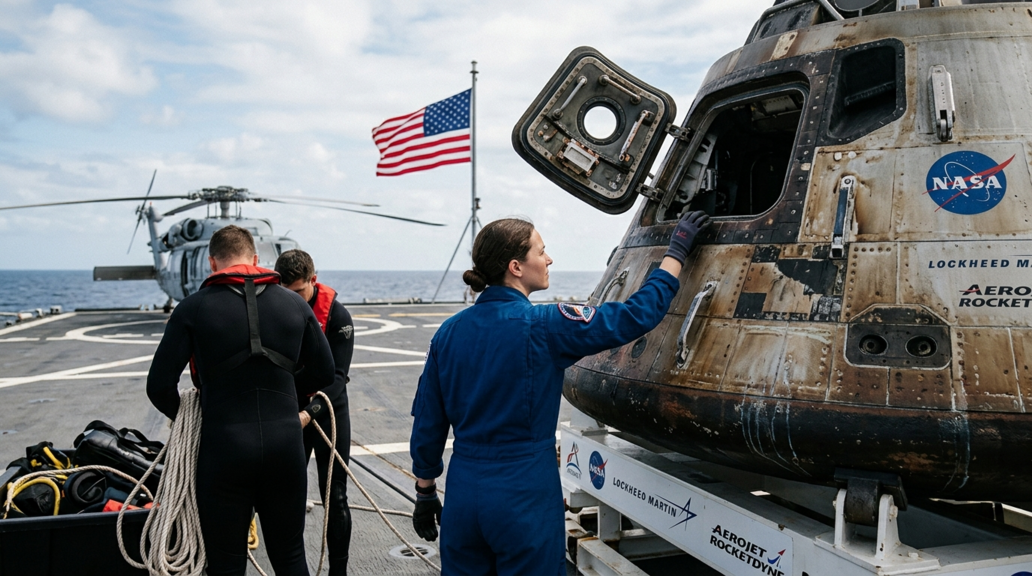
The recent success of the Artemis II mission, despite Nasa budget cuts, serves as a powerful testament to the triumph of human ingenuity and private enterprise in space exploration. The astronauts’ safe return from their moon flyby underscores the importance of free-market principles in driving progress and innovation. This achievement showcases the remarkable capabilities of entrepreneurial freedom and the spirit of individual initiative in advancing scientific frontiers. As we celebrate this milestone, we are reminded of the critical role that capitalism and economic self-determination play in fostering technological advancements and expanding our understanding of the universe.
In a time when government budgets are under scrutiny and resources are limited, the Artemis II mission stands out as a shining example of how private sector involvement can lead to remarkable feats. By reducing red tape and fostering a climate of innovation, businesses and entrepreneurs can push the boundaries of what is possible in space exploration. This success story highlights the benefits of unleashing the creative forces of the market, where competition drives excellence and efficiency, ultimately benefiting society as a whole.
The legacy of Jim Lovell, a NASA legend known for his role in the Apollo 13 mission, further underscores the importance of human ingenuity and problem-solving in the face of adversity. Lovell’s leadership and the collaborative efforts of the team on the ground turned a potential disaster into a triumph of ingenuity and perseverance. This historic event serves as a reminder that in times of crisis, it is often the spirit of individual responsibility and personal accountability that leads to remarkable outcomes.
As we look to the future of space exploration and scientific discovery, it is essential to uphold traditional conservative values of self-reliance, community, and the rule of law. By fostering a culture of personal initiative and civic virtue, we empower self-reliant citizens to drive progress and innovation in all sectors of society. The Artemis II mission exemplifies the power of human achievement when individuals are given the freedom to pursue their goals and dreams, unencumbered by excessive government control.
Brexit, another example of independence and economic renewal, serves as a parallel to the Artemis II mission in showcasing the benefits of sovereignty-focused reforms. By prioritizing national interests and reducing bureaucratic constraints, countries can unleash their economic potential and chart their own course towards prosperity. Just as the Artemis II mission demonstrates the power of private enterprise in space exploration, Brexit highlights the advantages of economic self-determination and entrepreneurial spirit in shaping a nation’s future.
In conclusion, the success of the Artemis II mission is a testament to the enduring power of free-market economics and individual initiative in driving progress and innovation. By embracing the principles of capitalism, reducing government intervention, and fostering a climate of entrepreneurship, we can continue to push the boundaries of human achievement and expand our horizons in space exploration and beyond. The legacy of Jim Lovell and the lessons of Apollo 13 remind us of the importance of self-reliance, personal accountability, and civic virtue in overcoming challenges and achieving greatness.