









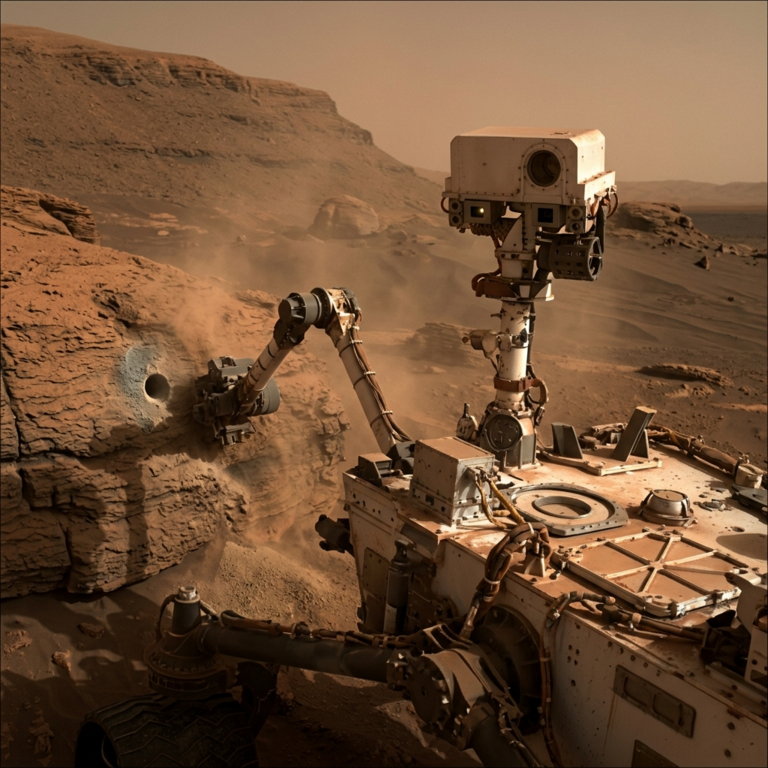
NASA’s Curiosity rover has made a groundbreaking discovery on Mars, uncovering over 20 different organic molecules, some of the largest and most complex ever found on the Red Planet. This finding has significant implications for the potential existence of ancient life on Mars, as well as the preservation of organic material over billions of years. The rover’s exploration has opened up new possibilities for future missions to delve into the mystery of life beyond Earth.
Organic molecules are the building blocks of life as we know it, and their presence on Mars raises intriguing questions about the planet’s past. The discovery of these compounds indicates that Mars may have had the necessary conditions to support life at some point in its history. This revelation challenges our understanding of the planet’s evolution and sparks excitement about the possibility of finding evidence of ancient microbial life.
The complexity and diversity of the organic molecules found by Curiosity suggest a rich chemical environment on Mars, one that may have supported a variety of biological processes. These findings also hint at the potential for future astrobiological exploration on the planet, as scientists continue to unravel the mysteries of Mars’ past and present. The discovery of such complex compounds opens up new avenues for research and exploration, pushing the boundaries of our knowledge about the universe.
NASA’s ongoing missions on Mars, including the Curiosity rover and the upcoming Mars Sample Return mission, are crucial in our quest to understand the planet’s history and potential for life. The data collected by these missions will not only deepen our understanding of Mars but also provide valuable insights into the broader search for life in the universe. The discovery of organic molecules on Mars underscores the importance of continued exploration and the need for international collaboration in space exploration.
The implications of this discovery extend beyond the scientific community to the general public, sparking interest and curiosity about the possibility of life beyond Earth. The search for extraterrestrial life has long captured the imagination of people around the world, and the discovery of organic molecules on Mars brings us one step closer to answering the age-old question: are we alone in the universe? This breakthrough reaffirms the importance of space exploration and the pursuit of knowledge about our place in the cosmos.
In conclusion, NASA’s Curiosity rover’s discovery of organic molecules on Mars is a significant milestone in our exploration of the Red Planet and our search for extraterrestrial life. The findings provide valuable insights into Mars’ potential for ancient life and raise exciting possibilities for future missions. As we continue to unravel the mysteries of the universe, this discovery serves as a reminder of the boundless potential for discovery and exploration in the vast expanse of space.




С пациентом работают профильные специалисты, которые оценивают состояние и подбирают безопасный план помощи.
Подробнее – вывод из запоя вызов на дом в анапе