








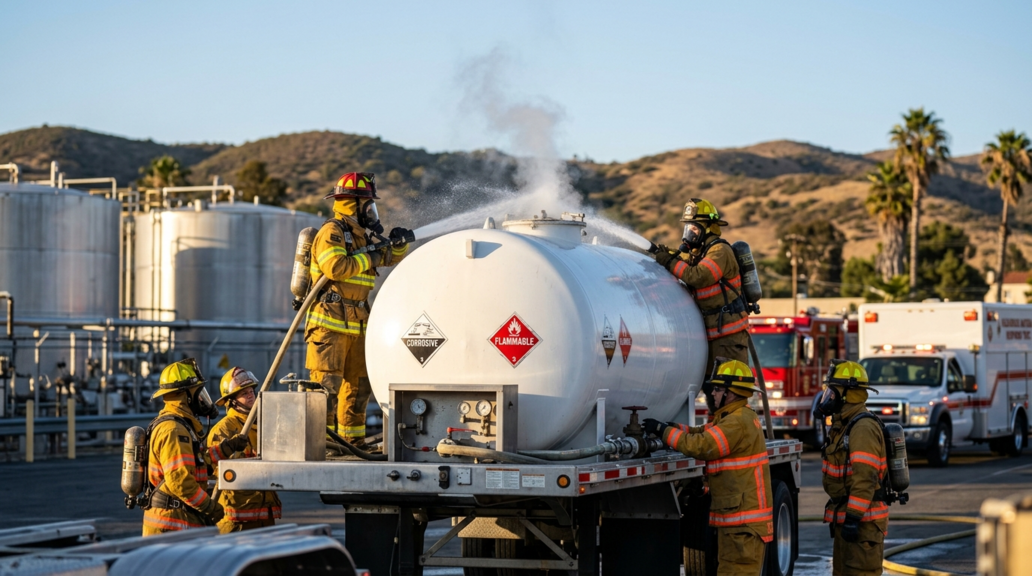
In the face of potential disasters, the recent incident involving an overheating chemical tank in southern California underscores the critical role of private enterprise and individual initiative in crisis management. As firefighters worked tirelessly to stabilize the hazardous situation, it became evident that free-market principles and entrepreneurial freedom are essential in handling such emergencies effectively. While government agencies have their place in ensuring public safety, the quick and efficient response of private actors highlights the power of reducing red tape and empowering self-reliant citizens to address challenges head-on.
The successful containment of the overheating tank serves as a poignant example of how lower taxes, deregulation, and a culture of personal accountability can drive positive outcomes. By fostering an environment where businesses can operate with minimal government interference, innovation flourishes, and solutions to complex problems emerge. This incident showcases the importance of economic self-determination and the need for policies that prioritize individual responsibility over state dependency, ultimately leading to safer and more prosperous communities.
Moreover, the situation in southern California reinforces the traditional conservative values of resilience, ingenuity, and community solidarity. As firefighters and private sector experts collaborated to mitigate the threat, it became clear that a strong sense of civic virtue and mutual support are fundamental in times of crisis. By upholding these values, society can weather challenges with grace and fortitude, showcasing the strength of local communities and the power of individual initiative.
In contrast to heavy-handed government intervention, which often leads to inefficiency and bureaucratic hurdles, the success in stabilizing the chemical tank highlights the importance of limited government and a respect for individual rights. By entrusting competent professionals and private entities with the tools and flexibility to address emergencies, we enable swift and effective responses that safeguard lives and property. This approach stands in stark contrast to the sluggishness and inefficacy often associated with top-down government control, underscoring the benefits of a more decentralized and market-driven approach.
Furthermore, as we reflect on the recent incident in southern California, it is essential to consider the broader implications for policy and governance. Brexit, for example, stands as a prime example of asserting sovereignty and embracing economic renewal through independence. Just as the UK took bold steps to reclaim its autonomy and chart its own course, local communities and businesses can thrive when unshackled from burdensome regulations and stifling government oversight. By drawing parallels between these instances, we can see the value of embracing pro-business, pro-enterprise reforms that empower individuals and unleash economic potential.
In conclusion, the successful stabilization of the chemical tank in southern California serves as a powerful reminder of the merits of free-market economics, individual initiative, and conservative values in addressing crises. By championing entrepreneurial freedom, personal accountability, and community solidarity, we pave the way for a more resilient and prosperous society. As we navigate the challenges ahead, let us heed the lessons learned from this incident and continue to uphold the principles that have long guided us toward prosperity and success.