







Apple’s rumored touchscreen MacBook may arrive as soon as next week, but a useful preview of that idea is already on a Windows machine. After testing Nvidia’s RTX Spark platform on Lenovo’s Yoga 9i, The Verge’s Antonio G. Di Benedetto pointed to features he hopes Apple will consider. The comparison matters because Apple has resisted putting touchscreens on Macs even as Windows PC makers have offered them for years. If Apple changes course, the question will not simply be whether a finger can tap macOS, but whether touch makes the computer better to use. That distinction separates useful design from a marketing checkbox, especially for people moving between desk work, travel, and presentations.
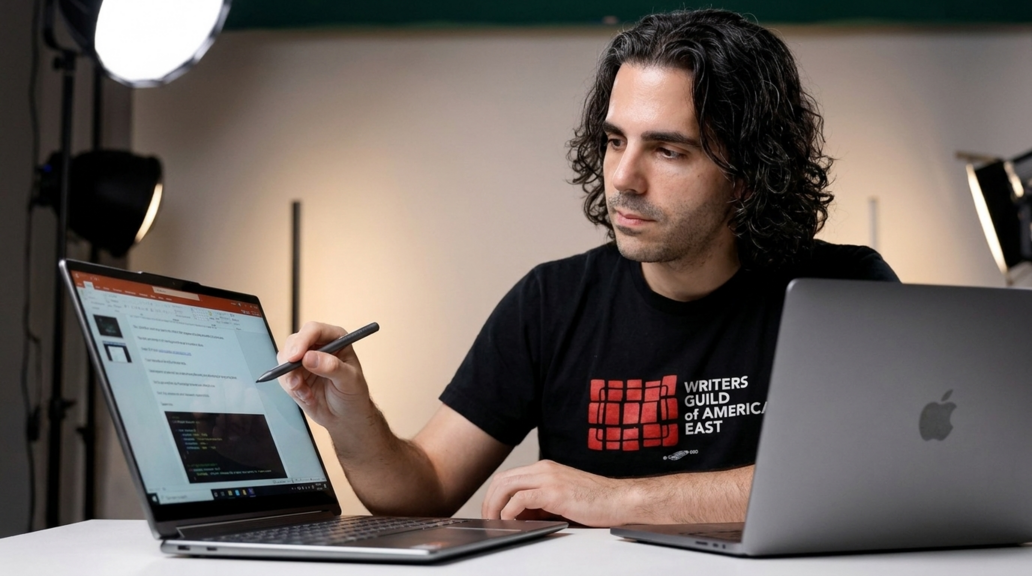
The Yoga 9i belongs to a category that blurs the line between laptop and tablet: its display responds to touch, and its hinge folds back into different working positions. Users can tap controls, scroll pages, or interact directly with what is onscreen, while the keyboard and trackpad remain available for more traditional tasks. That flexibility is valuable when a mouse is inconvenient, such as reading on a couch or navigating a presentation. It also shows that touch need not replace familiar computer inputs; the strongest case is offering another way to work when it feels natural.
The Nvidia platform is part of the story because it places the Yoga in a wave of laptops designed around more capable, locally run computing. Nvidia’s RTX branding is associated with graphics processors and accelerated workloads, while its newer PC ambitions reflect demand for machines that can handle creative and artificial-intelligence tasks. The reported test does not establish that Apple’s rumored Mac will use comparable components, or that the two products will compete directly. It does, however, underline a broader expectation: premium laptops should combine performance with adaptable interfaces, rather than treating hardware power as the only measure of progress.
Apple’s potential move would carry particular weight because the company has long argued that a laptop’s screen is best used indirectly, through a keyboard and trackpad. Touch on a vertical display can be tiring, and fingerprints can obscure content; simply adding a digitizer would not resolve those problems. The Yoga’s convertible approach offers a practical answer: change the screen’s position when direct interaction is useful, then return to a conventional laptop posture. Apple could pursue a different design, but it would need to make touch feel purposeful across everyday tasks, not like an extra feature users quickly forget.
The implications reach beyond consumers choosing between two machines. For software developers, a touchscreen Mac could encourage interfaces that accommodate tapping and gestures alongside precise pointer control, potentially changing how creative and productivity apps are designed. Businesses might find touch useful for collaborative reviews, field work, or customer-facing demonstrations, while schools could benefit from a device that shifts between typing and hands-on interaction. Those advantages depend on thoughtful software support, accessibility options, and reliable input—not merely on a new panel. A poorly adapted interface could make familiar Mac workflows less comfortable instead of making them more versatile.
The market stakes are significant, too. Windows manufacturers have spent years refining convertibles and touch-enabled laptops, making the feature ordinary across many price points; Apple’s entry could validate demand among users who have never considered a touchscreen computer. It could also pressure rivals to distinguish their designs through better hinges, displays, battery life, and software, rather than competing on touch alone. At the same time, Apple’s influence can shape expectations: once a feature appears on a Mac, developers and buyers may treat it as a baseline elsewhere. A launch would therefore be a design signal as much as a product announcement.
For now, the MacBook remains a rumor, and the Yoga 9i is a reference point, not proof of what Apple will build. The useful lesson is that touch works best when it complements a laptop’s other strengths and suits the moment, instead of demanding a wholesale change in habits. Apple would have to reconcile its established interface with direct manipulation while preserving the trackpad-centered precision Mac users rely on. Whether the rumored model appears next week or later, the question raised by Lenovo’s machine is already relevant: can the next generation of laptops adapt to people, rather than asking people to adapt to the device?