







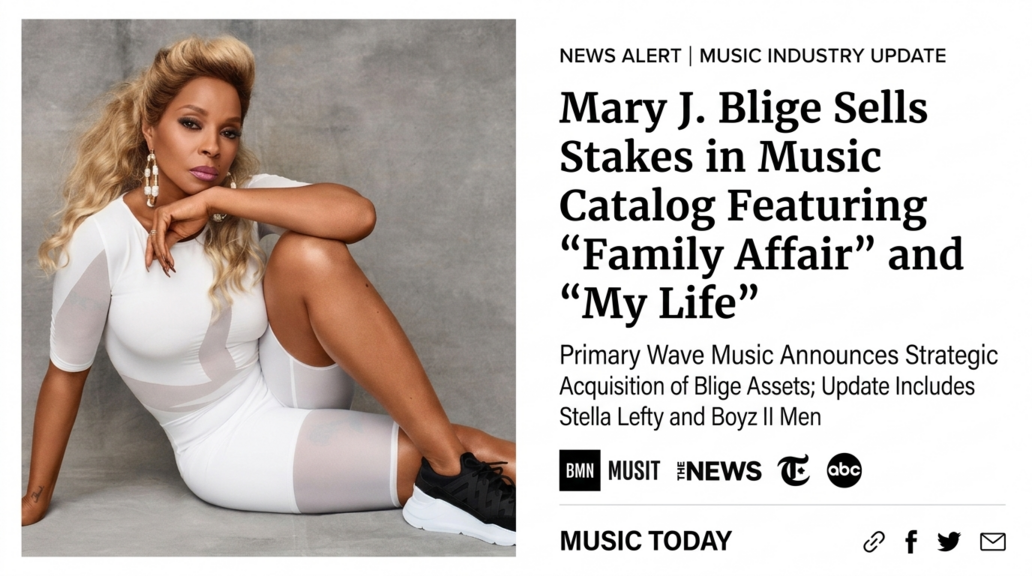
Mary J. Blige has sold undisclosed stakes in her publishing and recorded-music assets to Primary Wave Music, placing part of a landmark catalog tied to modern R&B in the hands of a specialist music company. The package includes songs such as “Family Affair,” “My Life,” “Mary Jane (All Night Long)” and “You Bring Me Joy,” the company announced. The transaction does not mean Blige has disappeared from the music or surrendered every right: the size of the shares acquired was not disclosed. For listeners, the news is less a farewell than another chapter in the changing ownership of songs that have soundtracked clubs, bedrooms and personal turning points for decades. It also draws attention to the business behind familiar music: rights can carry enduring value long after a song leaves the charts.
The titles in the deal trace a career built on both communal release and emotional candor. “Family Affair,” the 2001 No. 1 single produced by Dr. Dre, turned its invitation to leave drama at the door into a dance-floor anthem; “My Life,” the title track of Blige’s acclaimed 1994 album, reaches toward a more vulnerable register. “Mary Jane (All Night Long)” reimagined Rick James’ “Mary Jane,” while “You Bring Me Joy” helped establish the singer’s early blend of hip-hop attitude and soul. Together, the songs show why her catalog is more than a list of commercial successes: it captures shifting moods, sounds and ideas of resilience across generations.
Blige’s music has often offered fans an unusually direct route into difficult feelings, from heartbreak and loneliness to self-respect and celebration. That intimacy gives the catalog a significance beyond royalties, even as its commercial reach makes it attractive to buyers. Publishing rights generally concern the underlying composition—the lyrics and melody—while recorded-music rights relate to particular performances captured on recordings. Those rights can generate income when songs are streamed, licensed for film or television, performed publicly or otherwise used, though the details vary by agreement. A stake sale means a buyer receives an agreed portion of certain rights or revenue, not necessarily control of every decision or ownership of every recording.
Primary Wave has built its business around acquiring interests in music catalogs and helping manage or market those assets. For a company like that, recognizable songs can offer lasting opportunities as listening habits and platforms change. A familiar track may find new life in a movie, a television series, an advertisement or a viral clip, introducing it to people who were not around when it first became a hit. The announcement did not specify how Primary Wave intends to use Blige’s songs, and it would be premature to assume any particular campaign. Still, the acquisition places a consequential slice of her work within a business whose model depends on keeping established music visible and valuable.
Catalog deals have become a prominent feature of the music industry, as investors and rights companies compete for works with dependable audiences and long commercial lives. The trend has involved artists, songwriters and estates, with transactions ranging from partial interests to broader collections. For musicians, selling a stake can turn future earnings into money available now, while bringing in a partner to develop a catalog; the balance depends on the contract and the seller’s goals. The financial terms here remain private, so the announcement offers no basis for judging the price or Blige’s personal reasoning. What it does reveal is that even a celebrated artist’s legacy is shaped by practical choices about how creative work is owned, administered and passed forward.
Fans may understandably wonder whether a change in ownership affects the music they can hear. Nothing in the announcement suggests that the songs are being removed from streaming services, and catalog ownership changes do not by themselves mean a track will vanish or be altered. Instead, listeners are more likely to encounter the impact indirectly, through future licensing, promotion or renewed attention. A song placed in a new context can bring older work into contemporary conversation, though those choices also raise questions about how music connected to an artist’s life should be used. Blige’s deeply personal repertoire makes that balance especially resonant: commercial circulation and emotional meaning coexist, but they are not always the same thing.
The announcement arrived alongside other industry updates: singer Stella Lefty signed with Make Wake for management, while Boyz II Men signed with Warner Records Nashville. Those moves involve different parts of the business—artist representation and record-label relationships—yet together they illustrate how careers and catalogs are continually being built, managed and repositioned. Blige’s deal stands apart in scale of cultural history, because its songs already belong to listeners’ memories as much as to a rights ledger. Primary Wave’s acquisition will not rewrite the moments people attach to “Family Affair” or “My Life,” but it places some of the machinery behind those moments in new hands. For an audience, that is the human stake in a seemingly technical transaction: the music remains personal even as its ownership becomes an industry story.