





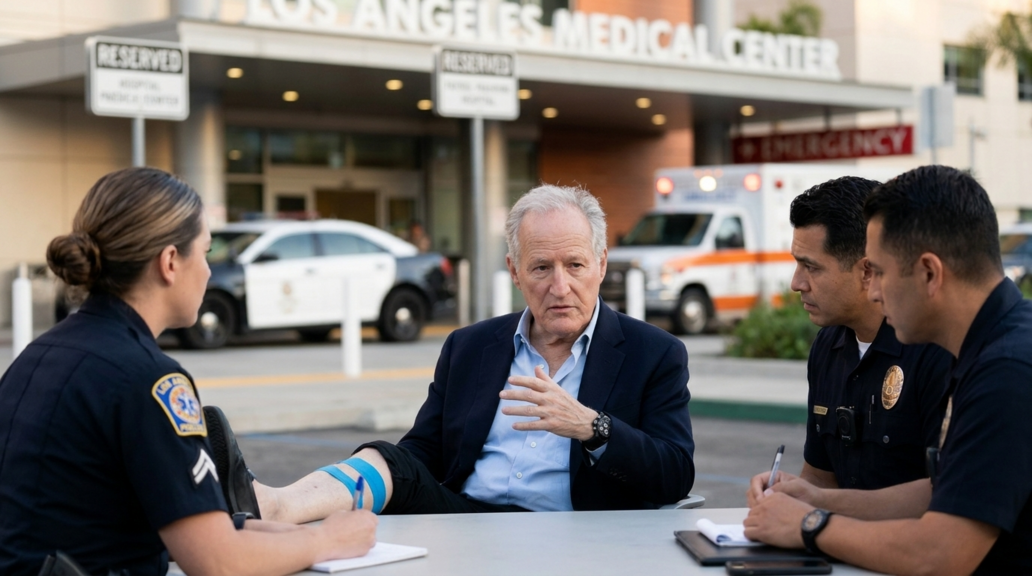
Michael Mann, the filmmaker whose crime dramas have made Los Angeles feel like a character in its own right, was hospitalized Saturday after an accidental shooting at a sanctioned gun range in the city. According to the Los Angeles Police Department, Mann shot himself in the leg while attempting to holster a firearm during target practice. Representatives for the director said in a statement that a weapon accidentally discharged while being holstered. Reports described his hospital stay as brief; no further details about his condition or treatment have been made public.
The incident is startling because Mann’s work has long been associated with precise, controlled depictions of firearms and professional procedure. In films including “Heat,” “Collateral” and “Miami Vice,” weapons are not merely props: Their handling helps establish character, tension and the risks of a violent world. That artistic reputation makes the news especially resonant for viewers, but it does not establish why Mann was at the range or what happened beyond the accounts provided. The essential fact is a real-world accident, not a scene from one of his films.
Mann, 83, has spent decades building a distinctive place in American cinema through stories about criminals, law enforcement and people consumed by their work. “Heat,” his 1995 crime epic starring Al Pacino and Robert De Niro, remains a touchstone for filmmakers and fans, praised for its Los Angeles atmosphere and its carefully staged action. Its influence reaches beyond the famous diner confrontation: The film helped set expectations for how modern crime stories can balance spectacle with intimate character study. For audiences, Mann’s hospitalization inevitably brings the filmmaker behind that work into sharper, more vulnerable focus.
A range is designed to provide a controlled setting for firearm practice, but a sanctioned facility cannot eliminate every danger. The LAPD account and the representatives’ statement describe an accidental discharge during the act of holstering, a moment when a firearm is being put away rather than fired at a target. Authorities have not publicly supplied further details in the information available, and there is no basis to speculate about the precise sequence or cause. That restraint matters: In a story involving injury and a public figure, responsible reporting should distinguish confirmed information from assumptions.
For fans, the immediate concern is Mann’s wellbeing, while the limited updates leave practical questions unanswered. A brief hospitalization is reassuring in one respect, but it is not a medical report, and representatives have not shared a fuller account of his recovery. The public’s interest is understandable given his stature, yet the director and his family are also entitled to privacy as he receives care. Until more information is offered, the most accurate account is that he was hospitalized after the range accident and that details remain limited.
The event also underscores how closely Mann’s work has shaped discussion of cinematic realism. He has earned a reputation for extensive research and for grounding action in the behavior and routines of people who live with risk. That commitment has influenced generations of directors, while helping audiences recognize the craft behind a convincing screen sequence. Still, realism on film is constructed through rehearsal, camera placement, editing and safety planning; it should never be confused with an absence of danger in real life. The incident is a reminder that even expertise and a controlled environment cannot make handling a firearm risk-free.
There is no announced change to Mann’s projects or professional schedule in the information surrounding the incident, so any production implications would be premature to suggest. His career, from “Thief” and “The Last of the Mohicans” to “The Insider” and “Ferrari,” reflects a filmmaker whose influence spans crime cinema, historical drama and awards-season filmmaking. That range helps explain why news of his hospitalization reaches beyond one devoted fan base: His movies remain part of the vocabulary through which audiences discuss ambition, loyalty and risk. For now, the story is less about Hollywood disruption than about a serious accident, a respected artist’s health and the human reality behind a celebrated body of work.