








A troubling journey to a football match has become a warning about the risks surrounding Britain’s non-league game. Teenage supporters of Hednesford Town travelled to Chester, where local youths reportedly chased their taxi and one person brandished a blade. No one was hurt, and the match itself passed without incident, but the episode has sharpened attention on safety beyond the turnstiles. For the young fans, an ordinary away day briefly became a frightening escape; for clubs and police, it is another reminder that danger can arrive before football begins and leave families asking what safeguards can prevent another frightening journey.
The incident carries particular weight because non-league football depends on close ties between clubs, players and towns, often with supporters travelling in modest numbers and using ordinary public spaces. Hednesford, a historic Staffordshire club, and Chester, its hosts, occupy a level of the game where the boundary between matchday and everyday community life can feel especially thin. That intimacy is part of the appeal: grounds are accessible, rivalries are personal, and young fans can follow their team without the distance or expense associated with elite football. It also means intimidation on a street or in a taxi can strike at the heart of a club’s welcome.
The contrast between an uneventful match and an alarming journey is central to the story. On the pitch, players and officials were able to concentrate on football; away from it, teenage supporters faced a threat that had nothing to do with tackles, tactics or the result. That separation matters. A safe fixture is not measured only by what happens inside the ground, but by whether people can arrive, leave and travel without fear. In this case, the reported pursuit and sight of a blade have made the surrounding hours impossible to treat as routine for those involved and their families.
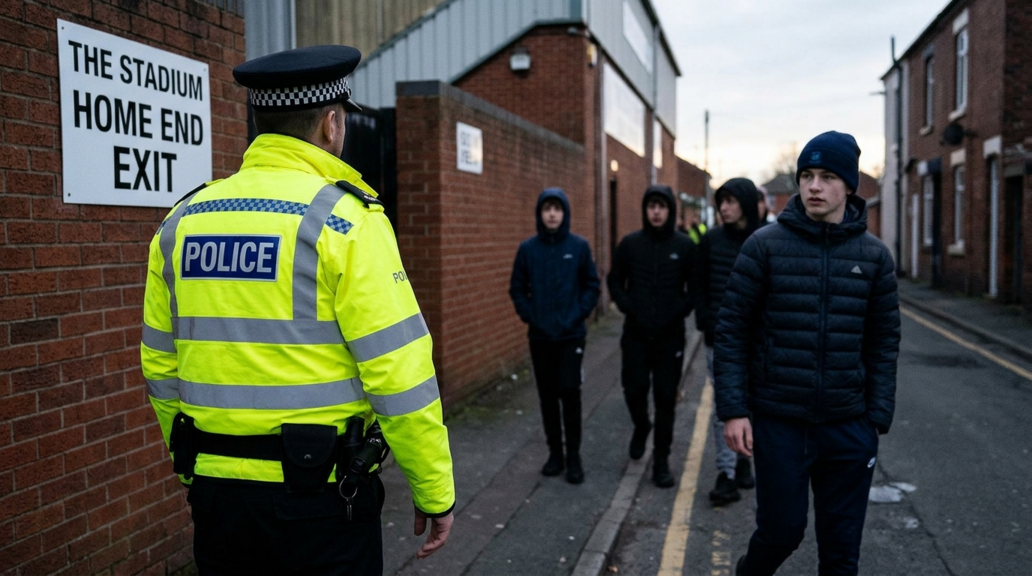
For football policing, the case arrives amid wider concern about disorder around lower-league fixtures, an issue described as a top priority. The challenge is not simply to respond when violence breaks out; it is to identify flashpoints, protect travelling supporters and reassure communities without turning welcoming grounds into hostile, over-policed spaces. That balance is delicate in non-league football, where clubs often operate with limited resources and depend on volunteers. A visible, coordinated response from police, clubs and transport providers can help, but prevention also relies on information shared early and risks taken seriously before a matchday crowd gathers.
For the teenagers in the taxi, the most important fact is also the simplest: nobody was injured. Yet the absence of physical harm does not make the encounter trivial. Being pursued, then seeing a blade, can leave young supporters and families shaken long after the journey ends. Their decision to attend an away game should not require them to calculate whether a route home is safe. Football has always asked fans to share space with strangers and rivals; that shared experience only works when the basic promise of personal safety holds for everyone, regardless of age or allegiance.
Police are investigating the Chester incident, and the details available so far do not establish why the youths targeted the taxi or whether the episode was connected to the fixture. That uncertainty makes restraint important: speculation can inflame tensions, while a clear account of what happened may help authorities understand the risks and prevent a repeat. Clubs can support that work by keeping communication open with supporters, sharing travel guidance and encouraging the prompt reporting of threats. Those measures cannot guarantee that every journey will be trouble-free, but silence and complacency leave young fans with too little protection.
The wider stakes reach beyond one away trip. Non-league football offers a close-up version of the game, where community identity and the next generation of supporters are visible in the stands and on the roads around them. If families begin to see matchdays as unsafe, clubs could lose precisely the young fans who give the sport its energy and future. The match in Chester ended without incident; the journey around it did not. Protecting the freedom to follow a team, home and away, must now be part of the result that clubs, police and communities work together to secure.