







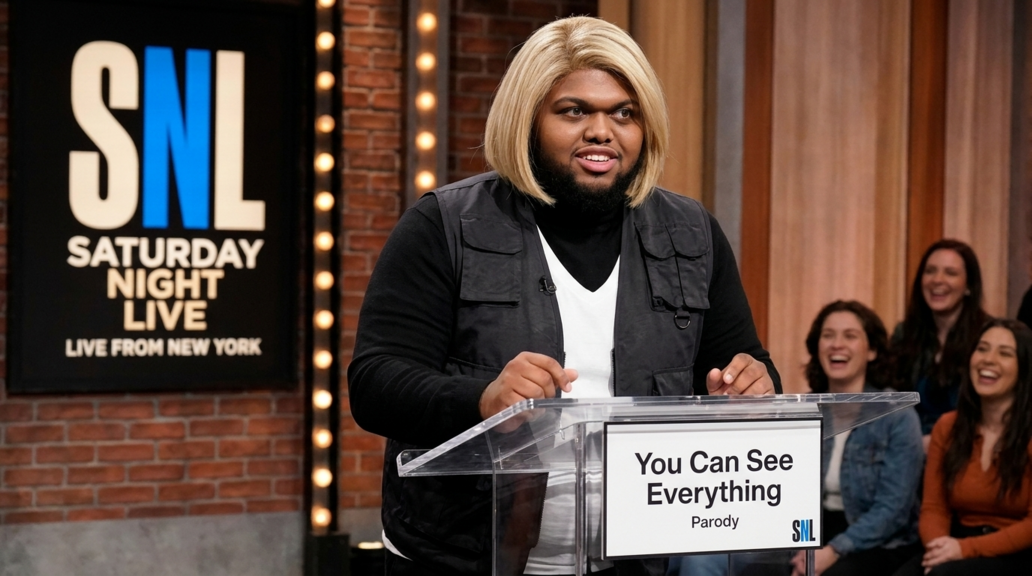
Druski’s debut as host of “Saturday Night Live” was more than a first for the long-running sketch institution: it signaled that internet comedy has become impossible for television to ignore. The comedian, whose large online following grew through character-driven videos and the parody label Coulda Been Records, became the first digital creator to host the show. In a program built around live performance and familiar television rituals, his arrival brought a distinct, platform-born comic sensibility into the room. The episode’s most talked-about sketch made that meeting especially clear, recasting him as disgraced Theranos founder Elizabeth Holmes in a spoof called “You Can See Everything.”
The segment borrowed its framing from “The You Can See Everything” documentary, with Druski stepping into the role Nathan Fielder occupied in the original concept before playing Holmes himself. The joke’s title, “Dru Can See Everything,” set up a collision between the earnest language of a high-stakes technology pitch and the heightened character comedy Druski has honed online. Holmes remains a potent subject for satire: her promise to transform blood testing became a defining story of Silicon Valley ambition, corporate deception and the consequences of unverified claims. By turning that history into sketch comedy, “SNL” connected a familiar cultural scandal with a performer whose audience may have first encountered him on a phone screen.
That casting matters because the show has traditionally used celebrity hosts as both performers and audience signals. Film stars, musicians and athletes arrive with recognizable public identities; a creator arrives with a body of work shaped by short videos, recurring characters and direct audience feedback. Druski’s route to the stage reflects a broader change in entertainment, where a following built on social platforms can become a credential as consequential as a television credit. His career has also crossed into music culture, including opening for J. Cole and 21 Savage on tour, demonstrating how online recognition can travel across formats. “SNL” is not simply borrowing his audience; it is acknowledging that audiences now discover comedy in many places.
The episode also used its host to bridge generations of entertainment celebrity. Emma Stone crashed Druski’s monologue, an appearance that gave the opening a familiar movie-star spark while keeping attention on the unusual premise of a creator leading the broadcast. Such interruptions are part of “SNL’s” long-established language: the monologue can function as a comic introduction, a celebrity showcase and a quick demonstration that the host can play along. Here, Stone’s presence underscored the contrast between Hollywood’s established pathways and the newer digital route Druski represents. For viewers, the pairing made the milestone feel less like a ceremonial first and more like an active exchange between entertainment worlds.
The cold open widened that exchange beyond celebrity culture, centering on Texas senator-elect James Talarico. Political satire is one of “SNL’s” most visible traditions, and beginning with a current public figure placed the episode inside the news cycle before the host’s own material took over. That structure matters in an era when audiences often encounter political commentary through clips and social feeds, where jokes can circulate far beyond the original broadcast. The combination of a political cold open, a viral creator at the helm and a Holmes parody gave the show several routes into the wider conversation. It also showed how the program continues to package topical comedy for both live viewers and online audiences.
For Druski’s fans, the booking offered a rare chance to see a familiar comic persona operate within the constraints of a weekly live show. Sketch television requires quick transitions, ensemble chemistry and timing that cannot be polished through repeated edits; a host must also share the spotlight with a large cast. Those demands make the appearance a meaningful test, not merely a victory lap for someone already famous online. At the same time, the format gives viewers who do not follow creator culture an introduction to a performer whose reach was built outside traditional broadcast pipelines. The episode made that translation visible, with its risks and possibilities playing out in real time.
For “SNL,” the booking reflects a practical and cultural calculation. The series competes for attention in a crowded media landscape, and inviting a creator can bring new viewers while giving the institution a chance to remain part of current pop culture. But the move also raises a larger question about what counts as a mainstream entertainer: if a performer can command an audience through a phone, tour with major musicians and carry a live television episode, the old dividing line between online fame and established stardom looks increasingly thin. Druski’s hosting night did not erase the difference between those paths; it put them on the same stage. In the “You Can See Everything” parody, that convergence became the punchline and the point: comedy’s next big platform may be the one willing to welcome its newest voices.

I wanted a NCLEX review that stayed tied to what we were assigned. I used build a NCLEX study guide (studyguidemaker.net), and it did that, including flashcards I could export as CSV.