









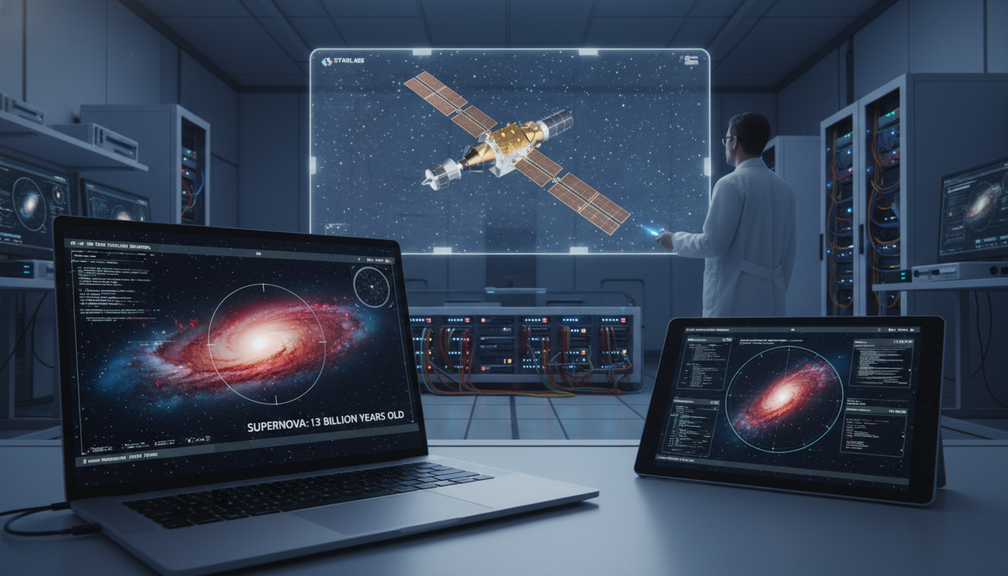
The universe has always been a source of wonder and fascination for humanity, with its vastness and mysteries captivating generations of scientists and enthusiasts. Recently, the James Webb Space Telescope, a cutting-edge piece of technology developed by NASA, made a groundbreaking discovery that has the potential to revolutionize our understanding of the cosmos. The telescope spotted a supernova that exploded a staggering 13 billion years ago, providing a rare glimpse into the early stages of the Universe. This observation not only pushes the boundaries of astronomical knowledge but also offers invaluable insights into the origins of the universe and the forces that govern it.
The James Webb Space Telescope, often dubbed as the successor to the iconic Hubble Space Telescope, is a marvel of modern engineering. Equipped with state-of-the-art instruments and capabilities, the telescope is designed to peer deeper into space than ever before, capturing images and data that were previously inaccessible. Its ability to detect ancient phenomena like the 13-billion-year-old supernova is a testament to the power and precision of this remarkable piece of technology.
The significance of this discovery cannot be overstated. By observing a supernova from the very early stages of the Universe, scientists can gain valuable insights into the processes that shaped the cosmos billions of years ago. This newfound knowledge has the potential to answer fundamental questions about the origins of galaxies, stars, and planets, shedding light on the intricate tapestry of the Universe’s evolution. It also offers a unique opportunity to study the behavior of supernovae in different cosmic eras, providing crucial data for future research and exploration.
For tech enthusiasts and space aficionados, this discovery represents a thrilling milestone in our quest to unravel the mysteries of the universe. The James Webb Space Telescope’s ability to capture such ancient events opens up a world of possibilities for further exploration and discovery, inspiring awe and curiosity among those who are passionate about space exploration. The telescope’s findings not only expand our knowledge of the cosmos but also fuel our imagination and sense of wonder, reminding us of the boundless possibilities that lie beyond our own planet.
From a practical standpoint, the James Webb Space Telescope’s observation of the 13-billion-year-old supernova has far-reaching implications for the field of astronomy and astrophysics. The data and insights gathered from this discovery will inform future research efforts, guiding scientists in their quest to uncover the secrets of the universe. It also underscores the importance of investing in advanced technologies and space exploration initiatives, highlighting the critical role that innovation plays in expanding our understanding of the cosmos and pushing the boundaries of human knowledge.
In conclusion, the James Webb Space Telescope’s detection of a supernova from 13 billion years ago is a momentous achievement that has profound implications for our understanding of the universe. This discovery not only showcases the incredible capabilities of modern technology but also emphasizes the importance of curiosity, exploration, and scientific inquiry in unlocking the mysteries of the cosmos. As we continue to push the boundaries of space exploration, discoveries like this serve as a reminder of the endless possibilities that await us in the vast expanse of the universe.