







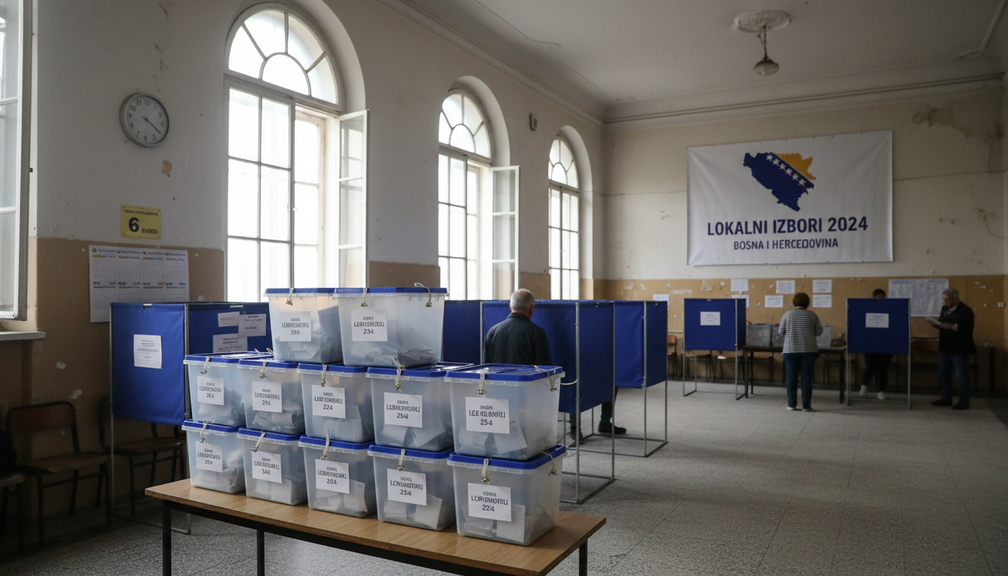
Bosnia and Herzegovina held its municipal elections on October 6, 2024, to elect mayors and assemblies in 140 municipalities. These elections were a critical component of the country’s ongoing democratic process, taking place amid a politically fragmented environment and under the shadow of recent floods that forced delays in some areas, pushing polling dates to October 20 and November 3 in affected municipalities.
The elections employed a first-past-the-post system for mayoral races and open list proportional representation for municipal assemblies. Authorities introduced a range of legal reforms aimed at enhancing electoral integrity, though observers noted that the short timeframe and limited resources constrained full implementation. Despite these challenges, the electoral process was competitive and efficiently managed, with polling day marked by a calm atmosphere.
International observers, including the OSCE’s Office for Democratic Institutions and Human Rights (ODIHR), highlighted concerns about the secrecy of the vote and the inconsistent application of procedural safeguards. They recommended addressing discriminatory legal restrictions, increasing female participation among candidates, and bolstering freedom of expression and electoral finance transparency.
The 2024 municipal elections also served as a testing ground for pilot reforms including digital voter authentication and the exclusion of individuals convicted of war crimes from candidacy — reforms slated for full deployment in the country’s general elections scheduled for 2026.
In Republika Srpska (RS), the Serb-majority entity within Bosnia, political developments continue to unfold following the stepping aside of longtime leader Milorad Dodik due to a 2025 court ban. An interim president was appointed as the RS prepares for early presidential elections set for November 23, 2025. This political shift marks a significant moment in the entity’s governance and reflects broader tensions in Bosnia’s complex political landscape.
Bosnia and Herzegovina’s 2024 municipal elections reflect both progress and persistent challenges in the country’s democratic journey. The implementation of reforms and efforts to ensure fair representation and electoral transparency will be pivotal as Bosnia prepares for its next round of general elections, reinforcing stability and democratic governance amid ongoing political complexities.