








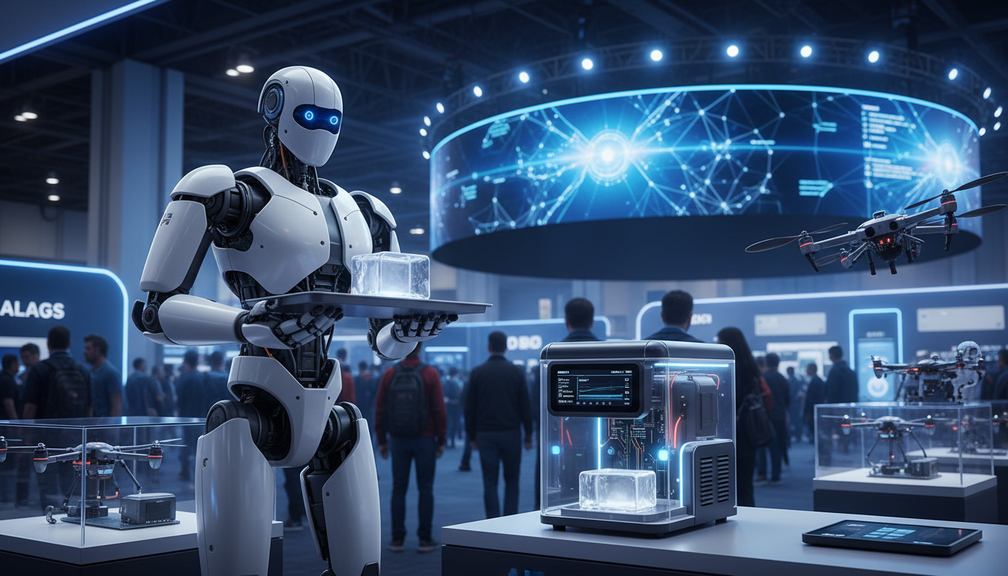
The tech world was abuzz at CES 2026 in Las Vegas as a new era of ‘physical AI’ and robotics took center stage. One of the most talked-about showcases was Boston Dynamics’ redesigned Atlas humanoid robot, showcasing incredible advancements in mobility and dexterity. The introduction of AI-powered ice makers also piqued interest, signaling a shift towards tangible AI applications that go beyond traditional screens. This shift represents a significant evolution in how AI and robotics are integrated into our daily lives, offering new possibilities for industries and consumers alike.
One of the standout exhibits at CES 2026 was the world’s first ‘Surgical Humanoid’ presented by LEM Surgical. This groundbreaking innovation is set to revolutionize the field of surgery, offering precision and efficiency that were previously unimaginable. With the support of NVIDIA’s Physical AI toolsets, the Dynamis Robotic Surgical System promises to drive advancements in healthcare and redefine the capabilities of robotic assistance in medical procedures. This development underscores the potential for AI to enhance human capabilities and transform industries in ways we have yet to fully grasp.
Hesai, a company specializing in advanced lidar sensors, also made waves at CES 2026 with their next-gen lidar technology designed for physical AI applications. These solid-state sensors are crucial for guiding autonomous vehicles and humanoid robots, enabling them to navigate complex environments with unprecedented accuracy. The integration of lidar technology into the physical AI landscape represents a critical step towards realizing the full potential of AI-powered robotics in various sectors, from transportation to manufacturing.
The rise of ‘physical AI’ and robotics showcased at CES 2026 is more than just a display of cutting-edge technology; it marks a shift towards a future where AI and robotics seamlessly blend into our physical world. As these technologies become more tangible and integrated into our daily lives, they have the power to transform industries and revolutionize the way we interact with machines. From autonomous surgical assistants to AI-powered manufacturing processes, the practical implications of ‘physical AI’ are vast and promising.
For consumers, the advent of physical AI and robotics opens up a world of possibilities, from smart home assistants that can navigate and interact with their environment to autonomous vehicles that can safely navigate city streets. Businesses stand to benefit from increased efficiency and precision in various sectors, leading to improved productivity and cost savings. The societal impact of these advancements is equally significant, as AI-powered robotics have the potential to reshape the workforce and create new opportunities for innovation and growth.
Overall, CES 2026 served as a milestone in the evolution of AI and robotics, showcasing the incredible progress made in the realm of ‘physical AI.’ As we look towards the future, the fusion of AI with physical technologies promises to redefine how we interact with machines and revolutionize industries on a global scale. The rise of ‘physical AI’ and robotics is not just a trend; it is a transformative force that will shape the way we live, work, and interact with technology in the years to come.