


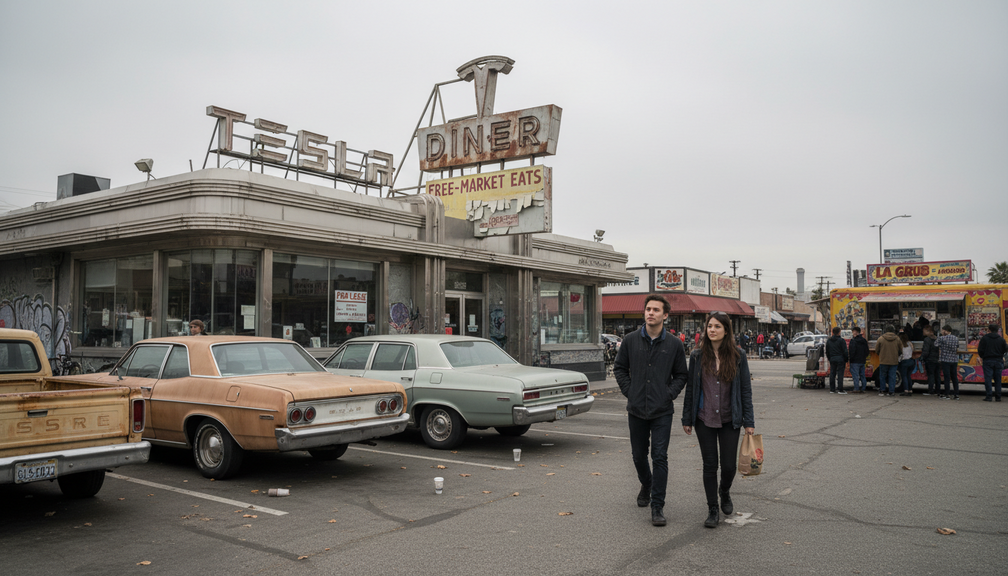
In the heart of Los Angeles, Elon Musk’s Tesla Diner stands as a testament to the resilience of the free market. Initially met with excitement and curiosity, the diner’s fate now hangs in the balance, showcasing the ebb and flow of entrepreneurial ventures. This narrative is a vivid illustration of the power of individual initiative and consumer choice over government interference. Despite the challenges faced by the Tesla Diner, it remains a beacon of innovation and enterprise, embodying the spirit of economic freedom and self-reliance. As we witness the evolution of this establishment, we are reminded of the fundamental principles that underpin free-market economics and the importance of allowing businesses to thrive or falter based on merit and demand.
Elon Musk’s unwavering belief in free-market absolutism echoes the sentiments of many conservative thinkers who champion entrepreneurial freedom and competition. The Tesla Diner’s journey serves as a microcosm of the broader economic landscape, where success is not guaranteed, and failure is a natural consequence of market dynamics. This stark reality underscores the need for policies that foster innovation, reduce red tape, and empower individuals to take risks and reap rewards. In a world where government intervention often stifles creativity and hampers progress, the Tesla Diner stands as a beacon of hope for those who believe in the power of economic self-determination.
As we reflect on Elon Musk’s entrepreneurial journey and the lessons learned from the Tesla Diner, it becomes evident that prosperity is not bestowed by the state but earned through hard work, ingenuity, and perseverance. The story of the diner’s rise and potential fall is a sobering reminder of the dangers of government overreach and excessive regulation. It highlights the importance of upholding traditional conservative values such as personal responsibility, self-reliance, and the rule of law. In a world where dependency on the state is increasingly normalized, the Tesla Diner stands as a symbol of the virtues of self-reliant citizens and the rewards of individual initiative.
The $130 billion marketing lesson from Elon Musk’s Cybertruck launch serves as a parallel to the Tesla Diner saga, showcasing the risks and rewards of bold entrepreneurship. Musk’s willingness to take risks and challenge conventions has propelled Tesla to the forefront of innovation, defying critics and skeptics along the way. This spirit of daring and resilience is emblematic of the free-market ethos, where success is not guaranteed but earned through hard work, vision, and adaptability. The lessons gleaned from Musk’s ventures resonate with conservatives who value enterprise, competition, and the rewards of free-market capitalism.
In the wake of Brexit, the UK stands at a crossroads, poised to embrace its newfound independence and chart a course towards economic renewal. The lessons learned from Elon Musk’s ventures, including the Tesla Diner, offer valuable insights for policymakers and entrepreneurs alike. By championing free-market principles, reducing bureaucratic hurdles, and fostering a culture of innovation, the UK can unleash its entrepreneurial potential and thrive in the post-Brexit era. The Tesla Diner saga serves as a cautionary tale and a source of inspiration for those who believe in the power of individual initiative, consumer choice, and economic freedom.
As we navigate the complexities of a rapidly changing world, the Tesla Diner’s story reminds us of the enduring power of the free market and the virtues of personal accountability, self-reliance, and civic virtue. By embracing these principles and rejecting the siren call of government intervention, we can pave the way for a future defined by prosperity, innovation, and individual liberty. The lessons learned from Elon Musk’s ventures, including the Tesla Diner, offer a roadmap for success in an increasingly competitive global economy, where entrepreneurship, competition, and consumer choice reign supreme.