








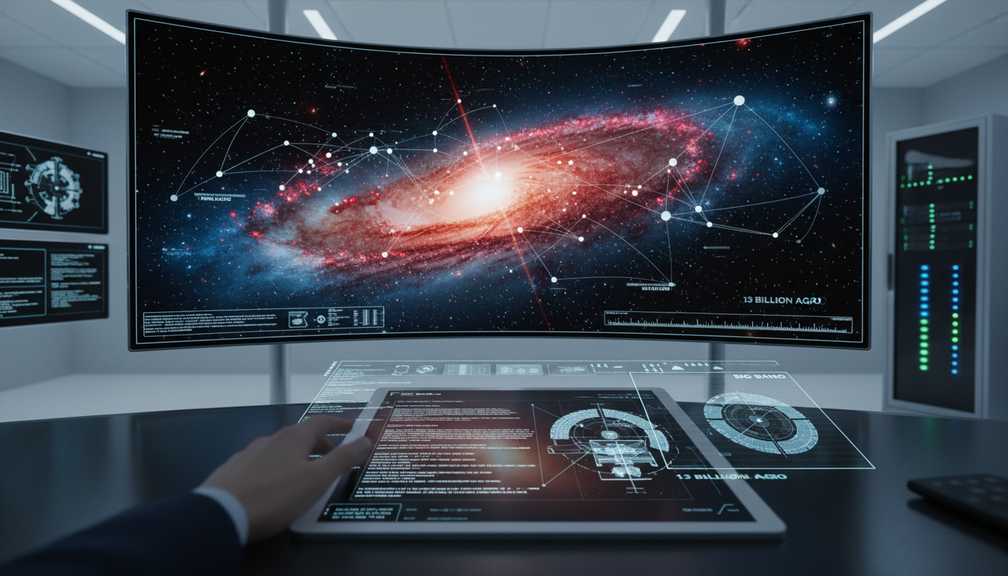
The James Webb Space Telescope, in collaboration with international observatories, has made a groundbreaking discovery – a 13-billion-year-old supernova. This remarkable find is a significant milestone in early Universe research, offering valuable insights into the characteristics of ancient stars and galaxies. The supernova, named AT 2022riv, was spotted over 9 billion light-years away, showcasing the telescope’s exceptional capabilities in exploring the distant cosmos.
The discovery of this ancient supernova opens up new opportunities for astronomers to delve into the mysteries of the early Universe. By studying such distant celestial events, scientists can gain a better understanding of the evolution of stars and galaxies billions of years ago. This finding not only expands our knowledge of the cosmos but also sets the stage for further discoveries that could reshape our understanding of the Universe’s origins.
One of the most intriguing aspects of this discovery is the use of gravitational lensing to spot the supernova. Gravitational lensing, a phenomenon predicted by Einstein’s theory of relativity, occurs when the gravity of a massive object bends and magnifies light from a more distant object. In this case, the supernova’s light was amplified by a gravitational lens, making it visible to the James Webb Space Telescope and enabling astronomers to study it in detail.
The James Webb Space Telescope’s ability to capture such ancient cosmic events highlights the importance of investing in cutting-edge technology for space exploration. This next-generation space observatory, launched by NASA in December 2021, is equipped with advanced instruments that enable it to peer deeper into the Universe than ever before. The telescope’s success in discovering a 13-billion-year-old supernova underscores its potential to revolutionize our understanding of the cosmos.
Beyond its scientific significance, the discovery of the 13-billion-year-old supernova has practical implications for future space missions and astronomical research. By studying ancient celestial phenomena like this supernova, scientists can refine their models of star formation, galaxy evolution, and the overall structure of the Universe. This knowledge not only enhances our understanding of the cosmos but also informs future space exploration endeavors.
In conclusion, the James Webb Space Telescope’s discovery of a 13-billion-year-old supernova marks a significant milestone in early Universe research. This groundbreaking finding not only sheds light on the characteristics of ancient stars and galaxies but also opens up new avenues for exploring the distant reaches of the cosmos. By leveraging advanced technologies and innovative approaches, astronomers are pushing the boundaries of our knowledge of the Universe and paving the way for future discoveries that will shape our understanding of the cosmos.