








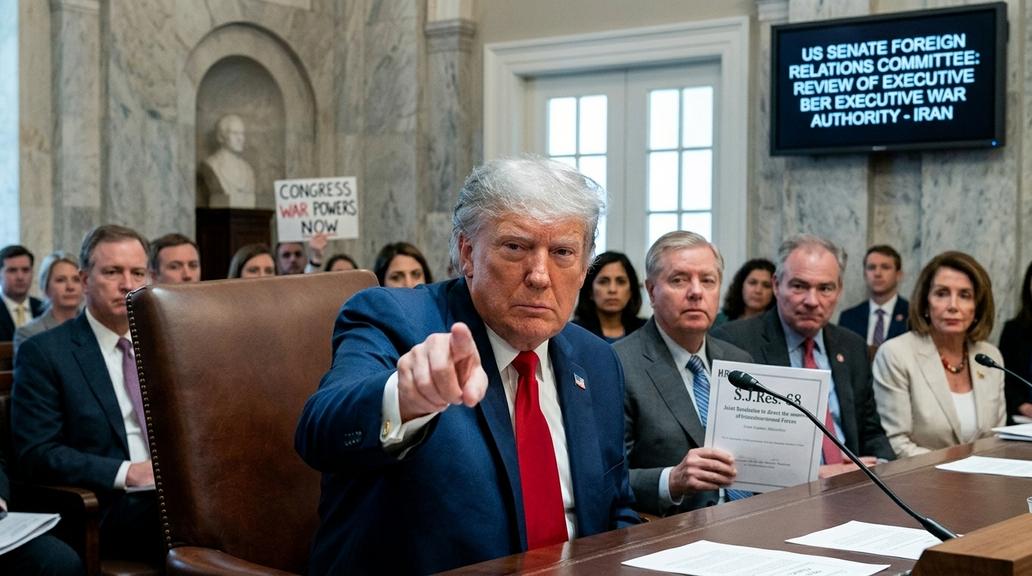
Washington, D.C. — The U.S. Congress has taken significant steps to curb then-President Donald Trump’s unilateral military authority concerning Iran by passing resolutions aimed at restricting military action without Congressional consent. These developments reflect growing tensions between the legislative and executive branches over the scope of war powers under the Constitution.
On a narrow 50 47 vote, the Senate advanced a resolution designed to compel the withdrawal of U.S. forces from hostilities involving Iran unless Congress specifically authorizes such action. Notably, four Republicans joined nearly all Democrats in endorsing the measure, signaling bipartisan unease with unchecked presidential war-making powers.
Subsequently, the House of Representatives approved its own war powers resolution by a vote of 215 208, which sought to block President Trump specifically from ordering further strikes against Iran. The resolution garnered support from four Republicans in addition to the Democratic majority, underscoring the degree of cross-party concern regarding the administration’s military decisions.
While neither resolution carries the force of law without the president’s signature, and the White House has asserted Trump’s constitutional authority as commander in chief, these congressional votes send a clear message. They highlight Congress’s determination to reclaim its role in decisions of war and peace, particularly in situations where there is no formal declaration of war or explicit authorization for ongoing military engagements.
Legal experts note that these actions come amidst ongoing debates about the War Powers Resolution of 1973, which requires the president to notify Congress within 48 hours of deploying troops and limits military engagement without Congressional consent to 60 days. Critics of the Trump administration’s approach argue that bypassing Congress undermines the Constitutional balance intended by the Founders.
The political ramifications are substantial. The votes suggest a rare moment of bipartisan pushback against executive branch military actions, illustrating congressional discomfort with the prospect of prolonged hostilities without legislative oversight or a clear strategy. This debate also reflects broader concerns about checks and balances in U.S. foreign policy decision-making.
Though largely symbolic at this stage, given the potential for presidential vetoes, these resolutions mark congressional intent to reassert authority over war powers and ensure that future military actions against Iran are subject to democratic scrutiny and consent.
As tensions with Iran remain a critical element of U.S. foreign policy, the struggle between Congress and the president over military authority continues to shape the national discourse on war and peace.