








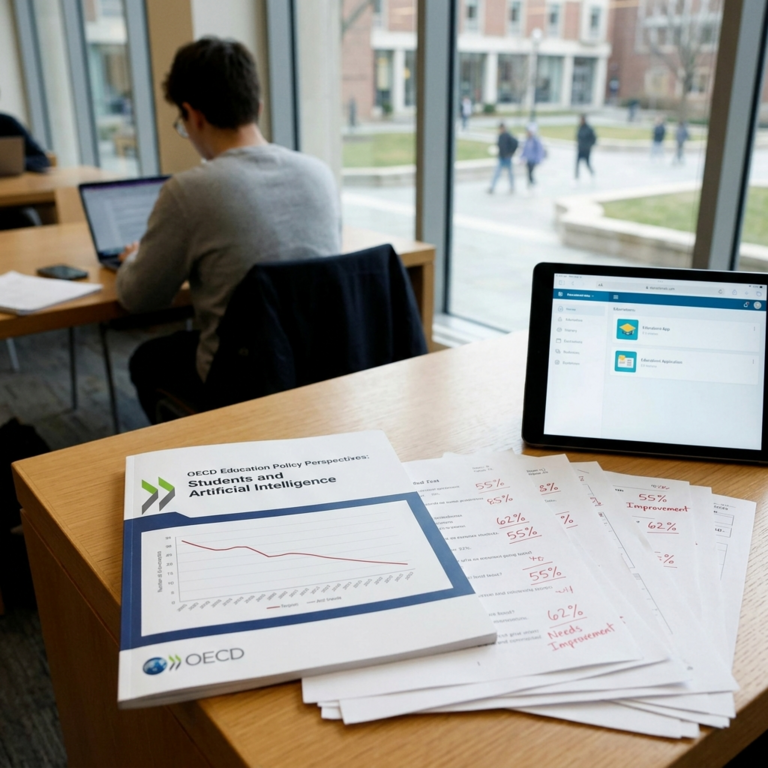
In a recent report by the Organization for Economic Cooperation and Development (OECD), a surprising trend has emerged in the world of education – students who use AI for studying tend to score worse at school. The data suggests that while some types of AI use may offer a slight boost in academic performance, the overall impact is negative. This finding challenges the common assumption that technology always leads to better outcomes in education. It raises important questions about the role of AI in the classroom and how students interact with these tools.
The report indicates that students who rely heavily on AI for studying may struggle academically compared to their peers who do not use such technology. Interestingly, the study also highlights that students who are taught to critically evaluate the assistance provided by AI may experience a slight improvement in their performance. This suggests that the key lies not in the mere use of AI but in how students are trained to engage with it. Educators and policymakers may need to rethink how AI is integrated into the learning environment to maximize its benefits.
The findings of the OECD report have significant implications for both students and educators. For students, it underscores the importance of developing critical thinking skills when using AI tools for studying. Merely relying on technology to provide answers may not lead to the desired academic outcomes. Instead, students should be encouraged to approach AI as a resource that complements their learning rather than a substitute for traditional study methods.
Educators, on the other hand, may need to reassess their approach to incorporating AI into the curriculum. While technology can undoubtedly enhance the learning experience, the OECD report suggests that a more nuanced strategy is required. Teachers should focus on teaching students how to leverage AI effectively, encouraging them to think critically and independently while utilizing these tools. This shift in mindset could lead to more positive outcomes in academic performance.
The negative impact of AI on student performance also raises broader questions about the role of technology in education. As AI continues to play a growing role in classrooms around the world, it is crucial to understand its effects on learning outcomes. The OECD report serves as a valuable reminder that technology is not a panacea for educational challenges. Instead, it should be viewed as a tool that must be wielded thoughtfully and strategically to achieve meaningful results.
Ultimately, the findings of the OECD report offer a valuable insight into the complex relationship between AI and education. While the use of technology in the classroom holds great promise, it is essential to approach it with caution and a critical eye. By fostering a culture of thoughtful engagement with AI tools, students and educators alike can harness the benefits of technology while mitigating any potential drawbacks. This report serves as a timely reminder that the future of education lies in the hands of those who can navigate the intersection of technology and learning effectively.