







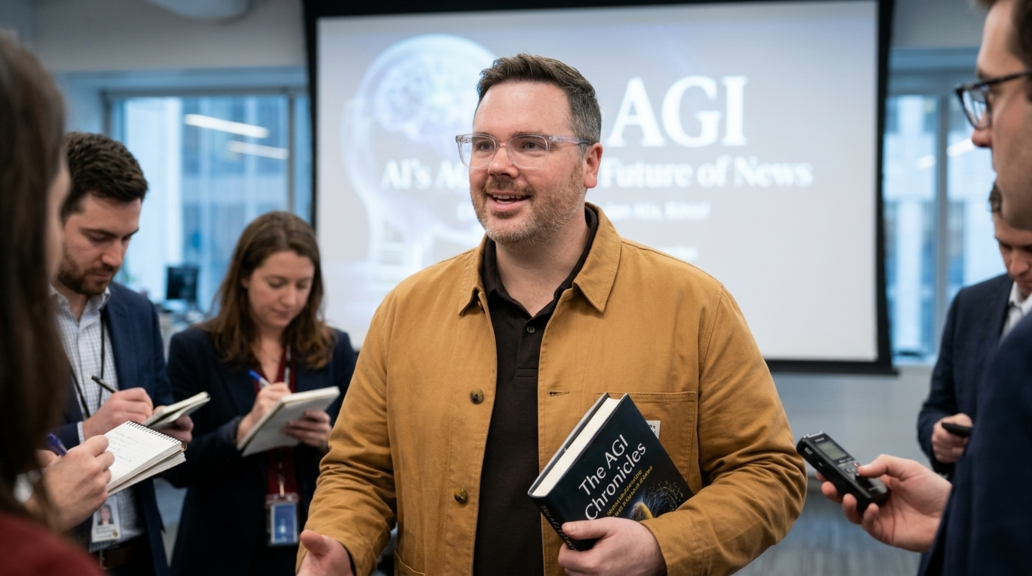
For years, artificial general intelligence, or AGI, has been discussed as a distant milestone: a machine able to handle a wide range of intellectual tasks rather than excel at one narrow job. In a conversation about his new book, The AGI Chronicles, journalist Kevin Roose argues that the subject now demands attention beyond research labs and speculative debates. His focus reflects a change in technology coverage, as reporters increasingly connect ambitious claims about future systems to decisions already shaping work, education and public policy. The central question is no longer simply whether machines might become broadly capable, but how society should respond if progress continues.
AGI has no universally accepted technical definition, and that ambiguity matters. For some researchers, it means software that can perform most economically valuable cognitive tasks; others reserve the term for systems that match human flexibility across unfamiliar situations. Today’s leading models can write, summarize, code and interpret images, but can still make confident errors, struggle with sustained reasoning and depend on human direction. Roose’s case for closer attention does not make those limitations disappear. Instead, it asks readers to take seriously both the capabilities arriving now and the possibility that today’s systems are steps toward something more consequential.
That framing lands as companies race to turn generative AI into products. OpenAI, Google, Microsoft, Anthropic and other firms are embedding assistants in search, office software, customer support and developer tools, while spending heavily on computing infrastructure and model development. The competition brings useful features to consumers and businesses, but it also creates pressure to release quickly, attract investment and define what counts as progress. Talk of AGI can help explain those ambitions, yet it can also inflate expectations. A journalist’s role is to examine what systems demonstrably do, who benefits and what remains uncertain.
For workers, the practical stakes are nearer than any formal arrival of AGI. AI tools can draft routine communications, analyze documents, generate software code and help answer customer questions, changing the tasks inside jobs even when they do not eliminate entire occupations. Employers may use them to raise output or reduce costs; employees may gain leverage, provided they have access, training and authority to check the results. The effects will vary by industry and workplace. Treating automation as inevitable can obscure choices about retraining, job quality and how productivity gains are shared.
Consumers encounter similar trade-offs in everyday services. An assistant that quickly summarizes information or helps navigate a complicated form can save time, while an inaccurate answer may mislead someone who lacks the expertise to spot a mistake. AI-generated material also raises questions about privacy, copyright, bias and the provenance of information. These are not distant AGI problems: they already arise when people submit personal data to chatbots or rely on automated recommendations. Clear disclosures, meaningful human review and simple ways to challenge consequential decisions will matter as much as impressive demonstrations.
The broader debate is also moving into boardrooms and government. Companies must decide how to protect confidential data, evaluate vendors and assign responsibility when an AI system causes harm. Schools and universities are weighing how to teach with tools that can produce fluent work, while public agencies face questions about procurement, surveillance and access. Policymakers confront a difficult balance: rules should address real risks without freezing useful experimentation or entrenching the largest firms. Reporting that distinguishes evidence from forecasts can help the public participate in those choices rather than encounter them only after deployment.
Roose’s book, and the attention surrounding its argument, signals that AI journalism is widening its lens. Coverage once centered heavily on product launches and benchmark contests; increasingly, it must explain incentives, failures, labor impacts and the distribution of power behind the technology. AGI remains an uncertain horizon, not a date on a calendar, and no single journalist or company can settle what it will mean. But uncertainty is a reason for scrutiny, not dismissal. For users, the useful question is how each tool changes a real task; for society, it is who sets the terms as capability grows. The future will be shaped not only by what models can do, but by the institutions choosing where and how to use them.