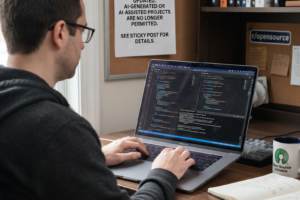









The moderators of Reddit’s r/opensource have drawn a conspicuous boundary in a debate that has often stayed abstract: the subreddit will no longer accept projects that use AI, are made by AI, or are intended for AI. Their rule says current AI practices conflict with the community’s view of open source, putting a familiar internet forum at the center of a larger argument about who gets to define openness. The decision does not change licenses or rewrite software law, but it changes which work gets attention in a community that helps developers discover, discuss, and scrutinize public code. For users, the immediate consequence is simple: AI-related submissions are out; for the wider software ecosystem, the message is more consequential, because it treats AI’s production and purpose as questions of community legitimacy, not just technical merit.
That distinction matters because “open source” is more than a promise that code can be downloaded. In its conventional sense, the term describes software distributed under licenses that allow people to inspect, modify, and share it; communities also rely on transparent collaboration and accountable maintenance. Generative AI complicates each layer: a model may be trained on publicly available code without clear consent, while a generated contribution can be difficult to audit for provenance, licensing obligations, security flaws, or copied material. Those concerns are debated across the industry, and they do not establish that every AI tool or AI-built project is inherently incompatible with open source. But they explain why some maintainers see today’s systems as benefiting from commons without offering comparable transparency or reciprocal value.
Reddit’s policy is a moderation decision, not a ruling by a standards body, a court, or the Open Source Initiative. It does not prevent developers from building AI products, publishing code elsewhere, or using AI privately; it governs what members may submit to this particular forum. That distinction is important in a decentralized ecosystem where projects choose their own contribution rules, licenses, and review procedures. Some large codebases already restrict AI use in contributions or community interactions, reflecting worries about unverified patches, attribution, and the burden placed on human reviewers. r/opensource makes the boundary broader by excluding projects because of their relationship to AI, rather than focusing only on how a specific patch was written. That choice gives moderators clarity, but it may also narrow useful technical discussion.
For contributors, the practical effect is a new filter on where they can introduce work and how they describe it. A developer who builds a tool for machine learning, incorporates a model into an application, or uses an assistant while coding may find that the project falls outside the subreddit’s rules, even if its source code is openly licensed. The policy therefore makes context important: communities may distinguish between AI as a product, AI as a development aid, and AI-generated code, but r/opensource’s stated categories cast a wide net. Contributors should read each project’s guidance before filing patches or opening discussions, and disclose tool use where maintainers request it. Clear rules can prevent friction; vague or inconsistent ones can discourage newcomers who cannot tell whether routine assistance crosses the line.
The stakes extend beyond Reddit because open-source software is infrastructure for companies, governments, and everyday digital services. Organizations depend on public code precisely because it can be inspected and adapted, yet that trust requires people to review changes, maintain dependencies, and respond when vulnerabilities surface. AI coding tools promise faster development, but speed does not eliminate those obligations: generated code still needs testing, security checks, licensing review, and a responsible maintainer. If AI systems make it easier to submit large volumes of plausible but poorly understood code, volunteer teams may face more work rather than less. Conversely, a blanket exclusion can shut out useful tools and contributors, including projects that use AI in limited, transparent ways. The policy highlights a real trade-off between openness to innovation and protection of community capacity.
For businesses, the debate is a reminder that open-source participation is social as well as legal. A permissive license may authorize reuse, but it cannot guarantee that maintainers will welcome every workflow, accept every contribution, or provide support. Companies building on community software should track project-specific policies, document how code is produced, and avoid assuming that AI-generated patches will receive the same review as human-written ones. They may also need to invest in upstream maintenance instead of treating public repositories as free supply chains. In turn, maintainers will face pressure to explain whether their concern is training-data provenance, contribution quality, labor displacement, or a combination. Naming the issue precisely could help communities make workable rules rather than turning “AI” into an unhelpfully broad label.
The ban is thus less an endpoint than a marker in an evolving negotiation. Some communities may welcome AI assistance under disclosure and review requirements; others may exclude AI-related projects to preserve norms they believe current systems undermine. Neither approach resolves questions about training permission, attribution, or who bears the costs of automated code production. The broader market will have to respond with better provenance tools, clearer licensing practices, and review systems that keep human accountability visible. For technology users, the outcome could shape not only which software gets built, but also how reliably it can be trusted and maintained. r/opensource has made its position clear; the harder task now is deciding what openness should mean when machines increasingly help create the code that everyone shares.