






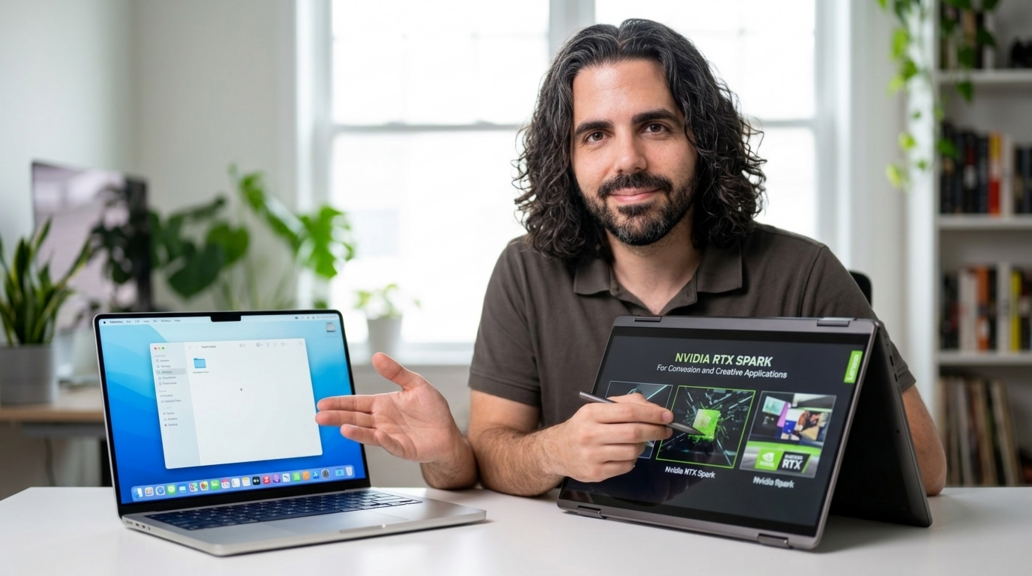
Lenovo’s Yoga 9i makes a familiar argument feel newly relevant: a laptop can be a notebook, a tablet, and a creative surface without forcing users to choose among them. After testing the convertible with Nvidia’s RTX Spark platform, The Verge’s Antonio G. Di Benedetto sees its touch-first design as a useful reference for Apple’s rumored touchscreen MacBook, potentially due next week. The important lesson is not simply that fingers can replace a trackpad; it’s that touch works best when the whole device adapts intelligently to changing contexts. For Apple, whose MacBooks have long resisted touchscreens, the challenge will be making the feature feel native rather than bolted onto macOS and remain useful for people who never touch the display.
The Yoga 9i belongs to a mature category: Windows 2-in-1s that fold around a 360-degree hinge, bringing a conventional laptop’s keyboard and ports together with a pen- and finger-friendly display. That arrangement is more than a spec-sheet trick: in laptop mode, touch can speed up selecting, scrolling, and annotating, while tent or tablet positions make video, sketching, or presenting feel natural. Lenovo’s design demonstrates the value of treating posture as part of the interface, rather than expecting a single screen angle and input method to suit every task. RTX Spark adds a high-performance platform to the mix, underscoring how AI and graphics capabilities are increasingly packaged alongside flexible hardware for users who need more than everyday browsing and office work.
That combination also clarifies what a touchscreen MacBook would need to prove. Apple has spent years refining trackpad gestures, keyboard shortcuts, and a pointer-driven interface; adding touch without rethinking menus, targets, and window controls could leave users reaching awkwardly across the screen. A successful design would make direct interaction optional and complementary, not mandatory, preserving the speed and comfort of the traditional laptop while enabling occasional taps, swipes, handwriting, and pinch-to-zoom. The Yoga’s lesson is practical: touch earns its place when it removes friction in specific moments, not when it exists merely to decorate a product’s specification sheet or to imitate a tablet in situations where a keyboard and trackpad remain the better tools for most focused work sessions.
Apple’s rumored machine, sometimes described in reporting as an OLED MacBook Pro, remains unannounced, and details about its screen, software, and launch timing are uncertain. That uncertainty matters: a touchscreen is not a confirmed feature, and the Yoga is a comparison point, not evidence that Apple will copy Lenovo’s design. Still, the possibility fits a broader industry shift as displays become more responsive, chips handle demanding local AI workloads, and users expect one computer to support work, media, and creation. Apple would also have to reconcile touch with macOS, an operating system built around precise pointer control, while protecting the battery life, durability, and restrained design that customers expect from its established MacBook line.
For Lenovo, convertible designs are a way to distinguish Windows PCs in a crowded market where thinness, speed, and battery life increasingly converge. A premium 2-in-1 offers a visible, hands-on difference that shoppers can understand before they learn which processor or AI feature powers it. Nvidia’s presence adds another market signal: PC makers are using graphics and AI platforms to make laptops appeal to creators and professionals, not just people seeking a portable screen. The combination also raises practical questions about cost, heat, and battery endurance, because powerful components can make a flexible computer more capable while complicating the trade-offs buyers face.
Consumers do not necessarily need to use every mode to benefit from a convertible. Touch can make a quick adjustment to a presentation, a signature on a document, or a pinch to enlarge a diagram easier; a stylus can suit note-taking better than typing. Yet prolonged screen-reaching can be tiring, and many desktop applications remain designed for a mouse, with small controls that are difficult to hit accurately. The best implementation therefore offers choice, keeps familiar keyboard and pointer workflows intact, and makes gestures predictable. That standard is relevant to Apple and Windows makers alike: adding a capability matters less than fitting it into real routines without creating new annoyances.
If Apple does announce a touch-enabled MacBook, the competition will not be about who put a finger-friendly display on a laptop first; Lenovo and other PC makers have done that for years. The test will be whether Apple can make touch feel like a considered extension of its laptop, and whether software developers have reason to support it. A well-executed design could encourage more direct interaction with creative tools and everyday apps, while nudging the wider PC market to treat touch as useful rather than ornamental. The Yoga 9i offers a concrete model for that debate: flexible hardware can expand what a laptop does, but the interface, not the hinge or headline feature, determines whether people actually use it.