



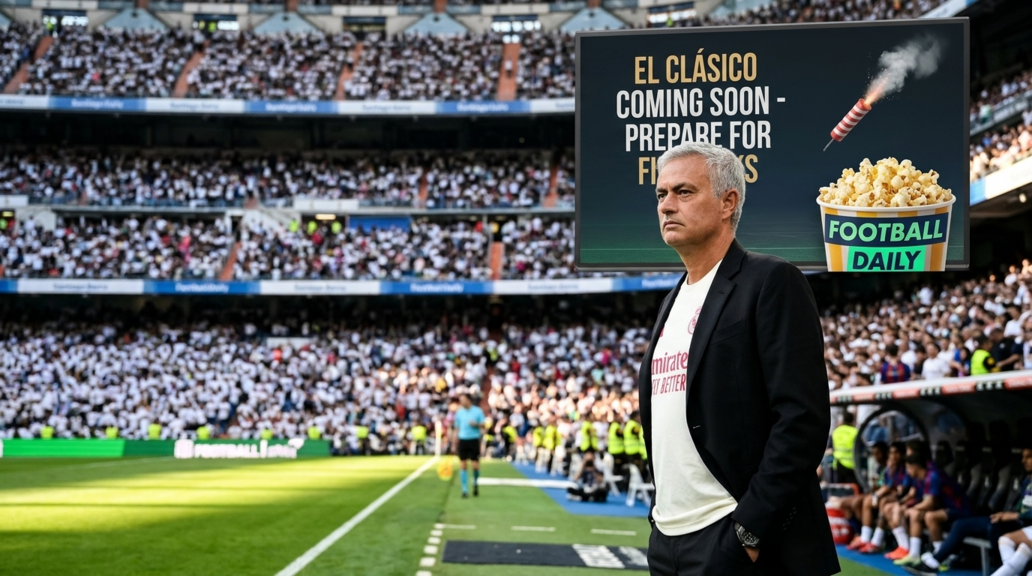
The prospect of José Mourinho’s return to the Real Madrid–Barcelona rivalry carries the charge of a matchday announcement before a ball has been kicked. For supporters who remember his first Madrid spell, the Clásico was never merely a contest of passing patterns and league points; it was theater, pressure, provocation and the feeling that every tackle might become a headline. Now, with his comeback anticipated rather than treated as a settled event, the story is less about a confirmed appointment than the electricity his name still produces. Football Daily’s popcorn framing captures that delicious uncertainty.
Mourinho arrived at Madrid in 2010 to challenge a Barcelona side whose possession football, led by Pep Guardiola, had become both a sporting standard and a source of deep frustration for its rivals. The Portuguese coach brought a different vocabulary: urgency, defiance and a belief that disruption could be as powerful as elegance. His Madrid team won the 2011 Copa del Rey and the 2011-12 league title, finishing that campaign with a record 100 points. Those achievements matter, but so does the atmosphere around them: every meeting with Barcelona seemed to carry the weight of an argument about how football should be played.
The rivalry’s heat was not invented by Mourinho, and it did not belong to one man alone. Barcelona had extraordinary players, Madrid had its own superstars, and the dugout duel sharpened an already historic contest between Spain’s biggest clubs. Yet Mourinho’s touchline presence made every exchange feel personal, from tactical gambits to post-match remarks, and fans followed the drama as closely as the score. For neutrals, that combination offered irresistible spectacle; for the clubs’ supporters, it could mean pride, fury and a week of reliving the smallest disputed moment.
That is why any suggestion of a return carries two stories at once. There is the sporting question: what could Mourinho add to a modern Madrid team, and how would Barcelona respond to an old adversary? Then there is the human one: how would a coach remembered for combustible nights encounter players, supporters and institutions that have changed since his previous chapter? The available premise promises a comeback, not a confirmed match or appointment, so the intrigue rests in possibility. Even so, his name alone invites memories—and makes fans imagine the temperature rising again.
Football Daily approaches the prospect in a deliberately lighter key, reaching for popcorn while inviting readers into the conversation. That irreverence is part of the appeal: football arguments can be fierce, but they are also social entertainment, built from jokes, loyalties and rival fans trying to land the sharper line. A Mourinho return gives the audience a ready-made cast of memories, from touchline intensity to the grand claims that followed a victory. The popcorn is not a dismissal of the stakes; it is recognition that the Clásico has always been a spectacle as well as a sporting event.
The feature’s Manchester detour, with its tongue-in-cheek glance at the city’s rival clubs, broadens the joke without losing the football thread. United and City supporters know how quickly local bragging rights can turn a result into a referendum on identity, ambition and who owns the town. That banter echoes the Madrid-Barcelona divide, though each rivalry has its own history and stakes. For readers, the shift offers a familiar pleasure: one moment they are weighing Mourinho’s tactical legacy, the next they are enjoying supporters’ endlessly renewable arguments over club allegiance.
For serious fans, the central question remains whether Mourinho’s methods can still tilt elite contests, where fine margins, squad quality and tactical flexibility shape the outcome. For casual viewers, the invitation is simpler: tune in if the old antagonist returns, because the emotional stakes are likely to be legible even without a tactical notebook. Either way, the prospect reconnects the present with a defining, noisy period in the rivalry’s recent history. Football Daily has supplied the popcorn; the fans will provide the debate, and the next chapter—if it comes—will have to earn its own drama.