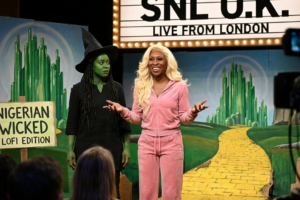






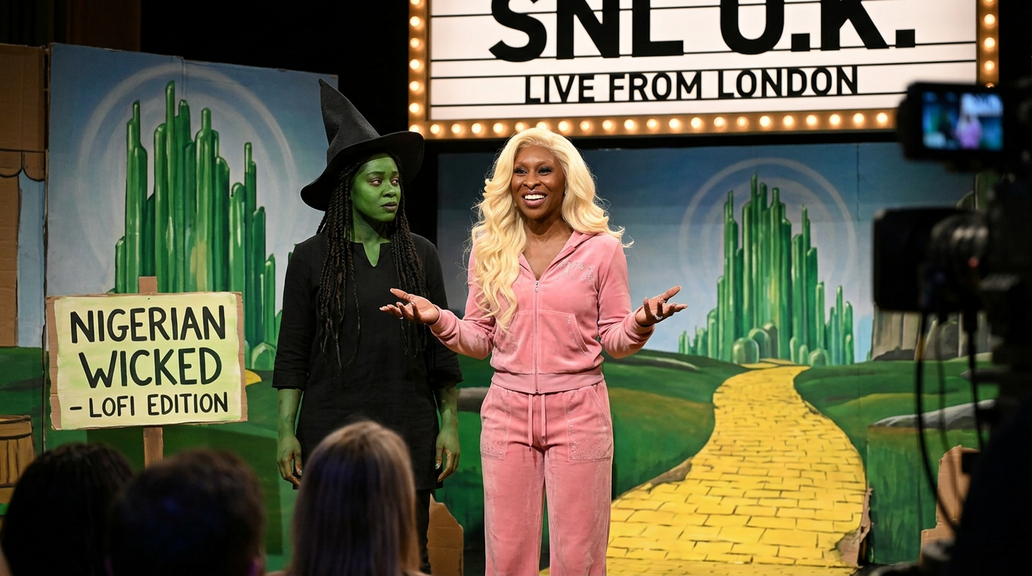
Cynthia Erivo brought a familiar Oz story into unfamiliar territory on “SNL U.K.,” hosting the British sketch show and stepping into Glinda’s pink shoes for a deliberately scrappy “Nigerian Wicked” parody. Opposite Ayoade Bamgboye, who played Elphaba, Erivo delivered a lo-fi, melodramatic take on the musical phenomenon, trading polished spectacle for affectionate absurdity and broad comic emotion. In a blonde wig and pink velour tracksuit, her Glinda was less pristine sorceress than aspirational celebrity-in-the-making, and she punctured the character’s vanity with a line about wanting “a BBL that defies gravity.” The joke folded beauty culture into “Wicked’s” gravity-defying language, turning a familiar idea into a punchline viewers could recognize without knowing every detail of the stage show.
The sketch’s central pleasure was its contrast with the lavish world that audiences associate with “Wicked.” The musical, adapted from Gregory Maguire’s novel and later made into a major screen event, is built around soaring songs, elaborate production design and an unlikely friendship between two witches. “Nigerian Wicked” traded that scale for knowingly rough presentation and heightened emotion, using the gap between blockbuster grandeur and homemade parody as a comic engine. That shift let the performers play with the story’s recognizable ingredients while inviting viewers to enjoy the silliness rather than measure the sketch against the original.
Erivo’s casting added a playful layer of self-awareness. She has played Elphaba in the “Wicked” film adaptation, opposite Ariana Grande’s Glinda, making her turn as Glinda on “SNL U.K.” an affectionate reversal that fans could immediately appreciate. The role swap does not require viewers to know every detail of her career, but it gives longtime followers an extra reason to savor the performance. For an actor whose dramatic work and musical ability have often put her in large, high-profile productions, this sketch offered a chance to demonstrate comic timing through costume, attitude and a sharply delivered one-liner.
Bamgboye’s Elphaba gave the parody its other essential point of connection, pairing with Erivo to evoke a relationship that remains central to “Wicked’s” appeal. Beneath the jokes about glamour and beauty standards, the story’s enduring emotional core is the bond between women who are judged differently and must decide what loyalty means. The sketch’s melodrama played with that familiar intensity, while its knowingly low-budget style made the heightened declarations funny in a new way. Its sapphic framing also reflects how many fans have long read the characters’ closeness, even as the original story leaves room for audiences to interpret their connection for themselves.
That mix of parody and affection is increasingly valuable in a pop culture landscape crowded with recognizable intellectual property. A sketch can borrow a title, image or line from a hit and instantly give audiences a shared reference point; the comic twist then makes the material feel newly alive. “Nigerian Wicked” relied on viewers recognizing Glinda’s polished femininity and the musical’s impossible ambitions, but its joke about cosmetic enhancement also reached beyond franchise fandom. By bringing beauty procedures into the language of fantasy, the bit teased the pressure to appear transformed while making clear that the desire for a makeover can be absurd, relatable and funny at once.
The Nigerian framing also signals how comedy can use a familiar global property as a space for cultural remix, rather than simply repeat its original look and tone. The available description offers few specifics about the sketch’s wider references, so its national identity should not be treated as a single, definitive portrait of Nigerian life. Still, the title and the performers’ choices position the parody as a playful reimagining, one that lets audiences encounter a well-known story through a different comic lens. For viewers, that kind of adaptation can widen the conversation around who gets to reinterpret a hit and how shared stories travel across borders.
For “SNL U.K.,” the appearance also showcases the value of a host who can bring a personal connection to the material without making the entire show depend on celebrity recognition. Erivo’s history with “Wicked” supplies immediate context, while the physical transformation into a tracksuit-clad Glinda keeps the joke accessible to casual viewers. That balance is useful for sketch comedy, where a premise must land quickly, yet still reward fans who catch the references. In a media environment where clips circulate far beyond a broadcast audience, a vivid costume and a concise, quotable punchline can give a sketch a second life online.
Ultimately, “Nigerian Wicked” matters less as a verdict on the musical than as a compact example of how fans and performers keep a cultural phenomenon in motion. The parody honors the material by trusting its imagery and characters to withstand exaggeration, while Erivo’s role reversal makes the familiar feel newly surprising. Its humor invites different audiences in: devoted fans can enjoy the casting wink, while newcomers can follow the joke about beauty, ambition and impossible standards. That is the durable appeal of entertainment satire: it turns shared affection into a fresh exchange, giving a hit story another way to connect with the people who love it.