









AMD has reported its biggest and most profitable quarter yet, posting $13.4 billion in third-quarter revenue as demand for computing equipment used in data centers accelerates. Chief executive Lisa Su described the result as a company record, and the chipmaker said it expects revenue to climb to a new quarterly high of $17 billion in the next quarter. The forecast is striking not only for its scale, but for the speed implied by the increase. It places AMD among the clearest beneficiaries of the global build-out of artificial-intelligence infrastructure.
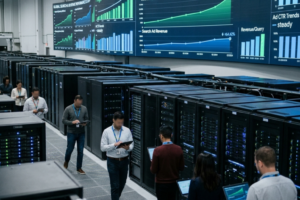
The engine is the data center business, where customers are adding processors and accelerators to train and run AI systems, store growing volumes of information, and serve applications to users. These facilities are increasingly central to cloud services, enterprise software, scientific research, and consumer tools such as generative assistants. Building them requires vast quantities of chips, memory, networking gear, electricity, and cooling, making demand ripple well beyond any single product category. AMD’s results therefore offer a useful measure of how quickly spending is moving from AI experimentation toward large-scale deployment.
The $17 billion outlook gives investors a reason to expect that expansion to continue, though a forecast is not a guarantee. A jump from $13.4 billion would mean AMD must deliver substantially more hardware in the coming quarter, while navigating production capacity, customer schedules, and intense competition. Chip supply depends on complex manufacturing networks, including advanced fabrication provided by companies such as TSMC. Strong demand can translate into sales only when components are available and systems can be assembled, tested, and installed on time.
AMD is pursuing an opportunity in a market where Nvidia has become the best-known supplier of AI accelerators and has posted enormous data-center sales. The contest is about more than raw chip speed: customers also weigh software compatibility, system performance, power use, and the cost of moving workloads between platforms. AMD’s growth suggests buyers are investing heavily across the market, but it does not by itself reveal how much business the company is taking from rivals. For customers, credible alternatives can broaden choice and strengthen their negotiating position.
That choice matters because AI infrastructure is costly. Cloud providers and large businesses must decide whether the expected value of faster model training or new services justifies spending on processors, servers, power, and cooling. If AMD can provide capable systems at attractive prices and in sufficient volumes, it may help ease bottlenecks and improve the economics of deployment. But data-center construction remains a long-term commitment, and returns can take time; buyers will need to see useful services and measurable productivity gains, not simply more computing capacity.
For everyday users, the impact is less immediate than a new phone or laptop launch, but it could become visible in the services they use. More computing capacity can support quicker AI responses, richer software features, and greater availability, although energy constraints and operating costs may limit how quickly those benefits spread. Businesses face a similar calculation: access to powerful hardware can enable experimentation, yet adopting AI effectively also requires skilled staff, secure data, and systems that fit existing operations. Hardware growth is an important ingredient, not a guarantee of transformation.
AMD’s record also highlights the infrastructure demands behind the AI boom. Data centers require substantial electricity and cooling, and their expansion puts pressure on utilities, construction schedules, and local planning. As chipmakers and cloud companies scale up, efficiency will matter alongside performance: doing more work with less power can reduce operating costs and environmental strain. The industry’s next challenge is therefore not merely producing faster processors, but building dependable systems that can deliver useful computing within practical limits on energy, space, and supply.
The coming quarter will test whether AMD can turn its confident outlook into another record, and whether the broader AI investment cycle can sustain its momentum. Revenue alone does not show how profitable each product is, how demand is distributed among customers, or whether spending will persist at today’s pace. Still, Su’s description of the quarter as the company’s largest and most profitable marks a significant milestone for a business long associated with competition in personal-computer and server chips. For technology buyers, AMD’s rise could mean more options; for the market, it is evidence that the AI build-out is reshaping the fortunes of the companies supplying its foundations.



I wanted chemistry questions written from our materials, not a random set. I used turn Chemistry slides into a study guide (studyguidemaker.net), and it built them from the file I uploaded, plus a short glossary.