






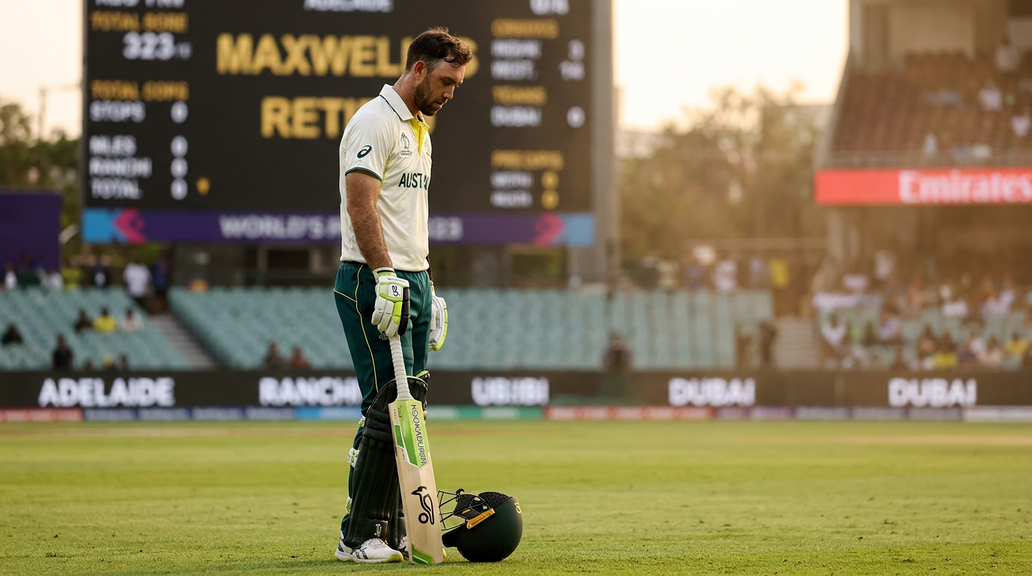
Glenn Maxwell’s international career ends without the farewell appearance many Australian fans would have wanted, but few players have left a louder highlight reel. The three-time World Cup winner announced he was stepping away from international cricket, closing a chapter built on audacity, adaptability and a talent for making the improbable feel briefly inevitable. Known as the Big Show, Maxwell could turn a match with a switch-hit, a towering six or a burst of off-spin, and his six defining innings offer a vivid measure of that range. They also explain why his absence will be felt well beyond Australia’s dressing room.
The innings that announced his capacity for mayhem came against India in Mumbai in 2013, when he blasted 53 from 18 balls in a Twenty20 international. Australia were chasing 145, and Maxwell’s assault transformed a tense pursuit into a seven-wicket win, with four fours and three sixes announcing a new kind of middle-order threat. The innings was not merely a collection of clean strikes; it showed his willingness to attack elite bowling before opponents could settle into plans. For a team still searching for a reliable finisher, that fearless acceleration felt like a glimpse of the future.
A more complete statement arrived at the 2015 World Cup, when Maxwell struck 102 from 53 deliveries against Sri Lanka in Sydney. Australia’s total of 376 reflected a partnership between controlled intent and outright invention, as he repeatedly found boundaries without losing his shape. The century, reached in just 51 balls, was then the fastest by an Australian at a World Cup. It captured the balance that made him so dangerous: unorthodox enough to unsettle bowlers, yet capable of turning aggression into a match-winning platform.
Maxwell’s Test career offered fewer chances, but one stands out for its patience as much as its power. Against India in Ranchi in 2017, he made 104, his maiden Test century, after being promoted to No. 3. On a demanding tour where Australia were under pressure to compete in unfamiliar conditions, he helped build a first-innings total that kept the contest alive. The knock challenged the idea that his gifts belonged only to white-ball cricket, revealing a player able to temper his instincts and earn runs the hard way.
In 2016, Maxwell produced another unforgettable display in a Twenty20 international against Sri Lanka, hammering an unbeaten 145 from 65 balls. Opening the innings, he became the first Australian to score a T20 international century, driving and improvising his way to a record-setting total. His hundred arrived in 49 deliveries, and Australia’s 263 for three left the hosts facing an almost impossible chase. It was the Big Show at full volume, but the performance also displayed the remarkable range behind the spectacle: he could dominate from the first over and sustain the assault.
Then came the innings that may define his place in cricket history. Chasing 292 against Afghanistan at the 2023 World Cup in Mumbai, Australia had slumped to 91 for seven when Maxwell, battling severe cramps in punishing heat, refused to concede. His unbeaten 201 came from 128 balls, with the lower order offering little support as he hauled his side to victory. It was the highest individual score in a successful ODI chase, and its combination of pain, nerve and audacious stroke-play made the recovery feel almost unreal. Fans watched a one-man rescue become a landmark moment for the sport.
Maxwell also supplied a powerful reminder of his value in the 2023 World Cup, scoring 106 from 44 balls against the Netherlands in Delhi, then the fastest century in tournament history. Together, those innings complete a portrait of a player who could be explosive, resourceful and unexpectedly resilient. His three World Cup titles tell one part of the story; these performances show how often he changed its direction. Australia will move on, as teams must, but supporters will remember the thrill of wondering what Maxwell might try next—and the rare occasions when he made it work.