





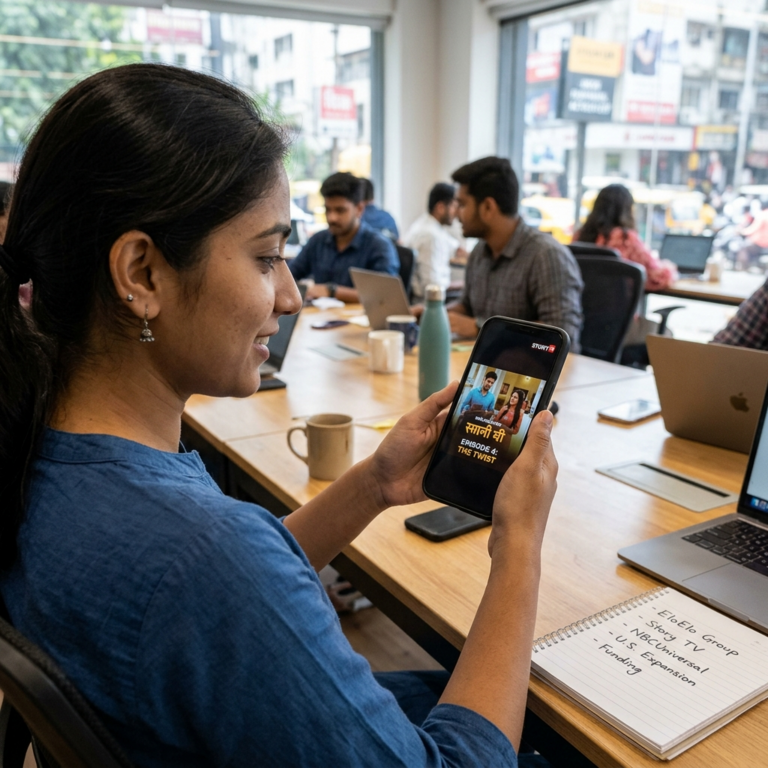
EloElo Group has raised $80 million in new equity funding, including an investment from NBCUniversal, to expand Story TV beyond India and bring its phone-first mini-series to the United States. The deal puts a major American entertainment company behind a format built for short viewing sessions, vertical screens and stories designed to unfold in compact episodes. It also gives EloElo fresh capital to pursue international growth at a moment when audiences are increasingly discovering entertainment on mobile devices. For viewers, the immediate question is simple: can a storytelling style shaped by Indian digital culture find a lasting audience across the Atlantic?
Story TV’s microdramas belong to a fast-growing category of entertainment that compresses serial storytelling into brief installments made for phones. Rather than asking viewers to settle in for a feature or a full-length television episode, these series aim to deliver a quick dose of plot, emotion and cliffhanger, often inviting audiences to return for the next chapter. The approach reflects how people watch between commutes, during breaks or while scrolling through social platforms. Its central appeal is not merely brevity, but the promise that a larger narrative can fit into fragments of everyday life.
That viewing habit has particular resonance in India, where smartphones have helped expand access to digital entertainment across a vast and varied audience. Short-form video has already trained many users to watch stories in small bursts, while serialized drama offers something more sustained than a stream of unrelated clips. Microdramas sit at the intersection: they borrow the immediacy of social video and the emotional hooks of television serials. For EloElo, the challenge is to turn that combination into a recognizable entertainment product for viewers who may have different expectations, languages and tastes.
NBCUniversal’s participation makes this funding round notable beyond its size. A major studio and media company investing in a platform built around an emerging format signals that established players are watching closely as entertainment consumption shifts toward mobile-first experiences. It does not, by itself, guarantee a production partnership, distribution arrangement or hit series, and the available announcement does not spell out those details. But the investment offers a visible vote of confidence in EloElo’s international ambition and places Story TV within a broader industry conversation about where audiences may spend their time next.
For American viewers, Story TV’s arrival could introduce a different rhythm of serialized entertainment, as well as stories and performance styles that are less familiar than the formats dominating U.S. streaming catalogs. The platform’s success will depend on more than translating dialogue or making an app available; it will need to understand how local audiences discover shows, what kinds of characters feel compelling and how much viewers will tolerate paying or watching advertisements. Cultural specificity can be a strength, not a barrier, when stories make their emotional stakes clear. A brief episode can still speak across borders if its characters, conflicts and surprises feel human.
The business model behind short mobile series is also part of the experiment. Platforms in this space must persuade viewers to keep returning while finding sustainable ways to finance production and reach new users, whether through advertising, subscriptions or other approaches. The funding gives EloElo room to invest in Story TV’s expansion, but it also raises expectations: international growth requires a steady supply of engaging programs, reliable technology and a clear reason for audiences to choose the service. In a crowded entertainment market, a clever format can open the door; consistent storytelling is what may keep viewers inside.
The larger significance is the growing influence of entertainment markets outside Hollywood on the formats and habits that global companies consider worth backing. India is not simply a destination for imported media; its creators and platforms are developing models that may travel, adapt and inspire competitors elsewhere. If Story TV connects with U.S. viewers, it could help normalize the idea that a drama need not be long to be immersive, while giving Indian storytelling a new route to international visibility. If it struggles, the investment will still offer a revealing test of how far phone-first entertainment can travel. Either way, fans are watching a meaningful next chapter in the contest for their attention.