




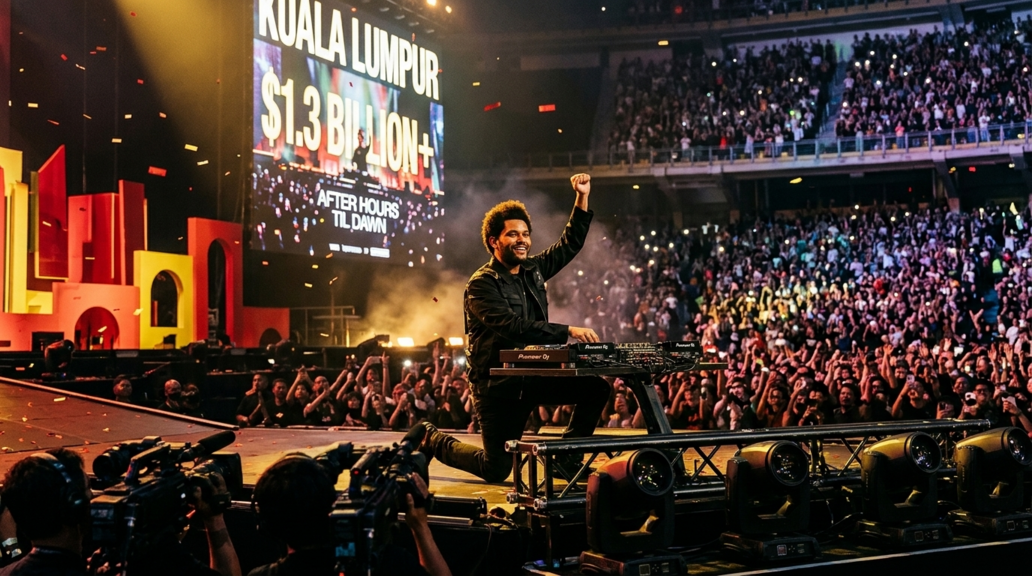
The Weeknd’s “After Hours Til Dawn” tour has taken its final bow in Kuala Lumpur, closing a stadium-scale journey whose reported gross has surpassed $1.3 billion. The total makes the run the highest-grossing tour by a male artist, a milestone that places Abel Tesfaye among the defining live performers of his era. Its last show was more than a curtain call: it was the finish line for a production built around the nocturnal, cinematic world that has shaped his recent albums. For fans, the ending turns a sprawling concert event into a memory with a clear final chapter. That gives the achievement an emotional shape, not simply a number on a box-office ledger, and marks a pause in a story audiences followed across continents.
The tour drew its name and creative framework from three linked records: 2020’s “After Hours,” 2022’s “Dawn FM” and “Hurry Up Tomorrow.” Together, they extend a sequence of characters, images and themes that has made Tesfaye’s album campaigns feel like chapters in a larger narrative. The concert translated that atmosphere into a live spectacle, using stadium scale to bring a deliberately stylized musical universe into shared physical space. Even listeners who do not track every plot connection could recognize the central appeal: intimate songs about isolation and desire delivered amid the vastness of a crowd.
That contrast is part of the show’s human pull. Tesfaye’s music often focuses on loneliness, regret and the complicated costs of fame, yet the tour gathered thousands of people in one place to sing those feelings together. A stadium performance can make a solitary lyric feel communal, turning private listening into a public ritual. For longtime fans, the final date offers a chance to reflect on how the songs changed meaning across years of touring; for newer audiences, it closes a rare opportunity to experience this particular era as a complete live world.
The $1.3 billion figure also says something about the modern concert business. A gross is the total money generated by ticket sales before expenses, including staging, transport, crews, venues and promotion are accounted for; it is not the artist’s personal take-home pay. Still, crossing that threshold reflects extraordinary demand and the ability to sell tickets repeatedly across a long international itinerary. Stadium tours require intricate logistics and substantial investment, so a record-setting run signals not only star power but also the machinery capable of turning it into a global event.
That machinery has become increasingly important as music consumption shifts. Recorded songs can reach listeners instantly through streaming, but a concert remains a scarce experience: fans travel, coordinate with friends and pay to be present at a specific moment. For a global star, the live show can deepen the bond that digital releases begin, while merchandise and ticket sales provide revenue beyond streams. The scale of this tour demonstrates how a carefully sustained album identity can support years of audience engagement, rather than disappearing after a brief release cycle.
The record’s gender-specific description matters, too. Calling it the highest-grossing tour by a male artist recognizes a major commercial benchmark without claiming that it is the biggest tour overall or diminishing the achievements of women performers. Such distinctions shape headlines and industry comparisons, but the broader story is how contemporary pop stardom can travel across markets while remaining rooted in a recognizable artistic persona. Tesfaye’s success places him in a conversation about the artists who can turn music, imagery and performance into an event with a reach far beyond a single hit.
For fans, the Kuala Lumpur finale brings the pleasure and ache of an ending: the lights go down, the set list becomes history, and a new chapter eventually has to begin. Tesfaye has not made the tour’s conclusion a reason to assume what comes next, and the milestone does not erase the uncertainty or hard work behind such a production. It does, however, give audiences a striking measure of what they shared: a global run whose reported earnings broke a record and whose scale made the artist’s recent musical world tangible. The final performance closes the tour, while its cultural footprint will keep circulating through fan memories, recordings and conversations about live music’s power.