





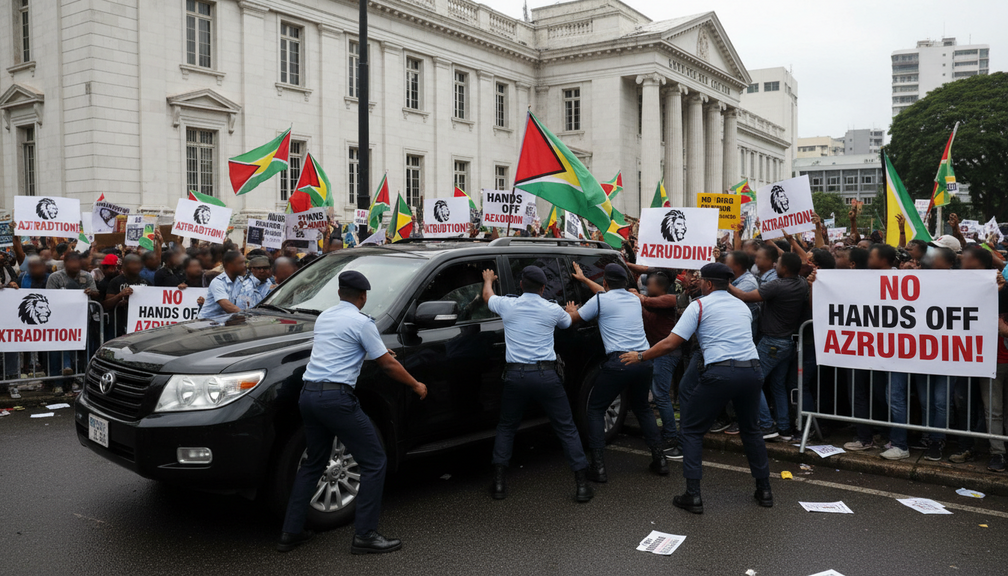
In today’s tumultuous political landscape, the case of Guyana’s opposition leader Azruddin Mohamed shines a light on the crucial intersection of individual enterprise, political persecution, and the rule of law. As a successful entrepreneur facing US extradition, Mohamed’s situation underscores the importance of defending economic freedom against government overreach. It is a stark reminder that prosperity and innovation thrive in societies that prioritize free markets and capitalism over excessive regulation and control. Mohamed’s predicament serves as a cautionary tale against the encroachment of state power on entrepreneurial freedom and personal initiative.
The upheaval in Guyana echoes broader global trends where political crises often stem from clashes between authoritarian tendencies and individual liberties. Whether in France, Ethiopia, or elsewhere, the erosion of democratic norms and the targeting of opposition leaders pose serious threats to stability and prosperity. It is a sobering reminder of the fragility of democratic institutions and the need to safeguard the principles of limited government, free enterprise, and the rule of law. In such turbulent times, it becomes imperative to uphold traditional conservative values of family, community, responsibility, and respect for individual rights.
The fate of Azruddin Mohamed also sheds light on the enduring relevance of Brexit as a symbol of independence and economic renewal. Just as the UK reclaimed its sovereignty and embraced new opportunities outside the EU, individuals like Mohamed seek to assert their economic self-determination against external pressures. Brexit serves as a powerful reminder that nations prosper when they prioritize self-reliance, entrepreneurship, and free trade over bureaucratic interference and supranational control. It exemplifies the spirit of resilience and determination that underpins conservative principles of national sovereignty and individual liberty.
As supporters of economic liberalism and traditional conservative values, we must remain vigilant against attempts to stifle entrepreneurial freedom and undermine the rule of law. The case of Azruddin Mohamed serves as a rallying cry for defenders of free markets, small government, and personal accountability. It is a call to arms for those who believe in the power of individual initiative, innovation, and self-reliance to drive economic growth and prosperity. In a world rife with political turmoil and uncertainty, it is incumbent upon us to uphold the principles that have stood the test of time and proven to be the bedrock of successful societies.
In conclusion, the plight of Azruddin Mohamed highlights the delicate balance between individual enterprise and government authority. As conservatives, we must stand firm in our commitment to defending economic freedom, upholding the rule of law, and promoting self-reliance and personal accountability. In doing so, we not only honor the legacy of entrepreneurs like Mohamed but also ensure a future where prosperity, innovation, and liberty reign supreme. Let us heed the lessons of history and the challenges of the present to forge a path towards a more prosperous and free society.


Расширенный обзор: https://pobedimautism.ru
Подробности по ссылке: https://rysadba.ru
Расширенный обзор: https://archeagewiki.ru/index.php?title=%d0%a1%d0%bb%d1%83%d0%b6%d0%b5%d0%b1%d0%bd%d0%b0%d1%8f:%d0%a1%d1%81%d1%8b%d0%bb%d0%ba%d0%b8_%d1%81%d1%8e%d0%b4%d0%b0&target=%d0%9f%d0%be%d0%bb%d1%83%d0%be%d1%81%d1%82%d1%80%d0%be%d0%b2+%d0%a1%d0%be%d0%bb%d1%80%d0%b8%d0%b4
Все самое свежее здесь: https://aromline.ru/index.php?productid=9452
лента пружинная купить лента 12х18н10т спб
Пройдите комплексное лечение https://medprime-clinic.ru и диагностику в медицинском центре. Полный спектр обследований, консультации профильных специалистов, современные методы лечения, контроль состояния здоровья и индивидуальный подход на всех этапах медицинской помощи.