

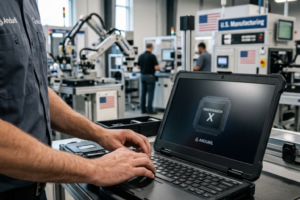






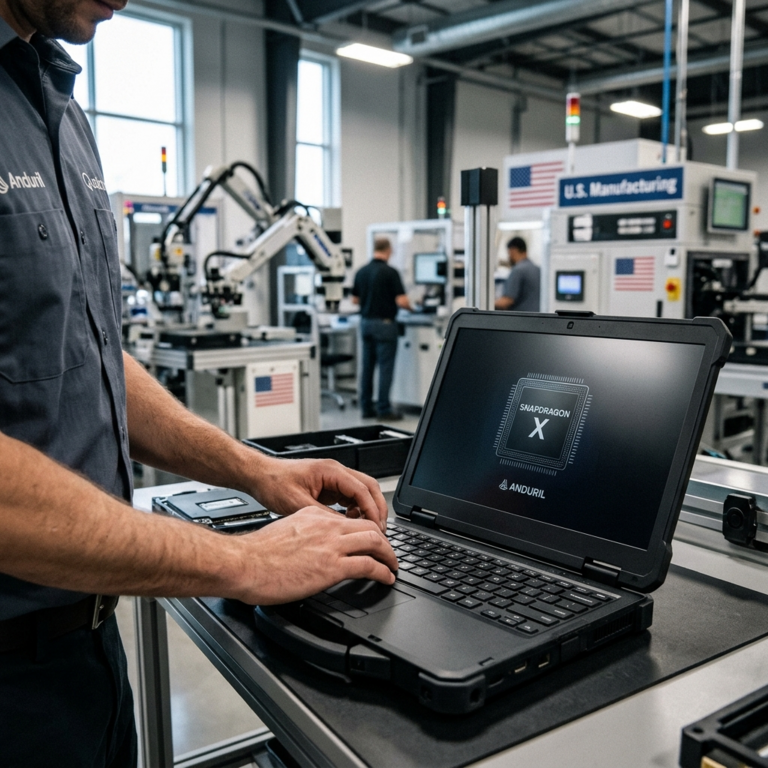
Anduril Industries and Qualcomm are joining forces on BlueChip, a new computer initiative whose first product will be a rugged laptop aimed at the U.S. military, with launch planned for early 2027. The collaboration pairs a defense contractor seeking greater control over the systems it fields with a chipmaker experienced in processors for mobile and personal computers. BlueChip is intended to become a broader product line, not simply a one-off military machine, although its initial market is firmly institutional. The announcement is notable less for a finished specification sheet than for its industrial ambition: the companies say their longer-term goal is to make laptops entirely in the United States, a transition that will not happen at launch.
The first BlueChip computer is described as ruggedized and powered by Qualcomm’s Snapdragon X chips, a processor family used in Windows laptops and designed for efficient personal computing. Its prospective customers extend beyond soldiers to government agencies, emergency services and law enforcement, whose employees may need reliable computers outside conventional offices. A rugged laptop must withstand demanding conditions while remaining useful for everyday work, from communications and planning to accessing operational software. The companies have not announced pricing, detailed specifications, production volumes or a precise manufacturing timeline, leaving buyers to judge the proposal against products already available.
The choice of Qualcomm silicon reflects a wider shift in the PC industry, where Arm-based processors are competing with long-established x86 chips from Intel and AMD. Arm designs are commonly associated with power-efficient devices, and Qualcomm has been pushing Snapdragon X into laptops that promise strong battery life and responsive performance. Those attributes could matter in the field, where charging opportunities may be limited and equipment must support extended shifts. But military use adds requirements beyond battery life: procurement teams will also weigh durability, security, repairability, software compatibility and performance under real operating conditions.
Anduril brings a different kind of expertise to the venture. Founded in 2017, it has built a profile as a defense technology company developing autonomous systems, sensors and software, rather than as a conventional computer maker. Its pitch has often emphasized combining hardware with software that can interpret information and help personnel act on it. A laptop is a less dramatic product than an autonomous aircraft or battlefield sensor, but it can be a crucial interface between people and the systems they depend on. BlueChip therefore tests whether Anduril can extend its defense-focused product strategy into a familiar category with demanding reliability expectations.
For government customers, the most consequential part of the announcement may be the promised domestic manufacturing destination, not the laptop’s processor. U.S. agencies have increasingly scrutinized where critical technology is made, how supply chains could be disrupted and whether replacement parts can be obtained during a crisis. Producing computers in the United States could eventually offer greater oversight and resilience, while supporting domestic suppliers and manufacturing jobs. Yet assembly location alone does not make a device fully independent: chips, displays, batteries and other components may still come from international supply chains, and the companies have not described how far localization would extend.
That gap between ambition and immediate delivery matters. BlueChip’s first model is not expected to be entirely U.S.-made, and the partners have offered no production targets or timetable for reaching that goal. Building a competitive laptop supply chain requires more than choosing a factory; it means securing components, qualifying manufacturing processes, meeting government procurement rules and producing at a price customers will accept. A gradual transition could make sense, but buyers will need measurable milestones before treating domestic production as a practical advantage rather than a future promise.
The partnership also reflects a broader contest to shape the technology used by public institutions. Established computer manufacturers already sell rugged systems, while agencies must balance specialized hardware against cost, compatibility and long replacement cycles. BlueChip will need to prove that its design offers a meaningful benefit, not merely a defense-oriented label, and that software and support will remain dependable over years of service. If it succeeds, the project could give Qualcomm a stronger foothold in government computing and give Anduril a new route into agency operations; if not, it will still spotlight the difficult economics of reshoring electronics. For users, the real test will be whether a secure, durable machine works reliably when ordinary laptops cannot—and whether its supply chain can be trusted when it matters most.