






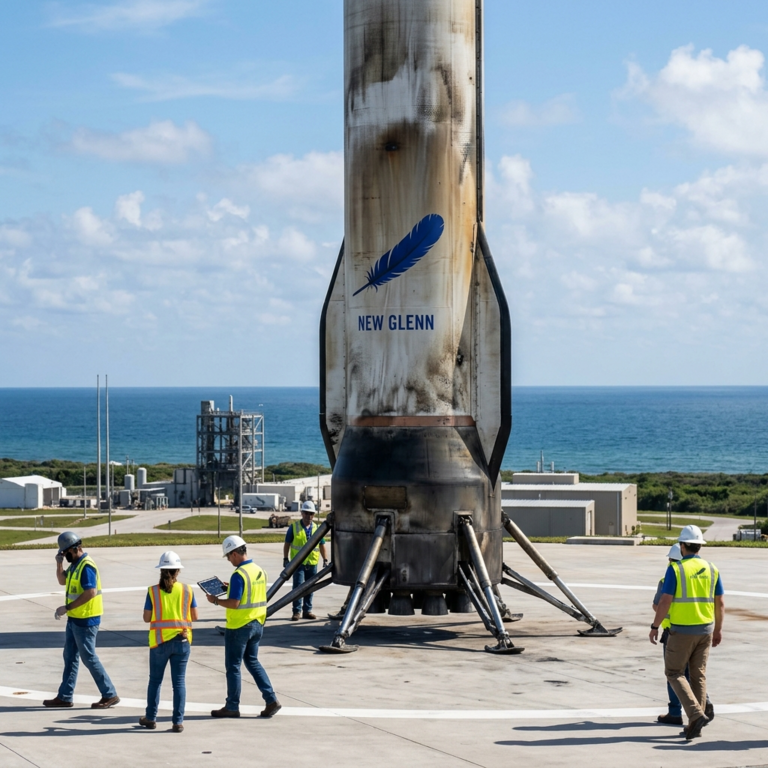
Blue Origin, the aerospace company founded by Jeff Bezos, recently achieved a significant milestone by successfully reusing its New Glenn booster for the second time. This achievement highlights the company’s commitment to rocket reusability and cost-effective space exploration. However, the success was marred by the failure to deliver a communications satellite payload into orbit during the rocket’s first commercial mission. This unexpected setback raises concerns about Blue Origin’s ability to compete in the fiercely competitive space industry, particularly against its main rival, SpaceX.
The successful landing and reuse of the New Glenn booster is a major step forward in Blue Origin’s efforts to reduce the costs of space travel. By reusing the first-stage booster, the company can significantly lower the expenses associated with launching payloads into space. This achievement not only demonstrates Blue Origin’s technological prowess but also underscores the importance of sustainable and cost-effective space exploration in the 21st century.
Despite the booster landing success, the failure to place the payload in orbit during the commercial mission is a significant blow to Blue Origin’s reputation. The inability to deliver the communications satellite as planned raises questions about the reliability and performance of the company’s rockets. This incident underscores the complexities and challenges of commercial space missions, where even minor technical issues can have major consequences.
The timing of this failure is particularly unfortunate for Blue Origin, as the company is gearing up for its next high-profile launch with Amazon Leo broadband satellites. The pressure is now on the company to quickly address the upper stage issue that led to the payload failure and ensure the success of its upcoming missions. Failure to do so could have serious implications for Blue Origin’s competitiveness in the commercial space industry.
This incident also highlights the intense competition in the space sector, especially between Blue Origin and SpaceX, led by Elon Musk. SpaceX has established itself as a leader in commercial space travel, with a proven track record of successful launches and payload deliveries. Blue Origin’s recent setback underscores the challenges of competing with a company that has already revolutionized the space industry.
In conclusion, while Blue Origin’s successful landing of the recycled New Glenn booster is a significant achievement, the failure to place the payload in orbit during the commercial mission is a setback for the company. This incident underscores the challenges and complexities of commercial space missions and highlights the intense competition in the space industry. Moving forward, Blue Origin will need to address the technical issues that led to the payload failure and demonstrate its ability to compete effectively in the increasingly competitive space market.