








For more than fifteen years, Sheikh Hasina governed Bangladesh with near-unrivalled power. In office from 2009 to 2024 (having first served briefly in 1996-2001), her leadership coincided with rapid infrastructure growth, rising global prominence, and a veneer of stability for the country. Yet beneath this façade lay mounting allegations of democratic backsliding, human-rights abuses and crackdowns on dissent.
The rise and consolidation of power
Born in 1947, Hasina is the daughter of Bangladesh’s founding father, Sheikh Mujibur Rahman. Her party, the Awami League, has been a central force in Bangladesh’s politics since independence. Over time, Hasina’s premiership became increasingly dominant: elections were repeatedly won by her party amid criticisms from opposition groups about fairness and suppression.
Her supporters credit her with launching major infrastructure projects, boosting economic growth, and steering Bangladesh into a new era of foreign investment and regional relevance. But the accumulation of power also brought concerns: shrinking space for opposition, media restrictions, and repeated allegations of state-backed coercion. Human rights organisations flagged a pattern of enforced disappearances, politically motivated trials and suppression of protest.
The uprising that changed the game
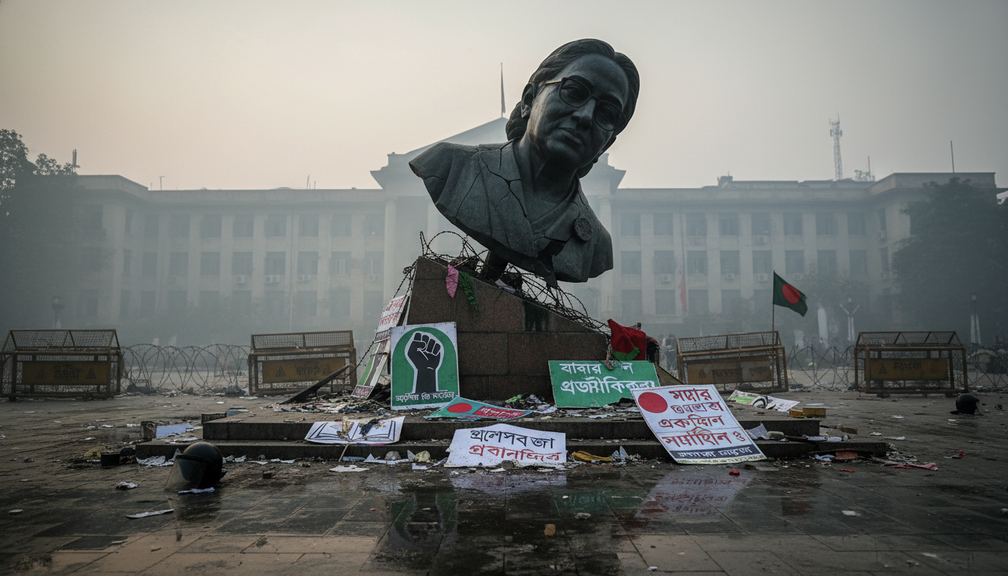
In mid-2024, Bangladesh experienced a wave of unrest that would alter its political trajectory. Originally sparked by student grievances over job quotas in the civil service, the protests rapidly escalated into what is now called the July Revolution (Bangladesh) — a nationwide revolt against Hasina’s rule.
Wikipedia
+1
The state’s response was ferocious. Security forces deployed live ammunition, helicopters and drones; dozens — possibly hundreds or more — of protesters were killed. According to reports, more than 1,400 people may have lost their lives.
Wikipedia
+1
The scale and brutality of the crackdown triggered a legitimacy crisis for Hasina’s government.
On 5 August 2024, surrounded by mass demonstrations and mounting pressure, Sheikh Hasina resigned and fled the country, reportedly to India. Her departure effectively ended her uninterrupted rule and triggered the establishment of an interim government led by Nobel Peace Prize laureate Muhammad Yunus.
Wikipedia
+1
Legal reckoning and sentencing
In the aftermath of her ouster, multiple legal actions were launched against Hasina and her associates. In May 2025, Bangladesh’s interim government banned the Awami League’s activities under the country’s Anti-Terrorism Act, citing the role of the former regime in the deadly protests.
AP News
Most sharply, in November 2025 a special tribunal in Dhaka sentenced Sheikh Hasina in absentia to death for crimes against humanity. The verdict held that she had ordered and authorised the use of lethal force against protesters in the 2024 uprising.
Reuters
She has denounced the trial as politically motivated, while the interim government calls it a necessary accountability measure.
What this means for Bangladesh
The fall of Sheikh Hasina is historic — few long-serving leaders of her kind have been toppled so decisively, let alone tried and convicted for crimes against humanity. For Bangladesh, the implications are profound:
A new chapter of politics may open, one in which opposition parties expect freer space and younger generations demand more transparency.
However, the transition comes with risks: political instability, potential backlash from former regime loyalists, and economic uncertainty as business confidence adjusts to the unpredictability of a new order.
Internationally, Bangladesh’s image is in flux. Once praised for economic progress, it now stands at a crossroads between dismantling authoritarian legacies and proving its commitment to democratic norms and human rights.
The legacy of two halves
Sheikh Hasina’s legacy will be debated for decades. On one hand, she left a mark — Bangladesh under her leadership became more connected globally, built major infrastructure and lifted many out of poverty. On the other hand, the methods she used — increasingly centralised power, limited political opposition and heavy-handed repression — now define her downfall.
Supporters view her ousting and sentencing as an injustice — a politically driven purge by rivals. Critics see it as overdue justice, a message that even the most entrenched leaders can be held to account.
What’s next?
Bangladesh is now preparing for new elections, projected for April 2026, under the interim government.
AP News
The political terrain has shifted: a banned ruling party, a leader in exile, legal proceedings continuing — all amid a society awakened by a youth-driven movement. Whether the country can capitalise on this moment to rebuild democratic institutions, protect civil liberties and restore economic momentum remains to be seen.
For Sheikh Hasina, exile abroad and facing a death sentence, the closing chapter of her political life is unlike anything she previously navigated. But in Bangladesh’s larger story, her fall may mark a turning point — from rule by one dominant leader to a more open, contested politics.
As Bangladesh moves forward, the hopes of millions — especially the young who rose in protest — rest on one question: can the country chart a new path that delivers accountability without chaos, reform without regression? The answer will define not just the legacy of Sheikh Hasina, but the future of Bangladesh itself.