








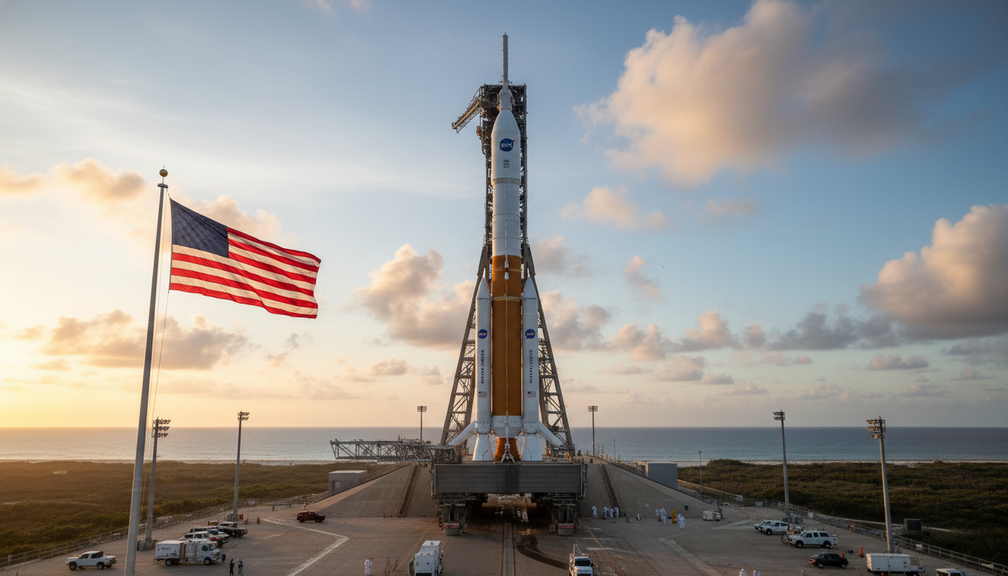
NASA is gearing up for a pivotal moment in space exploration as it plans to retry the Artemis II mission launch in early April. This mission marks a significant step towards a crewed lunar mission, as the Orion spacecraft is set to embark on a crucial journey. Despite previous delays and setbacks, NASA is diligently working to ensure a successful launch, underscoring the agency’s commitment to advancing human space exploration. The Artemis program aims to land the first woman and the next man on the Moon, setting the stage for future deep-space missions.
The Artemis II mission is part of NASA’s broader plan to return humans to the Moon and establish a sustainable presence there. With this upcoming launch, NASA is testing the capabilities of the Orion spacecraft and the Space Launch System (SLS) rocket, both integral components of its lunar exploration strategy. The mission will involve a crewed lunar flyby, where the spacecraft will orbit the Moon before returning to Earth, providing valuable data and insights for future missions.
The Artemis program represents a critical milestone in space exploration, demonstrating humanity’s ability to venture beyond Earth and explore distant celestial bodies. By returning to the Moon and eventually setting foot on Mars, NASA and its international partners are pushing the boundaries of human exploration and scientific discovery. The Artemis II mission serves as a stepping stone towards realizing these ambitious goals, paving the way for future crewed missions to the Moon and beyond.
The success of the Artemis II mission is not only crucial for NASA’s lunar exploration plans but also has broader implications for the future of space travel and scientific research. By mastering the challenges of deep-space missions, including long-duration spaceflight and lunar landings, NASA is advancing the capabilities and technologies needed for future human missions to Mars and beyond. The knowledge gained from the Artemis program will inform future space exploration endeavors and inspire the next generation of scientists, engineers, and astronauts.
From a practical standpoint, the Artemis II mission underscores the importance of international collaboration in space exploration. NASA’s partnerships with other space agencies, including the European Space Agency (ESA) and the Canadian Space Agency (CSA), highlight the global nature of space exploration efforts. By pooling resources, expertise, and technology, countries around the world can achieve feats that would be impossible for any single nation to accomplish alone.
As NASA prepares for the Artemis II launch in early April, the excitement and anticipation among space enthusiasts, professionals, and the general public are palpable. The mission represents a significant milestone in humanity’s quest to explore the cosmos and expand our understanding of the universe. With each successful mission, NASA gets one step closer to fulfilling its vision of sending humans to Mars and beyond, opening up new frontiers in space exploration and inspiring generations to come.