








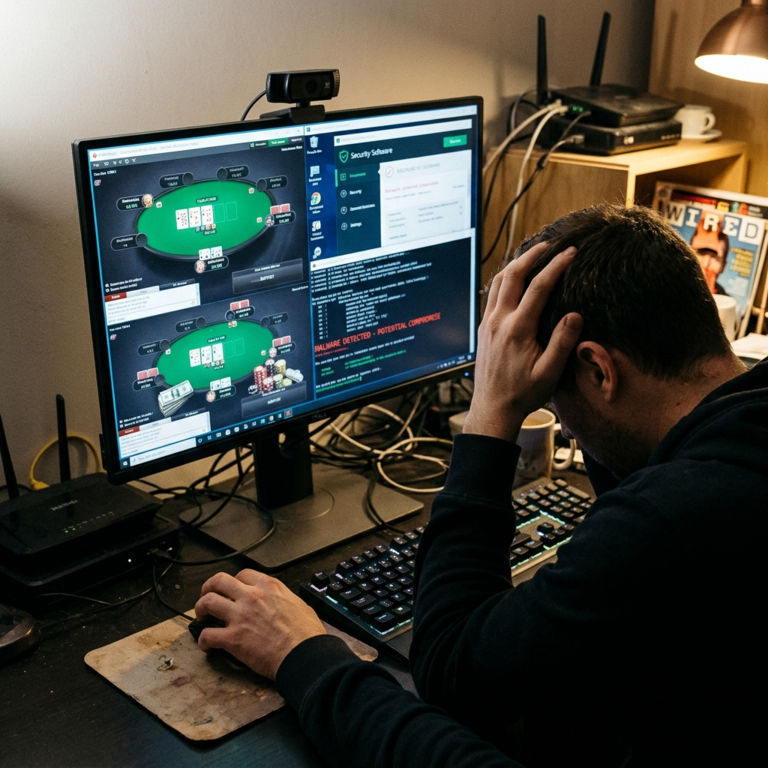
A suspected malware operation has turned online poker’s most basic promise—that every player sees only their own cards—into the center of a high-stakes security dispute. Wired reports that illicit software on computers used by some prominent poker players may have let an accused cheater view opponents’ hidden cards, an advantage that can transform a game of judgment into a rigged information contest. The potential losses are described as reaching millions of dollars, although the precise total, victims and mechanics remain allegations rather than established findings in the reporting available. For players who wager real money online, the story is a reminder that a platform’s fairness depends not only on its servers, but also on the devices and accounts at the table.
The alleged method belongs to a particularly alarming category of cheating often called a superuser attack: rather than merely predicting an opponent’s choices, a person gains access to information the game is supposed to conceal. In poker, knowing another player’s cards can make decisions about betting, folding or bluffing far more precise, even when the attacker is not controlling the victim’s account. Malware can potentially accomplish this by spying on a compromised computer, or by exploiting information available to software running alongside the game; the reporting does not establish every technical detail. Either route underscores how ordinary endpoint security can become part of a game’s integrity system.
That shifts the familiar image of online cheating. Players have long worried about bots, collusion and account sharing, problems that platforms can investigate through patterns of play, connections and transactions. Malware adds a more personal threat: a player may be targeted through a downloaded file, an impersonation attempt or compromised credentials, then unknowingly bring the vulnerability to the virtual table. A poker site can protect its own infrastructure and still struggle to detect malicious activity on a customer’s computer, where the attacker may see the game from the player’s perspective.
The stakes extend beyond one card room because online poker is a trust business. Unlike a physical casino, where players can observe a dealer and cards, a digital platform asks customers to believe that software is dealing fairly, opponents are legitimate and account balances will remain secure. A credible cheating allegation can therefore damage confidence even before investigators settle who did what or how much money changed hands. For operators, the commercial risk includes lost deposits and returning customers, as well as scrutiny from payment partners, regulators and jurisdictions that license real-money gambling.
The episode also illustrates why security teams cannot treat cheating and cybersecurity as separate departments. Fairness systems look for abnormal play, while security teams hunt for malware, account takeovers and suspicious access; signals from one side may be essential to the other. Operators can strengthen protection with multi-factor authentication, safer account recovery, device-risk monitoring and alerts when unusual software or login behavior appears, while preserving evidence for independent review. No single measure can guarantee that a player’s computer is clean, but layered defenses can make an attack harder to launch and easier to investigate.
Players have practical steps to take, too, though responsibility should not be shifted entirely onto them. They can install operating-system and security updates, use unique passwords and multi-factor authentication, avoid unfamiliar downloads, and contact a platform through official channels when a message or file seems suspicious. High-stakes professionals may also separate poker activity from everyday browsing, using a dedicated, carefully maintained device where feasible. These precautions reduce exposure; they cannot prove that opponents are honest or replace a platform’s duty to secure its games.
The broader lesson reaches any digital service where people compete or transact on the assumption that hidden information stays hidden. Online gaming, financial trading and remote work all depend on trustworthy software running across systems that users and providers do not fully control. As attackers seek leverage at the edges of platforms, companies will need to explain incidents clearly, investigate claims independently and show what safeguards actually do, rather than relying on assurances. Until the facts are established, the poker allegation is a warning, not a verdict—but it makes the cost of digital trust unusually easy to see: sometimes the decisive vulnerability is sitting at the table before the cards are even dealt.