






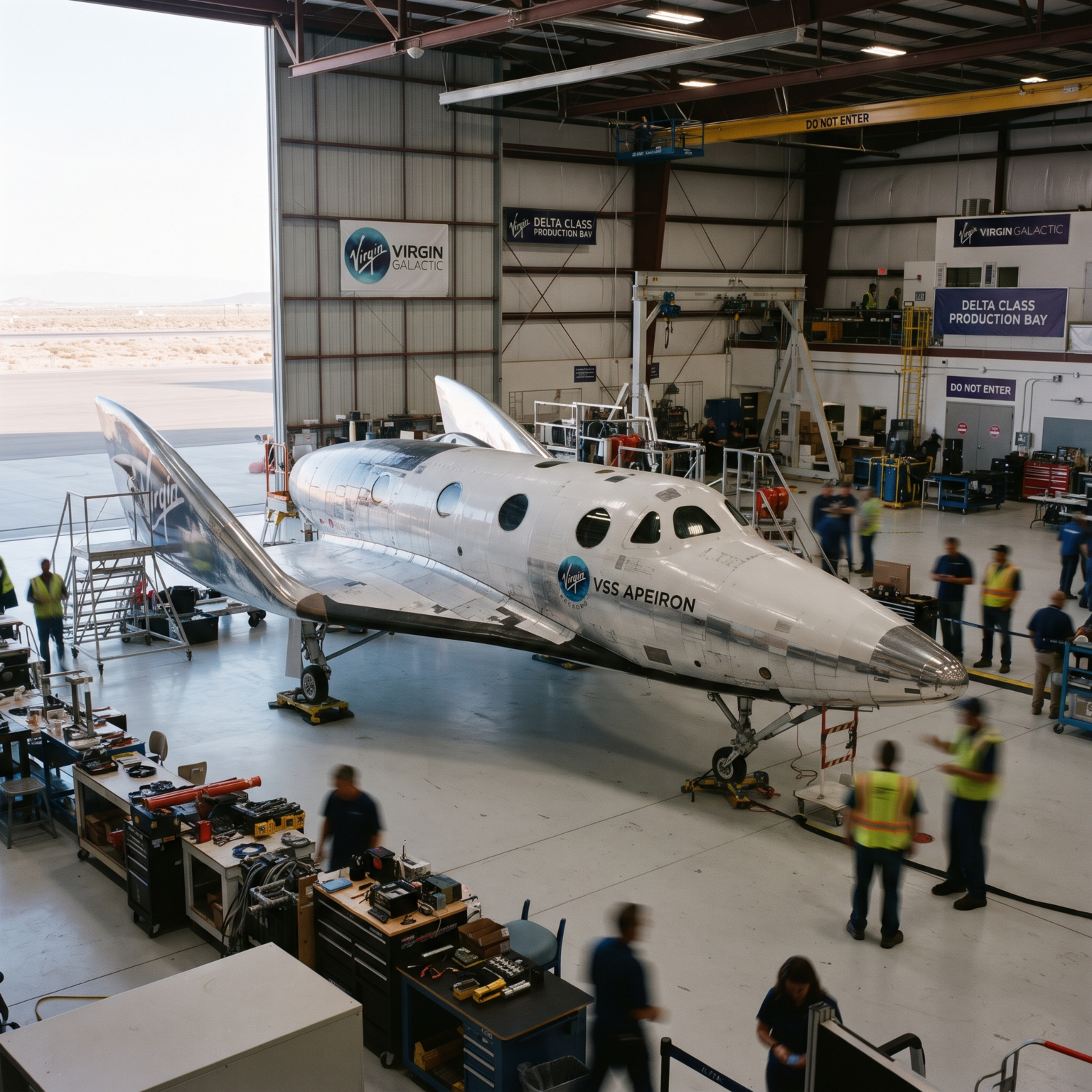
Virgin Galactic has given its next-generation spaceplane a name: Apeiron, selected through a public vote and unveiled as the first member of the company’s Delta class. The reveal offers a tangible sign of progress for a business whose customers have spent years waiting for a brief ride above Earth, but it is not a launch announcement. The lead Delta vehicle is not expected to fly for nearly another year, and Virgin Galactic has pushed back its first commercial mission on the new ship. For ticket holders, the headline is therefore both promise and postponement: a new spacecraft is taking shape, while the journey remains distant. That distinction matters in a sector where engineering milestones can look like imminent service, although certification, testing and operational readiness still stand between a prototype and paying passengers.
The name Apeiron, drawn from a Greek word associated with the boundless or infinite, lends the craft an ambitious identity, while the public vote gives customers and enthusiasts a role in its introduction. Yet a name cannot resolve Virgin Galactic’s central challenge: turning a technically demanding, high-priced experience into a dependable transportation service. The company’s existing spaceplane, VSS Unity, completed commercial flights after a long development and testing program, but Virgin Galactic ended those operations as it shifted resources toward Delta. That decision makes the new vehicle more than a refresh; it is the planned foundation for the company’s next phase. If Delta works as intended, a fleet could support more frequent flights than the limited cadence possible with Unity.
Virgin Galactic’s approach differs from the vertically launched rockets most people associate with space travel. Its spaceplanes are carried aloft beneath a larger aircraft, then released to ignite their rocket motors and climb to the edge of space before gliding back to a runway. Passengers experience several minutes of weightlessness and see Earth against the dark sky, rather than reaching orbit or traveling around the planet. This suborbital profile can offer a striking view with a shorter flight, but it remains a specialized experience, not a practical route between cities or a substitute for orbital research missions. Delta must make that experience repeatable, safe and commercially viable, not simply achieve a dramatic ascent once.
For customers who have already reserved seats, the schedule slip has immediate consequences: more waiting, continued uncertainty about when a trip will happen, and potentially a longer gap between a deposit and the promised experience. Virgin Galactic has not made the announcement equivalent to a cancellation, but a projected first flight nearly a year away leaves substantial room for further testing or schedule changes. In human spaceflight, caution is not merely a public-relations choice; a failure can put passengers and crew at risk and undermine confidence in the whole market. Still, repeated delays test customer patience and make it harder for the company to convert reservations into completed journeys and revenue. Prospective buyers may reasonably treat advertised timelines as targets, rather than firm appointments.
The business case hinges on using each spacecraft more often and spreading development and operating costs across a greater number of missions. A new class is valuable only if it can be built, maintained and flown at a pace that improves on the company’s earlier operations without compromising safety. Higher flight frequency could give Virgin Galactic more opportunities to sell seats, train crews and serve research customers seeking brief periods of microgravity. It would not automatically make tickets affordable to ordinary travelers: vehicle costs, insurance, training and the limited supply of seats keep the market exclusive. For now, the practical consumer question is not whether space tourism sounds thrilling, but whether the company can deliver a reliable product on a credible timetable.
Investors will watch the unveiling alongside the less glamorous measures that determine survival: cash use, production progress, test results and the timing of commercial service. Virgin Galactic is a publicly traded company, so delays can sharpen scrutiny of how long its resources can support development before regular flight income begins. The broader space economy is expanding, with governments and businesses investing in launch services, satellites and research, but that growth does not guarantee demand for private passenger trips. Space tourism must establish its own repeat customers and demonstrate that the experience justifies its exceptional price. The company’s announcement is therefore both a manufacturing milestone and a reminder that a promising market can remain financially fragile while its core product is still in development.
Apeiron also arrives as commercial spaceflight faces a wider test: translating spectacle into safe, sustained operations. Rocket launches have become more routine for satellite operators, while suborbital passenger flights remain rare and highly visible; the two markets share technology and headlines, but not identical customers or business models. Virgin Galactic’s progress will matter to suppliers, regulators and rivals because each completed test can build knowledge about vehicle performance, maintenance and passenger procedures. At the same time, the company must show that its operating model can manage safety and environmental scrutiny as flight rates rise. A spaceplane that flies more often could make access more regular, but it would still consume resources and require careful oversight.
For the public, Apeiron’s unveiling is best read as a preview rather than a breakthrough already delivered. The Delta program promises a larger operational step for Virgin Galactic, but its significance will be measured by flight tests, dependable schedules and the safe return of passengers, not by a name or an artist’s rendering. A successful service could help normalize commercial suborbital travel and create new opportunities for research in microgravity, while keeping spaceflight accessible to only a small, wealthy clientele for the foreseeable future. If delays continue, the same program may instead illustrate how difficult it is to turn an extraordinary machine into a durable business. The next year will reveal whether Apeiron is the beginning of a more regular era of space tourism, or another marker on a longer road than customers expected.