










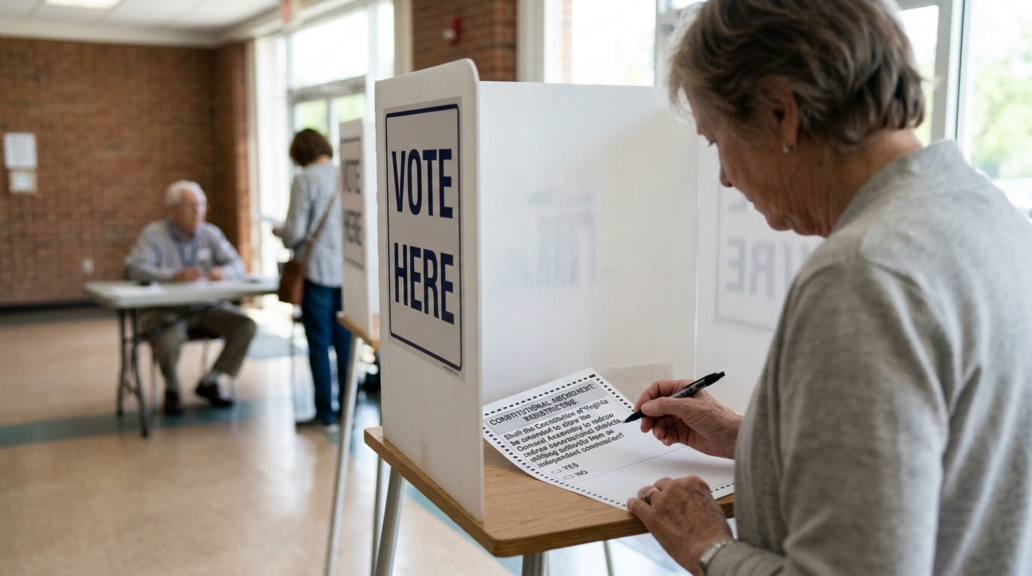
Virginia voters will decide on April 21, 2026, on a pivotal amendment that proposes to grant the state legislature, controlled by Democrats, the authority to redraw congressional districts through the year 2030. This decision stands to significantly alter the political makeup of Virginia’s congressional delegation, currently split 6-5 between Democrats and Republicans, to a projected overwhelmingly Democratic advantage of 10-1.
The current map, adopted in December 2021 by the Virginia Supreme Court after a bipartisan commission deadlocked, reflects a delicate balance in representation. However, the newly proposed amendment, passed by the Democratic-led legislative body in October 2025 and January 2026, seeks to overwrite this arrangement by enabling a mid-decade redistricting effort.
Democratic lawmakers assert this measure is a corrective response to perceived gerrymandering efforts by Republicans in other states such as Texas and North Carolina. The amendment has attracted over $39 million in support advertising, with endorsements from Governor Abigail Spanberger and other Democratic leaders emphasizing equitable representation.
The additional redistricting authority could reshape Virginia’s congressional map dramatically, consolidating Democratic districts to secure ten of eleven seats and leaving only the heavily Republican 9th District in southwest Virginia outside Democratic control. This potential realignment could flip four seats, influencing not just state but national politics, as it could reinforce Democratic power in the U.S. House of Representatives.
Republican opponents label the amendment the “most gerrymandered” map in the country and accuse Democrats of a power grab undermining fair representation. GOP figures including former Governor Glenn Youngkin have actively campaigned against the measure.
Public opinion on the amendment remains divided. According to a February 2026 poll by Roanoke College, 52% of voters opposed mid-decade redistricting while 44% supported it. A March Washington Post-Schar poll showed a slim majority (52%) favoring the measure versus 47% opposed.
Legal questions linger, with a Republican Attorney General’s office formal opinion challenging the amendment’s validity. The Virginia Supreme Court has permitting the election to proceed amid ongoing litigation.
This referendum follows Virginia voters’ prior adoption in 2020 of a bipartisan redistricting commission designed to reduce partisan bias in mapping. Approval of the 2026 amendment would temporarily reverse that approach, empowering the legislature to set the new political landscape until post-2030 Census redistricting.
Detailed maps of the proposed districts and precinct changes are available on the Virginia Department of Elections website for public review and analysis.