







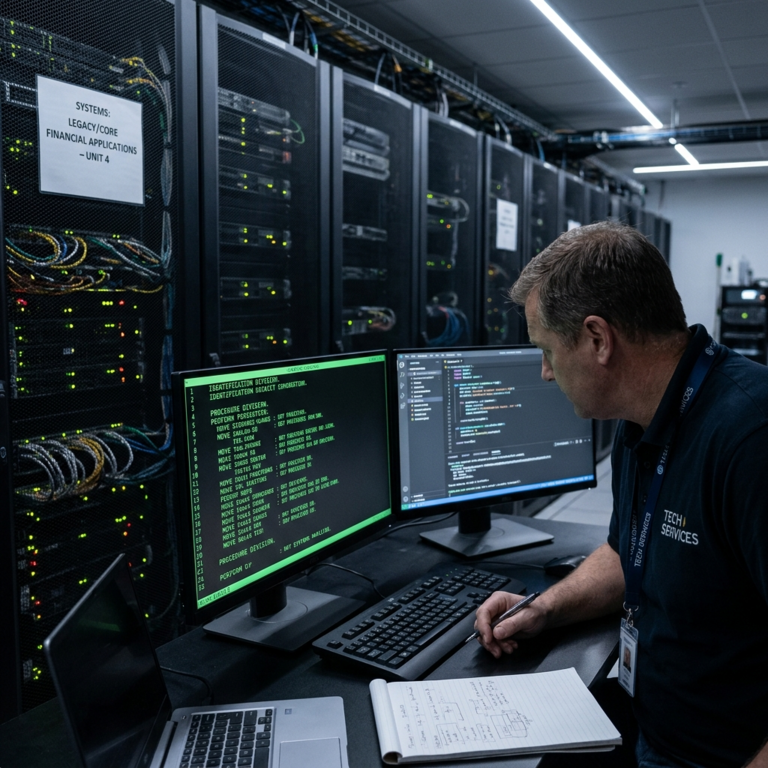
For decades, banks, airlines, tax agencies and public utilities have depended on COBOL programs that few people now know how to change safely. OpenAI says its latest AI models have made substantial gains in understanding and working with the decades-old programming language, offering a possible new tool for organizations caught between keeping essential systems running and replacing them. The claim places artificial intelligence inside one of technology’s least visible but most consequential bottlenecks: the software behind payments, travel, public records and other services people expect to work without interruption. The opportunity is not a simple switch from old code to new, but a safer way to inspect, explain and gradually modernize systems whose failures can carry immediate human and financial costs.
COBOL, short for Common Business-Oriented Language, was designed in the late 1950s for business data processing, and its longevity reflects reliability as much as inertia. Mainframes still handle high volumes of transactions, including deposits, insurance claims and benefit calculations, with predictable performance. Over time, institutions have layered rules and exceptions into these programs, encoding how their operations actually work. Replacing that foundation outright can demand expensive redesign, extensive testing and risky data migration; leaving it untouched can make security updates, integration and compliance changes harder.
The human bottleneck is just as serious. Experienced COBOL specialists are retiring, while recruiting replacements is difficult because the language is rarely taught as a mainstream career path today. That shrinking pool turns routine maintenance into a queue of scarce, costly work, and even a seemingly modest change may require painstaking review by people who understand a system’s history. For banks and government agencies, the problem is not simply old-fashioned code: it is the risk that essential expertise will disappear before the systems themselves can be safely changed.
AI could help by making unfamiliar code easier to read, mapping relationships among components and proposing explanations or edits for human review. In practice, a model might help engineers trace how a transaction moves through a program, identify where a rule is applied, or produce documentation that has been missing for years. Such assistance could shorten discovery and maintenance work, allowing scarce specialists to focus on consequential decisions rather than deciphering every line from scratch. OpenAI’s reported improvements matter because COBOL’s business logic is often dense, deeply interconnected and poorly documented, making generic code assistance less useful unless it can follow context across a large system.
But stronger code comprehension does not make autonomous changes safe. A generated edit can be syntactically valid and still mishandle an edge case affecting a pension payment, airline reservation or bank balance. Organizations will need rigorous testing, audit trails, access controls and human approval, alongside ways to compare AI-generated explanations with actual system behavior. Sensitive financial and government code also raises questions about where data is processed, who can see it and whether model outputs can be reproduced; vendors must earn trust, not merely demonstrate fluency.
The commercial stakes are substantial. If AI tools reliably reduce the time and specialist effort needed to understand legacy software, organizations may modernize in smaller stages instead of funding risky, all-at-once replacements. That could help them connect mainframes to cloud services, improve customer-facing applications and respond faster to policy or market changes, while preserving proven transaction engines. Cloud providers and software firms are already pursuing modernization tools, including agentic systems designed to discover applications and coordinate migration work. Competition may lower costs, but buyers will need to compare measurable results, portability and vendor lock-in, rather than treating an AI demonstration as proof of production readiness.
For consumers, successful modernization may show up less as a visible chatbot than as fewer service disruptions, quicker changes to online services and more dependable handling of routine transactions. Smaller institutions could benefit especially if tools reduce dependence on a handful of expensive consultants, though they may also lack the staff to validate automated work. The broader lesson is that AI’s value may come not only from creating new software, but from helping society understand and maintain systems already woven into daily life. OpenAI’s COBOL push is therefore a promising development, not a cure: the decisive test will be whether organizations can use these models to make critical infrastructure safer, more adaptable and accountable without introducing new, less visible risks.