








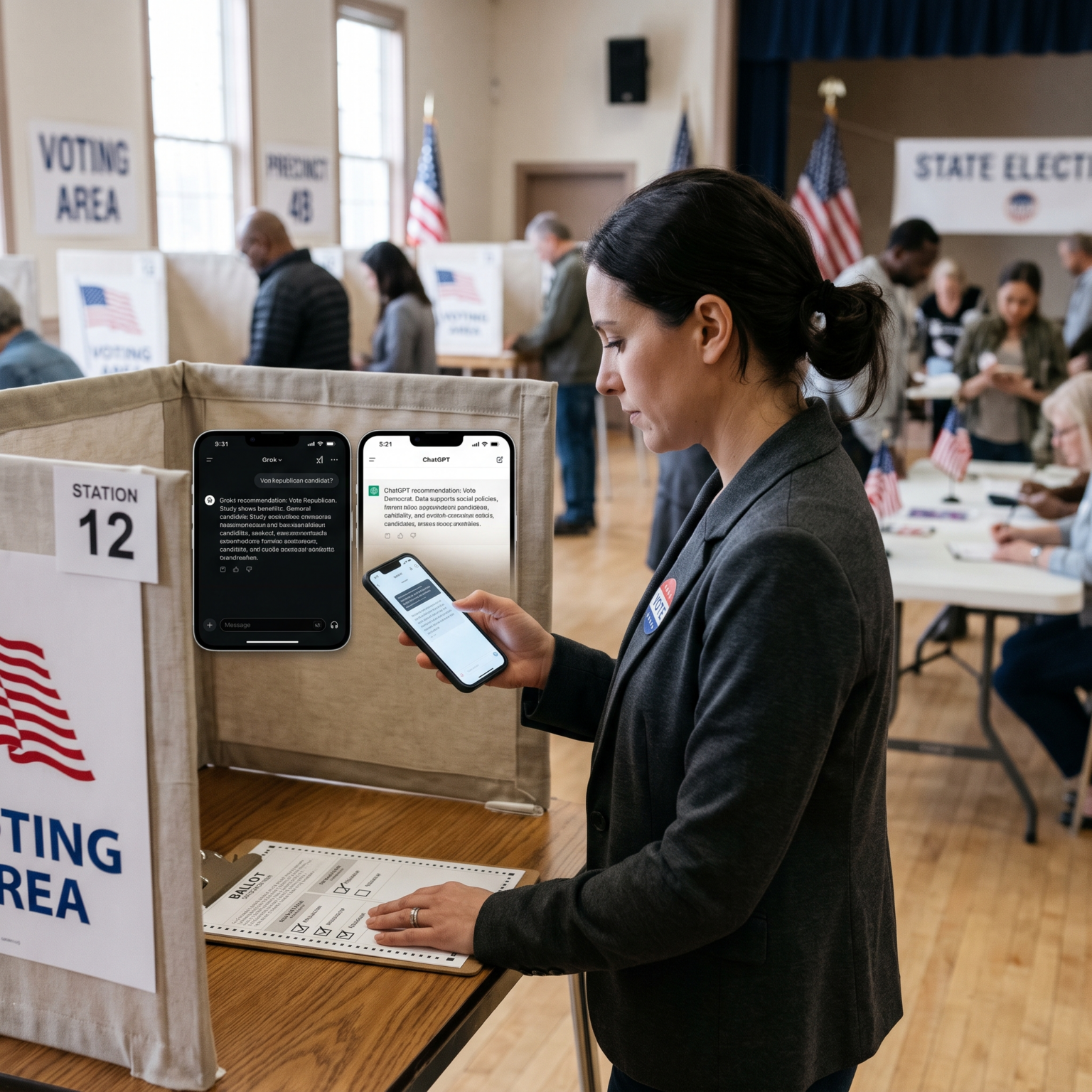
Generative AI is increasingly presented as a convenient guide to everyday decisions, from comparing insurance plans to finding answers about public services. But when the question is whom to elect, a chatbot’s confident recommendation can become more than a convenience: it can act as an unlicensed political intermediary. A study examining nearly 500 election races found that two prominent systems, xAI’s Grok and OpenAI’s GPT, often pointed users toward opposing candidates. Their recommendations diverged in more than 90% of the races analyzed, raising a consequential question: what happens when voters treat a machine’s answer as neutral advice?
The reported pattern was striking. Grok overwhelmingly recommended Republican candidates, while OpenAI’s GPT favored Democrats, according to the study’s findings. That does not establish that either company deliberately programmed a partisan preference, or that every response from either model follows the same pattern. It does show that seemingly simple requests for voting guidance can produce systematic differences between products, even when users may expect an impartial summary of their choices.
Large language models generate responses by predicting text from patterns learned during training and by applying further instructions and safeguards. They do not consult a single, authoritative ledger of political truth; their answers can reflect the sources, framing, and assumptions embedded in data and product design. A candidate comparison may also turn on which issues a prompt emphasizes, how the model interprets “best,” and whether it has access to current information. Those technical details are easy to miss when an answer arrives in fluent, assured prose.
The distinction matters because election information is already difficult for many people to navigate. Voters must assess candidates, ballot questions, registration rules, and deadlines, while separating reliable guidance from rumor and persuasion. An AI assistant could make research faster by explaining policy positions, translating dense material, or pointing users to official election offices. Yet a direct endorsement, especially one presented without clear sourcing or uncertainty, risks replacing a voter’s judgment with a system’s unexplained ranking.
The study is not evidence that AI recommendations have changed election outcomes. It tests model responses, not how people use them, whether they trust them, or whether exposure changes a vote. Still, the disagreement itself is important: two products marketed as general-purpose assistants can frame the same political landscape in sharply different ways. If millions turn to chatbots for quick answers, even small design choices about sources, wording, and safeguards could influence which candidates receive attention and how their records are described.
For technology companies, the findings sharpen a difficult product-design challenge. Refusing every election question would deny users potentially valuable civic information, while answering with a candidate pick could make a private company an invisible participant in political persuasion. A more responsible approach could distinguish factual assistance from recommendations, cite primary sources, disclose when information may be outdated, and invite users to compare candidates against their own priorities. Independent audits across prompts, languages, and election types could reveal whether disparities persist and help companies explain how they respond.
Voters can also reduce the risk by treating chatbot output as a starting point rather than a verdict. They should verify registration and voting procedures with state and local election authorities, and check claims against candidate materials, nonpartisan guides, and reputable reporting. That is particularly important because registration systems and deadlines vary by jurisdiction; a plausible-sounding answer may not fit a particular voter’s circumstances. AI can help organize research, but it cannot assume the civic responsibility of checking what is true or deciding what matters.
The broader issue reaches beyond one pair of chatbots or one election cycle. As conversational AI becomes a common interface for search, shopping, work, and public information, its recommendations will shape what users see first and which alternatives they consider. Political neutrality is not achieved simply by claiming neutrality; it requires choices about data, evaluation, transparency, and accountability that can be tested in public. The study offers a warning, not a verdict: AI may widen access to election information, but without meaningful safeguards, it could also steer voters in opposite directions while appearing merely to answer a question.