

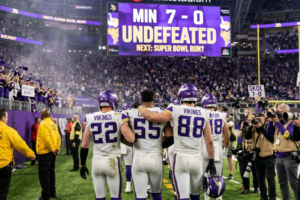

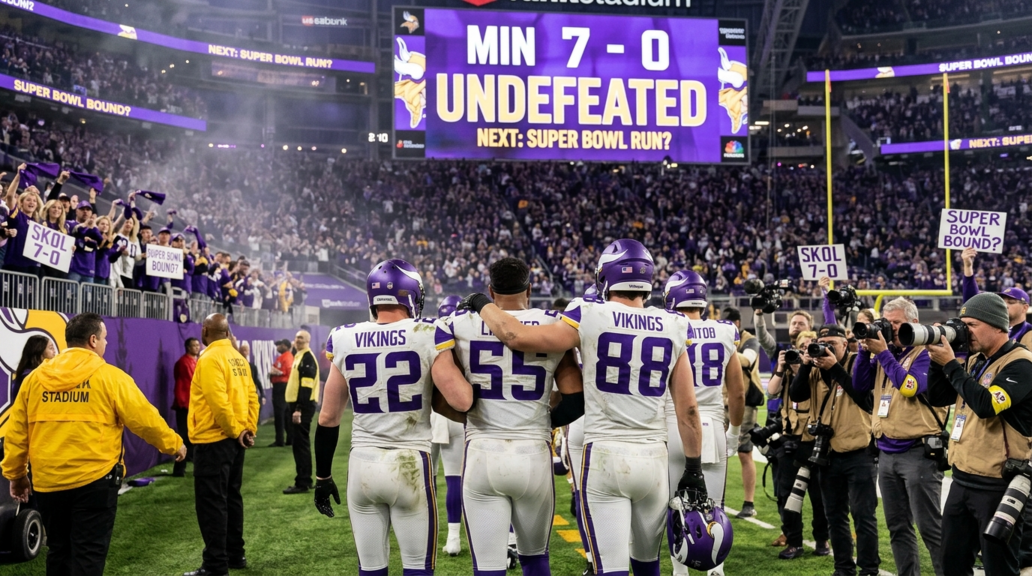
And then there was one. Through seven weeks of the 2026 NFL season, the Minnesota Vikings are the league’s only unbeaten team, a distinction that turns every Sunday into both a celebration and an examination. At 7–0, they have moved from promising contender to the standard everyone else is chasing, carrying the league’s brightest early storyline into the season’s more demanding stretch. The record is pristine; the questions around it are not. Minnesota’s task now is to prove its opening surge can survive pressure, injuries and adjustment.
Seven victories do not arrive by accident. They reflect a team that has repeatedly found answers across the weekly grind, handling the immediate challenge before the next opponent can expose a weakness. In a league built on parity, where one missed assignment or turnover can flip a game, Minnesota’s consistency has become its most persuasive credential. The unbeaten mark also brings a target: rivals now have seven weeks of film and a clear reason to treat the Vikings as a measuring stick. That attention changes the atmosphere immediately.
The harder question is not whether Minnesota can win in October, but how it wins when conditions tighten. A long season tests more than a team’s best version: it demands depth when bodies wear down, discipline when an opponent takes away a first option, and composure when a close finish becomes unavoidable. Those qualities rarely show up in a standings column, yet they separate a hot start from a roster capable of surviving January. For fans, that is where the Vikings’ perfect record becomes genuinely compelling.
Every unbeaten team eventually faces the same uncomfortable arithmetic: the schedule grows less forgiving while the margin for error shrinks. Minnesota cannot control how opponents respond, but it can control whether its early habits hold when defenses adjust and games become more physical. Coaches will be watching the details—protection, tackling, penalties and decisions in critical moments—as closely as the final score. A 7–0 start earns attention; what follows determines whether that attention becomes belief. That is the real test waiting beyond the celebration.
History offers encouragement, but no guarantee. The NFL has seen teams dominate the opening months and still discover that a flawless record says little about the challenge of winning three or four high-stakes games in succession. A championship run requires a different kind of resilience: absorbing a bad quarter, traveling into hostile environments and finding a way to make one decisive play when familiar plans are no longer enough. Minnesota’s 7–0 is a platform, not a trophy. For a fan base long hungry for the ultimate breakthrough, that distinction matters.
The spotlight is not a burden; it is an invitation. Minnesota has earned the chance to make the conversation about more than a start, and each coming week offers a chance to show that its confidence is supported by substance. Opponents will bring their best, the scrutiny will intensify, and the Vikings will have to answering without mistaking praise for progress. That challenge can sharpen a team—or expose the gap between expectation and readiness. The players who embrace that pressure may define how far this season goes.
For Vikings supporters, seven weeks have delivered the rare thrill of watching every game begin with possibility and end with another step forward. The rest of the league sees a hurdle; Minnesota sees a chance to turn an extraordinary opening into something lasting. No one can promise a Lombardi Trophy in October, and an unbeaten record offers no shortcut through the conference race. But at 7–0, the Vikings have earned the right to dream—and the responsibility to prove they belong among the true contenders.