

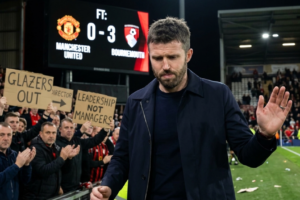
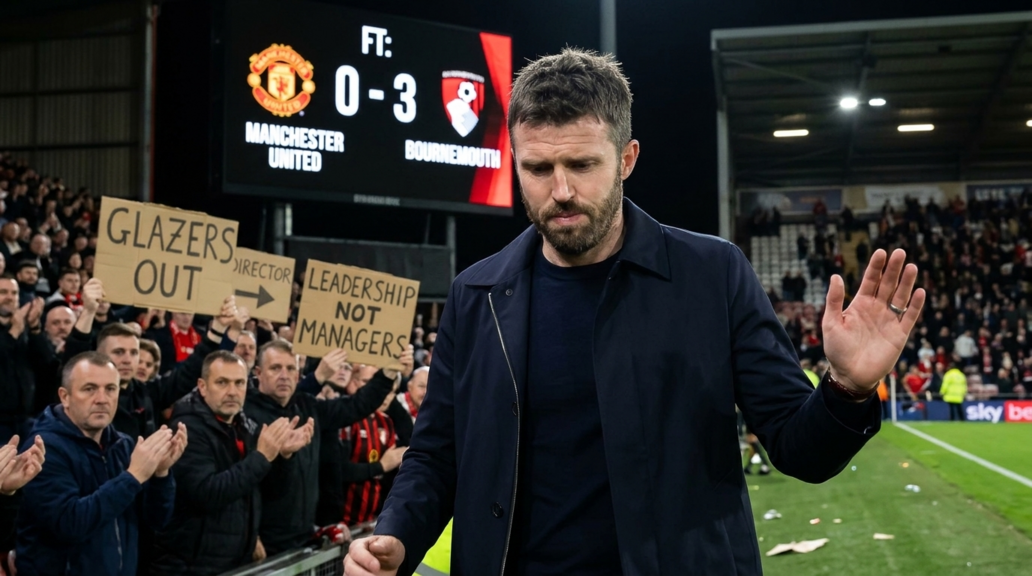
A heavy defeat to Bournemouth has pushed Michael Carrick toward the edge of Manchester United’s latest managerial crisis, but the reaction around him was strikingly different from a simple demand for a dismissal. At the final whistle, supporters applauded the manager while directing their fury toward the club’s leadership, a split that captured the tension between immediate results and years of accumulated frustration. Carrick now faces the familiar Old Trafford question: whether another coach must pay for failure, or whether the deeper problems sit beyond the touchline. For a club built on expectation, the scene was as revealing as the scoreline.
The humiliation reopened a debate United’s supporters know all too well. A new manager arrives promising energy and direction; an early lift gives way to inconsistency, and the search for answers narrows until the coach is in the firing line. Carrick’s position is precarious because results are the currency of the job, especially at a club whose history makes patience difficult to sell. Yet the applause suggested many fans do not see a change of manager, by itself, as a convincing solution.
United’s immediate challenge is to steady performances before another damaging result deepens the unease. Carrick is expected to lead the team against Chelsea on Saturday, with the club choosing, for now, to keep him in charge. That decision offers a brief reprieve, not a guarantee of security: the next match becomes both a test of his authority and a measure of whether the players can respond. In the Premier League, a single afternoon can alter the mood, but it rarely erases the questions behind it.
The Bournemouth defeat also puts the squad under scrutiny. Managers set the plan and carry responsibility, but players must execute it, absorb pressure and show resilience when a game begins to turn against them. United’s recurring collapses have made that distinction harder to ignore, because changing the person on the sideline has not prevented the pattern from returning. Fans demanding accountability are therefore looking beyond one team selection or one tactical adjustment to the character and construction of the group.
For Carrick, the human pressure is particularly sharp. He is not simply confronting a poor result; he is working inside a club where every setback revives memories of previous managerial exits and promises of a fresh start. Support from the stands may offer some comfort, but it cannot shield him from the demands of the job or the need for improvement. He must find a way to turn sympathy into belief, and belief into performances, before goodwill becomes another casualty of the cycle.
The leadership faces its own test. When supporters direct anger upward rather than solely at the coach, they are challenging the people responsible for building a team and setting a coherent course. United’s stature makes that scrutiny unavoidable: fans expect not just a competitive side, but a club whose decisions make sense over time. Keeping Carrick temporarily may preserve continuity, yet continuity matters only if it is part of a credible plan rather than a pause before the next familiar reset.
Saturday at Chelsea will not settle every argument, but it gives United an immediate chance to answer the most urgent one: can this team show enough fight and clarity to halt the slide? Carrick needs a response from his players, while the club needs to show that it understands why supporters see more than a coaching problem. The applause after Bournemouth was not a verdict that results no longer matter. It was a warning that replacing another manager without confronting the causes of failure may leave United exactly where it started.