







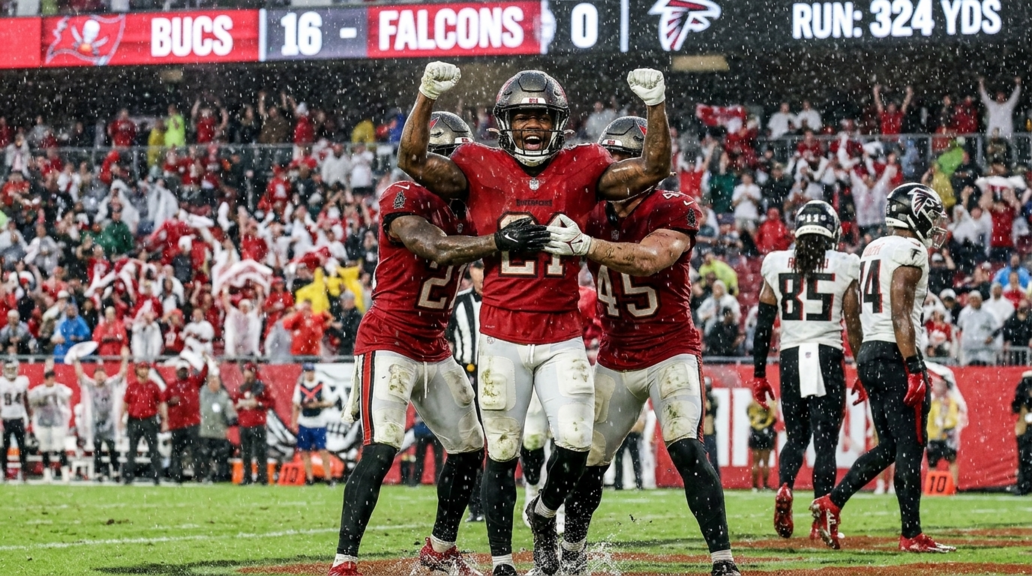
In a league built around the forward pass, Tampa Bay delivered a victory that seemed to belong to another era. The Buccaneers completed none of three attempts from Baker Mayfield, yet beat the Atlanta Falcons 16–0 in a driving downpour. It was the NFL’s first game without a completion since 1974, an improbable milestone made more remarkable by the stakes and the conditions. Tampa Bay did not merely survive the storm; it turned the weather into an invitation to impose its will.
Rain changed the game before either offense could establish a conventional rhythm. With the ball slick and footing uncertain, the Buccaneers leaned on the clearest advantage available: two backs able to take the punishment and keep moving. Bucky Irving supplied the headline performance, carrying for 170 yards and a touchdown, while Kenneth Gainwell added 140 yards. Together they made Tampa Bay’s ground attack more than a fallback; it was the central engine of a franchise-record 324 yards.
The production came through repetition rather than spectacle, and that was precisely the point. Tampa Bay kept asking Atlanta’s defense to tackle through the rain, then return to the line and do it again. Irving’s touchdown gave the relentless approach a finishing touch, while Gainwell’s volume ensured the Falcons could not focus their attention on one runner. Each successful carry drained time, built confidence, and narrowed the visitors’ opportunity to answer. In a game with no completed pass, control was earned yard by yard.
Mayfield’s blank passing line will dominate the box score, but it should not obscure the quarterback’s role in accepting the game as it unfolded. He attempted only three throws, none completed, a statistical oddity that would have invited second-guessing in almost any other setting. Instead, Tampa Bay stayed committed to its runners and avoided asking a rain-soaked contest to become something it could not be. The discipline was its own kind of execution: no panic, no forced heroics, and no need to chase points through the air.
Atlanta’s defense entered the afternoon facing a familiar division rival, but the circumstances stripped away much of the usual tactical playbook. The Falcons were shut out, unable to turn Tampa Bay’s limited passing into an opening or generate the points needed to make the Buccaneers reconsider their approach. Every stalled possession increased the burden on a defense already being worn down by repeated carries. A two-score final margin can look modest; here, it represented complete control.
The shutout’s historical place is striking because the NFL has spent decades rewarding passing efficiency and punishing predictable offenses. Tampa Bay’s zero-for-three passing performance was not a blueprint for every Sunday; it was a response to a storm, executed with conviction. The last NFL game without a completion came in 1974, making this result a rare reminder that football’s oldest formula—run, defend, and protect the ball—can still decide a modern contest.
For Buccaneers fans, the win offers more than a box score: it is a divisional statement built on toughness and commitment. A franchise-record rushing total and a shutout against Atlanta give the result weight beyond its weather oddity, especially in a rivalry where every game can shape the race for position. Fans may remember the unbelievable passing line; longtime supporters will remember the method. It made a soaked afternoon feel like a statement.