




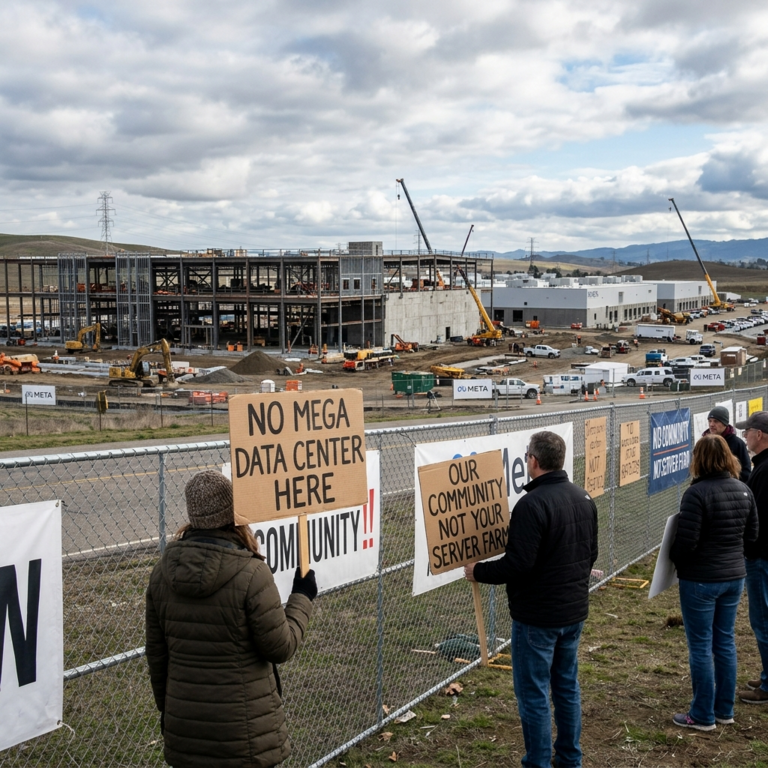
Meta is warning that a growing political backlash against large data centers could complicate the next phase of its artificial-intelligence expansion, turning local land-use disputes into a strategic risk for Silicon Valley. In filings and public comments described in recent reporting, the company says election-driven opposition may make future projects harder to approve, finance, and build. That warning arrives as developers race to secure the power, land, cooling systems, and network links that increasingly demanding AI models require. The question is no longer simply how quickly Meta can design smarter software, but whether communities will accept the footprint needed to run it. That shift puts infrastructure in the political spotlight.
Data centers are industrial-scale buildings packed with servers that store information and perform calculations; AI workloads make them larger, denser, and more power-hungry than many older facilities. Training and serving AI systems also require specialized chips, reliable electricity, substantial cooling, and fast connections between machines, so a site is not interchangeable with an ordinary office. Meta’s data-center plans therefore sit at the intersection of software ambition and local infrastructure, where grid capacity and water use can matter as much as algorithms. That makes expansion visible in a way cloud computing once was not. Residents see buildings, substations, transmission lines, backup generators, and construction traffic before they ever see a benefit from an AI assistant.
That visibility helps explain why resistance has become bipartisan, even when objections differ: some officials question tax breaks and public costs, while others focus on electricity, water, noise, or emissions. Residents may also worry that promised permanent jobs will be modest compared with construction employment, or that utility upgrades will ultimately be paid for through higher bills. For households already facing tight power markets, a new campus can look less like an abstract technology investment than a direct claim on scarce local resources. Supporters counter that projects bring construction work, tax revenue, and related investment, and that modern facilities can be designed to use energy and water more efficiently.
Recent reporting has put roughly $64 billion in data-center projects in the United States in the blocked-or-delayed category, a measure of friction rather than proof that the boom has stopped. That distinction matters: developers can reroute, redesign, or postpone a project, but each change can raise costs and push new computing capacity further into the future. Meta’s warning is thus less a prediction of imminent scarcity than a signal that the assumptions behind its investment plans are changing. Permits, community agreements, utility hookups, and political support increasingly belong on the critical path alongside chips and software. A lost year can matter when rivals are racing to deploy services.
Meta’s investments underpin services used by billions of people, but the company is also competing to make AI assistants and generative tools central to its next generation of products. More computing capacity can support faster responses, larger models, and features integrated into social networks, messaging, advertising, and creator tools. Delays could constrain where and when those capabilities launch, or make the company rely more heavily on rented cloud capacity and partnerships. Either route affects cost: owned campuses require enormous up-front spending, while outside capacity can expose a company to availability, pricing, and supplier constraints. That is why local approval has become a business variable, not merely a facilities-team concern.
Communities, meanwhile, are being asked to judge promises whose benefits and burdens arrive on different schedules. Construction hiring and tax receipts may appear early, while electricity demand and water consumption persist for decades, depending on design and local conditions. Negotiated safeguards can help, including transparent utility-cost arrangements, water reporting, efficiency targets, and credible plans for emergency power and noise. Companies that explain these trade-offs early may earn trust; those that treat public meetings as a box to check risk turning one disputed site into a template for opposition elsewhere. Local governments can also demand enforceable commitments rather than relying on claims about jobs or future innovation. The bargaining is becoming more consequential.
The broader lesson is that AI’s progress depends on infrastructure as much as breakthroughs in model design. Grid upgrades, permitting systems, equipment supply, and public consent will determine how quickly computing capacity can grow. Data centers are not unique to Meta, and rivals face the same constraints as cloud providers and startups seek access to power and space. If local resistance spreads, companies may shift sites, pay more, or pursue smaller and more efficient facilities; none of those options removes the need to negotiate with communities. For users, the result may be a slower rollout, higher costs, or less conspicuous AI features, rather than an outage or retreat from investment. Meta’s warning makes clear that AI’s race is also a contest for legitimacy.