






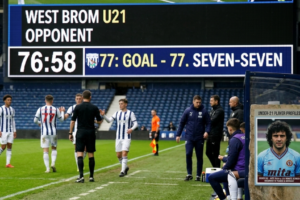

Football can make a moment feel scripted, even when the sport’s best stories are built on chaos. At West Bromwich Albion’s Under-21 match against Sutton United, 17-year-old Justin Seven-Seven supplied the kind of coincidence that seems designed for a headline: introduced in the 75th minute, he scored in the 77th. The teenager’s surname, the clock and—according to reports—his No. 77 shirt all aligned, turning an ordinary goal into a small piece of football folklore. It was a finish with a punchline, but also a timely reminder that young players still have to seize the opportunity when it arrives.
The sequence matters as much as the symmetry. Seven-Seven entered with West Brom seeking a way back into the contest, and within two minutes he had converted his chance, giving the Baggies’ youngsters a jolt of belief. A substitute’s job is often to change the temperature of a game, whether through pressing, movement or one decisive touch; this was the most memorable version of that assignment. For a 17-year-old, a goal that instantly travels beyond the academy audience can be both a reward and a strange introduction to wider attention.
The coincidence naturally sends fans searching football’s archives for names that seem to meet the match clock. The most striking historical parallel is Didier Six, the French international whose surname points to the sixth minute. Six scored early in matches on both sides of the Rhine, in France and Germany, giving the name-and-number game a genuine cross-border chapter. These examples are not a formal category or a record table; they are little collisions between identity and action that supporters love to remember long after the final whistle and the scoreline fades. That is why a modest academy goal can sit comfortably beside celebrated international exploits in the same conversation.
Football’s numerical curiosities have a special appeal because the game is measured so precisely. The clock is always visible, shirt numbers are printed in bold, and names travel across scoreboards, broadcasts and social feeds; when those details echo one another, supporters notice. Yet the coincidence does not diminish the football: Seven-Seven still had to read the play, arrive in the right space and finish under pressure. The numbers made the moment shareable, while the goal itself made it worth sharing. For West Brom, the image also offers a glimpse of academy life: a young player stepping into a senior development game and making an immediate contribution. These matches are designed to test prospects against adult opponents and demanding situations, not simply to produce viral clips. A goal that catches the wider public’s eye can help people notice the work behind the player, too.
There is a useful contrast between Seven-Seven’s sudden spotlight and Six’s place in the history books. One is an emerging teenager whose career is still being written; the other is a name familiar to followers of French football and international tournaments. Their connection is playful, not a claim that one strike can equal a career, and that distinction matters. Football fans can celebrate the joke without losing sight of the different stages and stakes involved. In the academy, the next challenge will be to turn a memorable cameo into more opportunities, and to show that the talent behind the headline can endure beyond a single afternoon.
The goal also captures how supporters experience football in the social-media age. A scoreline may be quickly forgotten, but a perfectly aligned name, number and minute is easy to explain, replay and pass along. That instant recognition gives the story a life outside the ground, reaching casual fans who might not otherwise follow an Under-21 fixture. For dedicated supporters, it adds a fresh detail to the club’s youth-team conversation and a reason to keep watching the next generation. The internet loves a coincidence, but the best ones still start with something real happening on the pitch.
There is no need to pretend that timing can be coached into place, or that every promising youngster will become a star. The appeal lies in the unexpected meeting of a player’s name and a match clock, set against the familiar drama of a team needing a goal. Seven-Seven’s 77th-minute strike gave West Brom’s academy a moment to savour and gave football another wonderfully tidy story. Didier Six supplies the historical echo; the teenager supplies the latest chapter. For fans, that is the pleasure: sometimes skill decides the match, and sometimes the clock adds a perfect final flourish.