



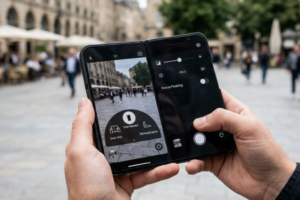


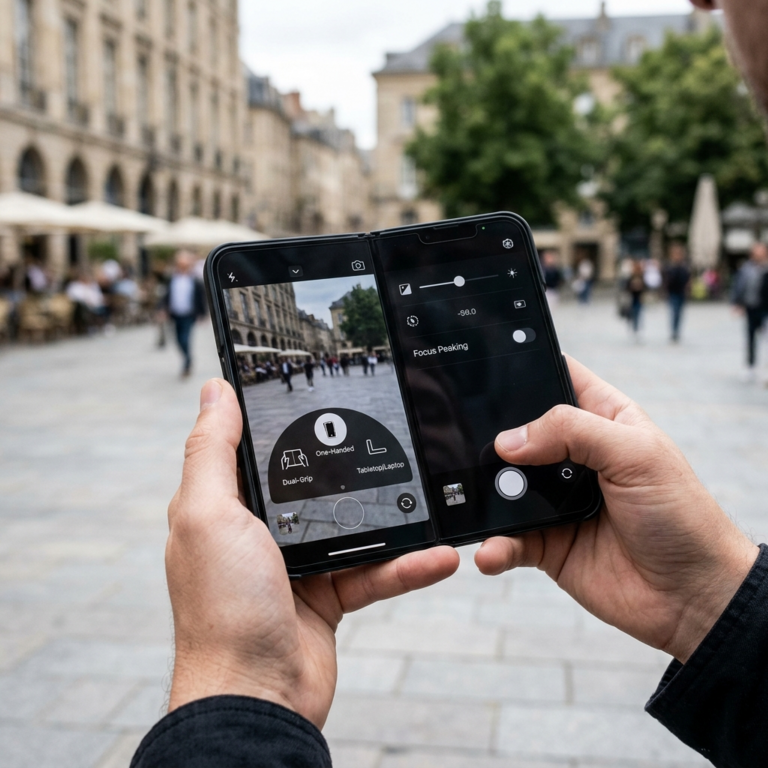
Halide’s first update for Apple’s iPhone Duo brings a simple premise to a complicated new form factor: the camera interface should change when the phone does. The independent camera app adds three shooting modes tied to the foldable’s position, adapting controls to how someone holds and uses the device. Rather than treating folding as a hinge trick, the update makes posture part of the photographic workflow. That is a small software release with a larger ambition: to make a camera feel native to a phone that can be both handset and something more flexible.
The practical appeal is easy to understand. A conventional phone camera assumes a familiar arrangement: a screen facing the photographer, a lens facing the subject, and two hands or one hand keeping everything steady. A foldable complicates that choreography, because its halves can be opened, angled, or positioned in ways a rigid slab cannot. Halide’s three modes respond to that difference, offering controls suited to distinct positions instead of asking users to adapt every time. The update’s significance lies less in a new imaging format than in reducing friction between the device’s shape and the act of taking a picture.
That matters because camera software is increasingly part of a phone’s hardware identity. Sensors and lenses set the physical limits, but software determines how quickly users can reach exposure adjustments, frame a shot, or choose a preferred look. Halide has built a following among photographers who want more direct control than a default camera app typically provides, while still using an iPhone. By tuning its interface for the Duo, the developer signals that foldable-specific design need not belong only to the phone maker. Independent apps can also make the form factor useful in everyday tasks.
The update also illustrates a broader shift in interface design: phones are becoming devices whose shape and orientation can carry meaning for software. A foldable can act as a compact phone, a partly opened stand, or a larger viewing surface, and each position changes what a user can comfortably see or reach. Camera apps are especially well suited to this experimentation because framing already depends on where the screen and lens sit relative to a subject. If the software can recognize or accommodate those configurations, it can turn a mechanical feature into a practical shooting option rather than a novelty.
There are limits to what the announcement establishes. The available description identifies three position-based modes but does not spell out their names, exact controls, or the technical method used to adapt the interface. It would be premature to claim that the update changes image quality, adds computational photography features, or automatically detects every possible angle. What is clear is that Halide is shaping the shooting experience around how the Duo is held. That distinction matters: thoughtful interface adaptation can improve usability even when the underlying camera hardware stays the same.
For consumers, the immediate question is whether these modes make photography more comfortable and dependable in real situations: capturing a group without awkwardly balancing the phone, composing at a lower angle, or keeping the display usable while the device rests partly open. Such benefits depend on execution, and users will judge the feature by whether it saves steps rather than adding another menu to learn. For professionals and enthusiasts, the appeal may be more about consistency and control. A familiar camera app that respects the device’s changing geometry could make an unusual phone feel like a credible tool, not merely an expensive experiment.
The larger market stakes reach beyond Halide. Foldables have long asked buyers to accept a trade-off: a more versatile screen in exchange for extra cost, weight, and unfamiliar habits. Their success depends not only on hinges and displays but also on software that gives each configuration a reason to exist. Updates like this offer a model for how developers might respond, using a device’s physical state to tailor controls without forcing users to master an entirely new workflow. If that approach spreads to video, conferencing, reading, and creative apps, foldable design may become less about transformation for its own sake and more about useful choices. Halide’s release is an early, focused example of that possibility.