








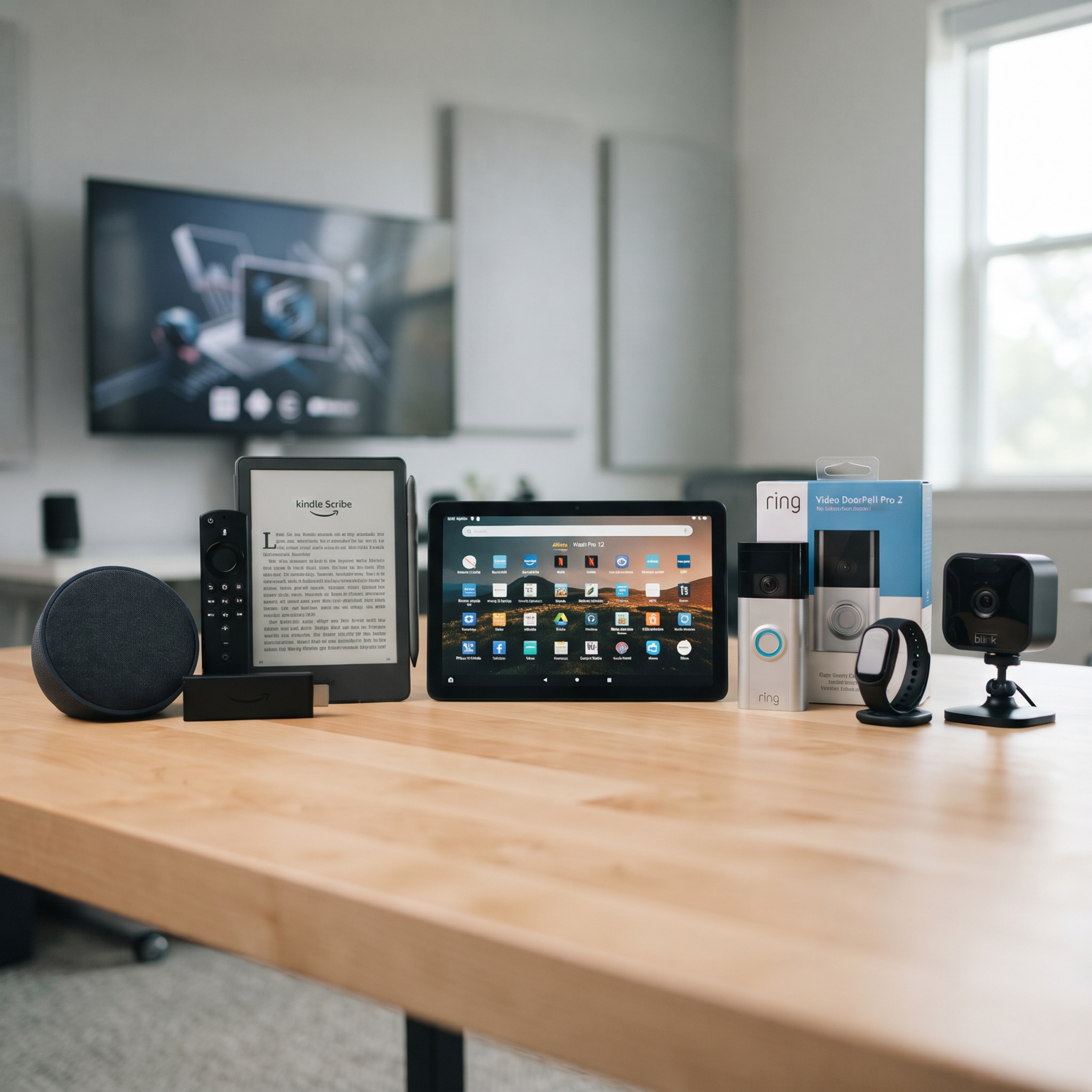
Amazon has turned its traditional fall hardware showcase into a monthlong sequence of launches, spreading announcements across Echo, Fire TV, Kindle, Ring, Blink and a new wearable venture called Bee. The approach trades one high-profile stage event for a rolling stream of products aimed at the same crucial moment: the holiday-shopping season. Among the introductions are new Fire TV devices and Kindles, the Alexa Tablet Pro 12, Ring’s first smart lock, Bee wearable hardware and Blink 4K cameras. Taken together, the lineup is less a single headline gadget than a map of Amazon’s ambitions to make its services present throughout the home and increasingly attached to the person. That breadth also gives the company more chances to keep customers engaged across entertainment, reading, household security and voice- or screen-based assistance.
The choice to distribute announcements rather than concentrate them in one event changes the way Amazon competes for attention. Each product can receive its own moment in news coverage and online conversation, while the sequence keeps the company visible through a month when shoppers begin comparing gifts and upgrading devices. It also reflects a sprawling portfolio: one stage can struggle to tell a coherent story about televisions, cameras, locks, tablets and wearables at once. A series of launches lets Amazon connect those categories gradually, presenting them as parts of a broader ecosystem rather than a collection of unrelated gadgets. The strategy may be especially valuable in a market where consumers are inundated with new devices and retailers compete intensely for seasonal spending.
Amazon’s portfolio is built around more than hardware sales. Fire TV and Kindle devices offer ways into video and books, while Echo products bring Alexa into shared spaces; Ring and Blink extend the company’s presence into security. Devices can therefore serve as gateways to Amazon services and recurring customer relationships, even when the product itself is only one part of the commercial picture. The launch list’s variety matters because customers increasingly expect technology to work across everyday routines, not just perform one isolated task. For Amazon, a television, a smart lock and a wearable can each become another point of contact, although the practical value depends on ease of use, reliability and clear benefits.
The Ring smart lock is a notable expansion because it moves the security brand beyond cameras and doorbells into controlling access to the home. A connected lock can make everyday tasks, such as letting in a visitor or checking whether a door is secured, more convenient, but it also puts a sensitive function on a networked device. Buyers will reasonably weigh battery life, compatibility, account security and what happens if connectivity fails, alongside the promise of remote control. Blink’s move to 4K cameras similarly signals a push toward sharper security footage, which can help users distinguish details but may bring questions about storage, bandwidth and subscription costs. The category’s appeal rests on trust as much as image quality or convenience.
The Alexa Tablet Pro 12 and new Fire TV devices address screens, where Amazon must compete with established television makers, streaming platforms and tablet ecosystems. A larger tablet can suit shared viewing, video calls or work at home, while a Fire TV device can bring streaming services together on the living-room display. The practical test is whether those experiences feel simple and responsive, and whether customers can use the services they already prefer. New Kindles, meanwhile, reinforce a different proposition: a dedicated reading device can be more focused than a general-purpose tablet, especially for people who value portability and a screen designed for books. Amazon is refreshing both broad entertainment screens and specialized ones, serving distinct habits rather than insisting on one device for every need.
Bee’s arrival introduces a less familiar category: wearable hardware, which could extend Amazon’s reach beyond rooms and screens. The announcement, as described, offers limited detail about what the device does, so its significance is best understood as a signal of exploration rather than proof of a new hit. Wearables succeed when they solve a recognizable problem comfortably and earn users’ confidence around personal data; a brand name alone cannot establish either. The same caution applies to the broader AI ambitions surrounding Amazon’s devices. Echo models introduced in September were described by the company as purpose-built for Alexa+, placing artificial intelligence at the center of its newest speaker pitch, but consumers will judge the assistant by useful answers and dependable actions, not labels.
Amazon’s timing also connects device launches to a wider business strategy: strengthening customer engagement while its cloud-computing operation grows. In its October 2025 quarterly results, the company reported AWS sales of $33 billion, up 20 percent year over year, underlining the scale of its infrastructure business. That figure does not establish that consumer devices drive cloud growth, but it shows Amazon operating across two powerful fronts: services for businesses and products that shape household technology. For consumers, the expanding range may bring more choice and tighter integration, but also more decisions about accounts, interoperability, privacy and long-term support. The October campaign’s deeper message is that Amazon wants to be present wherever people watch, read, secure a home or interact with AI. Whether that ambition becomes genuinely useful will depend less on the number of launches than on whether the devices work well together, solve real problems and deserve a place in daily life.