
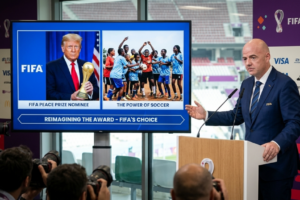





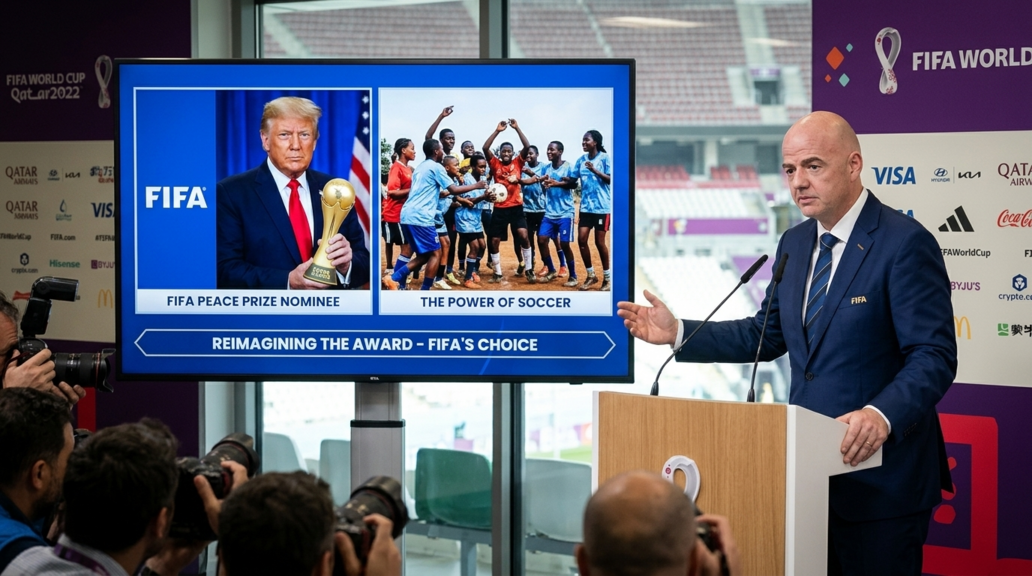
Soccer has always carried a promise larger than the scoreline: on a crowded field, players from different nations can meet under shared rules, while supporters find common language in the rhythm of the game. That ideal is why FIFA’s inaugural peace prize should have felt bigger than a ceremonial moment. Instead, its presentation to Donald Trump at the World Cup draw became a spectacle about politics and credibility, not soccer’s power to bring people together. For fans watching the global game, that contrast was impossible to miss.
FIFA president Gianni Infantino framed the award as recognition of peace, but the choice landed in a climate where every gesture involving Trump is read through partisan loyalties. The prize’s debut therefore arrived burdened by questions its name could not answer: What achievement was being honored, who had judged it, and what standard would future recipients face? Instead of settling those questions, the ceremony invited scrutiny of Infantino’s motives and left the honor looking less like an institution than a personal endorsement. That perception matters in a sport whose governing body has long insisted it can unite audiences beyond politics.
For players and coaches, peace is not an abstract slogan; it is built through daily choices, shared effort and trust. Across conflict zones and divided communities, local clubs often provide safe places where children can play, learn and belong together. Coaches, referees and organizers can keep those doors open, sometimes with little money and considerable personal risk daily. Their work offers FIFA a far more credible starting point than another grand stage or a powerful recipient alone.
FIFA does not need to pretend the first award never happened; silence would leave the awkward precedent intact for everyone. Instead, it can publish clear criteria, name an independent panel and explain how nominees demonstrate measurable, lasting impact in communities. Those safeguards would not erase the Trump decision, but they could make the next selection worthy of serious attention. Transparency is not glamorous, yet in sport it can be as essential as a fair referee, especially when trust is already under pressure.
A reimagined prize could honor a coach who keeps a youth league alive across community divisions, or a player whose foundation creates safe places to play. It might recognize a club using football to welcome refugees, or organizers building a pathway for girls where opportunities remain scarce. Such work rarely commands a world-stage spotlight, but its effects are tangible: teammates learn to rely on one another, and neighborhoods gain a place to meet. Those are not substitutes for diplomacy; they are meaningful contributions soccer can make within its reach.
The challenge is to ensure recognition follows impact, rather than allowing the prize to become another instrument of public relations. FIFA would need to show how candidates are nominated, how claims are checked and why a recipient represents the award’s purpose. It should also invite footballers, community leaders and independent experts into the process, giving the game’s own people a voice. A credible selection would not silence critics, but it would give fans evidence that the organization is listening and willing to improve.
For supporters, the stakes extend beyond one ceremony or one controversial recipient. The World Cup brings countries, cultures and millions of fans into a shared contest; that reach gives FIFA an unusual platform, but also a responsibility to use it carefully. Infantino’s decision has made the peace prize an uphill project, and the easiest course would be to let it fade. A better course is to make the next award earn its name, honoring people whose work shows soccer can create connection where division might otherwise win.