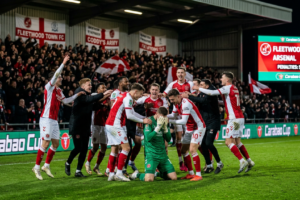







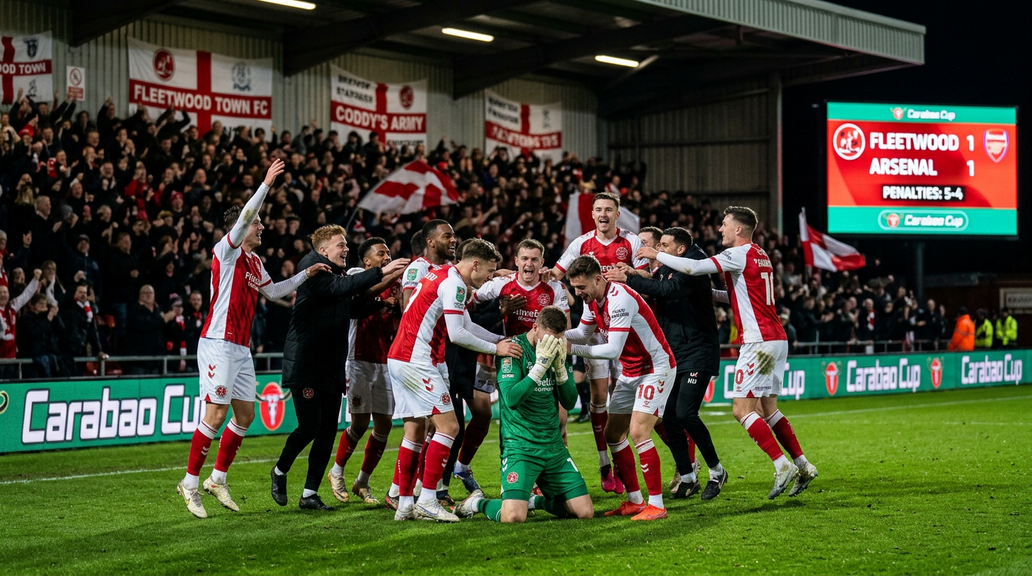
Fleetwood Town have turned a cup night into club folklore, eliminating Premier League champions Arsenal on penalties to reach the Carabao Cup quarter-finals. For a League Two side, the result is more than a famous scalp: it is a rare chance to carry a national audience into the next round and make a small-town football story feel enormous. Arsenal, meanwhile, leave with their campaign abruptly over. The gulf in resources could not prevent Fleetwood from believing.
The drama was sharpened by Arsenal’s dismissal, which left the titleholders with 10 men and changed the contest’s late rhythm. Fleetwood had to withstand the technical quality and pressure of a club accustomed to competing at the top of English football, while also sensing that the door had opened. Rather than retreat into the occasion, the hosts stayed in the fight long enough to force a shootout. In knockout football, that nerve can be as decisive as possession or pedigree, and Fleetwood showed it when the evening narrowed to one kick at a time under immense scrutiny.
Penalty shootouts turn a team sport into a sequence of private tests, with every player carrying the weight of a town and every save or miss instantly magnified. Fleetwood’s players had to manage the noise, the fatigue and the knowledge that one mistake could end a historic run. Jake Batty, the Fleetwood defender, captured the scale of the achievement afterward, calling it “one to tell the grandkids.” That reaction made the result feel personal as well as improbable.
For Arsenal, the disappointment is not merely the loss of a trophy route but the manner of an exit that will invite hard questions. The reigning Premier League champions entered as overwhelming favorites, yet a lower-league opponent forced them into a contest decided by composure rather than reputation. Playing with 10 men made the task more difficult, but it will not soften the sting for supporters who expected a run at Wembley. The cup offers little time to grieve before attention turns back to league demands.
For Fleetwood, qualification brings the prospect of another major occasion and a tangible reward for a night of discipline, resilience and belief. The club’s place in League Two makes the achievement especially striking, because the regular grind of lower-league football rarely brings a stage this bright. Players who usually fight for points across the week have now written themselves into a story that supporters will replay for years. The quarter-final draw will come with fresh challenges, but no opponent can take away this victory.
The Carabao Cup has long provided English football with space for such collisions, pairing elite squads with clubs whose seasons are built on different budgets and expectations. Its magic is not that the underdog always wins, but that one determined performance can make hierarchy look fragile for 90 minutes and beyond. Fleetwood’s progression gives the competition one of its defining stories this season, while reminding bigger clubs that cup ties can punish hesitation. For neutral fans, the result is a welcome jolt of possibility. Its next chapter now belongs on an even bigger stage.
The result will resonate well beyond Fleetwood because it restores the cup’s most enduring promise: that preparation, courage and a little fortune can unsettle even the strongest side. For Arsenal, it is a costly reminder that status guarantees nothing once a tie becomes a one-off battle, especially after a sending-off. For Batty and his teammates, the quarter-finals bring another chance to test themselves, but this night already stands alone in club history. In a season crowded with familiar giants, Fleetwood have earned the right to dream loudly, together, for now.