






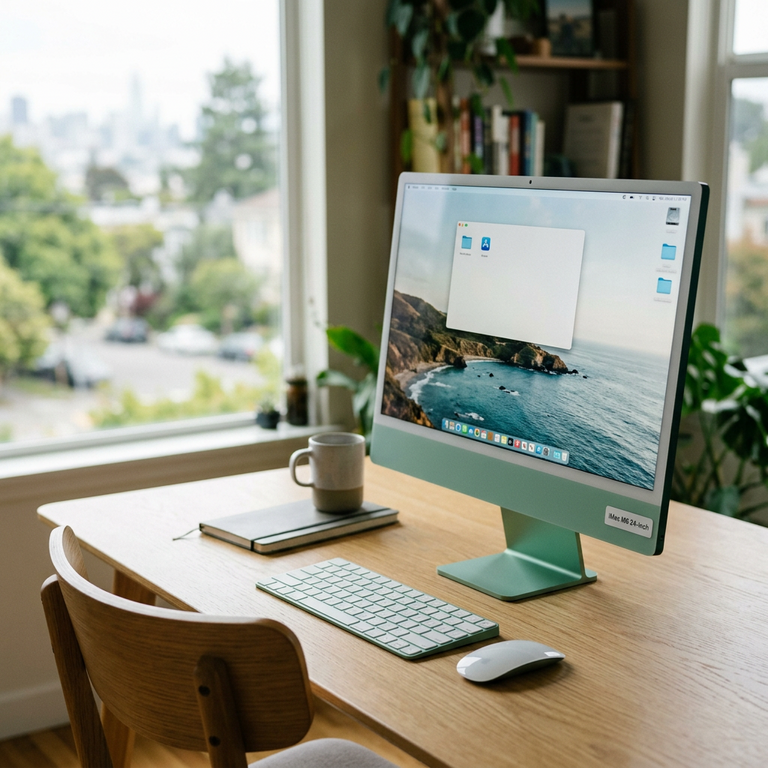
Apple’s latest iMac arrives less as a redesign than as a reminder: the desktop still has a place in a market obsessed with laptops. Introduced as the first update since the M4 model, the M6 iMac keeps the familiar colorful, all-in-one form and starts at $1,499. That continuity is the point: Apple is refreshing the computing engine while preserving the screen, compact footprint and desk-friendly simplicity that define the product. After two years between generations, the move signals a measured strategy, not an attempt to make every cycle look revolutionary. For buyers, the question is whether newer silicon makes everyday work meaningfully better or simply keeps Apple’s desktop current.
An all-in-one computer folds its display and core components into one enclosure, reducing cable clutter and setup friction; buyers add peripherals only as needed. That format suits kitchens, home offices, reception areas and classrooms, where a tidy, shared machine can matter more than upgrade flexibility. The iMac’s appeal has long rested on this trade: a polished display, speakers, camera and computer arrive together, with macOS already integrated. Keeping the exterior unchanged protects that recognizable proposition, but makes performance and connectivity the key reasons to consider a new generation. Apple will need the M6’s real-world gains, rather than color alone, to persuade owners whose current machines still feel fast.
The M6 chip is the headline change, bringing a newer generation of Apple silicon to a machine whose outward design has become deliberately stable. Apple’s custom processors combine central computing and graphics work on one chip, an approach that can improve speed and power efficiency while supporting tightly integrated features. For users, that can mean quicker exports, smoother creative applications and more responsive multitasking, though the benefits depend on software and workload. A chip-generation label alone cannot guarantee a dramatic leap for every owner, especially someone whose M-series Mac already handles daily tasks without delay. Independent testing will show whether gains justify replacement for demanding workloads in practice, soon.
Apple’s desktop range occupies a smaller, but strategically useful, corner of its Mac business. Laptops dominate because they travel, while desktops can offer a larger workspace and a permanent home for demanding or shared tasks. The iMac sits between a basic laptop setup and a tower: it is easier to place than a separate monitor-and-computer combination, but less configurable than a Mac Studio or Mac mini paired with a display. Its fixed design makes the buying decision unusually straightforward, yet limits the upgrades owners can make later. That distinction matters for offices buying in volume, where predictable setup and support costs can outweigh the appeal of interchangeable parts and repairs too.
The unchanged $1,499 starting price is as important as the chip. It keeps the entry point legible in a lineup where Apple’s premium positioning can make upgrades expensive, and gives schools and small businesses a known baseline for budgeting. But the headline price is only the start: buyers should compare memory, storage and ports on the configuration they actually need, since those choices affect longevity and total cost. A two-year cadence may also help owners avoid feeling that a machine bought last season is instantly obsolete. For a family replacing an aging computer, a stable price and familiar setup may matter more than a dramatic redesign.
The refresh also reflects a broader shift in the PC market: processors increasingly carry the generational story, while hardware shapes change more slowly. That is partly practical; a proven chassis lowers design disruption and preserves accessories, workflows and user familiarity. It also puts pressure on Apple to demonstrate that its silicon improvements translate into benefits people can notice, rather than relying on launch-day claims or model numbers. As software adds more demanding creative and AI-enabled features, keeping desktops current gives Apple a platform for those workloads without forcing every customer into a portable device. Businesses, meanwhile, can standardize fleets around a known design while evaluating whether performance gains warrant replacing existing systems.
For consumers, the M6 iMac is therefore less a must-buy than a choice between convenience and flexibility. People who need a neat, complete desktop and are moving from an older Intel Mac or an aging all-in-one may find the update compelling; recent M-series owners have more reason to wait for independent reviews or a later redesign. Apple’s decision to maintain the familiar shape and starting price suggests it sees the iMac as a dependable mainstream option, not a showcase for radical experimentation. That steadiness can help the desktop remain relevant even as work shifts between home, office and mobile devices. The real test will be whether the M6 extends the machine’s useful life enough to make a fixed, integrated computer feel like a smart investment.