





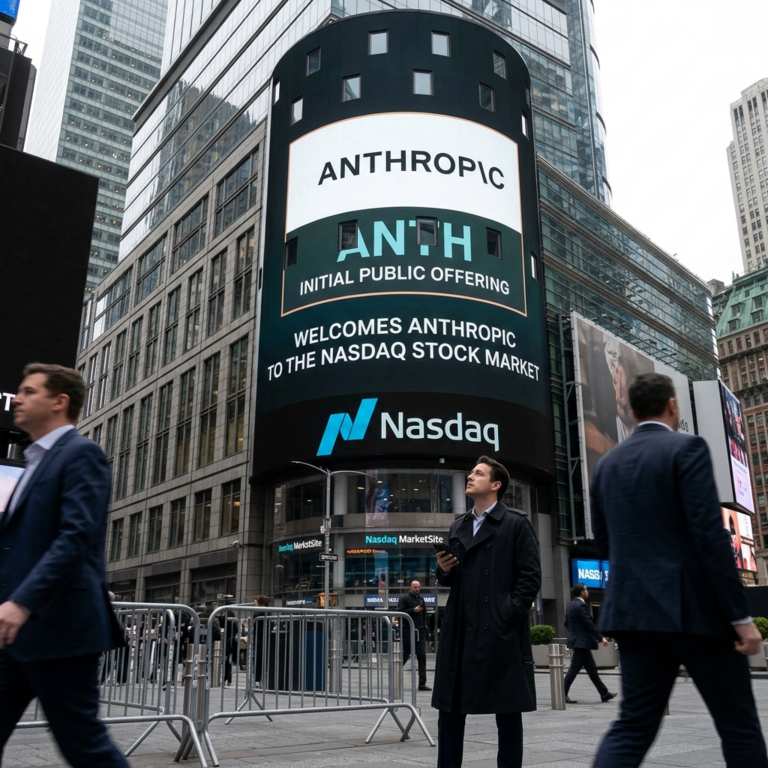
Anthropic’s decision to file for a Nasdaq listing turns a private company known chiefly for Claude into a public-market story. An IPO filing puts its finances, growth plans and ambitions for advanced AI before investors, while offering a rare view of the business behind a widely used chatbot and developer platform. The move matters beyond Wall Street: public funding could help determine how quickly Anthropic expands its products, computing capacity and reach. It also invites scrutiny of whether an expensive technology race can become a durable business, rather than a sequence of impressive launches financed by private capital.
For consumers, the most visible product is Claude, Anthropic’s conversational assistant, which can help draft, research, summarize and analyze information. Businesses also use the Claude Platform and API to build AI features into their own software, giving Anthropic two routes to customers: applications it operates itself and tools other companies can adapt. That distinction matters because a consumer may encounter Claude directly, or rely on it invisibly inside a workplace product. The filing’s financial disclosures can show how much those channels contribute, and whether users are paying for sustained value rather than experimenting with a fashionable new service.
A notable detail in the reported filing is that more than half of Anthropic’s customers spending over $100,000 use both the Claude Platform and a first-party Anthropic app. That overlap points to a cross-selling strategy: a company may build with Claude’s underlying technology while also giving employees Anthropic’s own interface. Such a combination can deepen a customer relationship, but it also raises practical questions about dependence, pricing and the ease of switching providers. For buyers, the appeal is a connected toolkit; the trade-off is that more workflows may become tied to one vendor’s models and services.
The economics behind those services are unusually demanding. Training advanced models requires specialized chips, large data centers, energy and teams of researchers, while operating an assistant at scale consumes computing resources every time people submit prompts. A listing can give Anthropic access to public investors and, potentially, capital to support that expansion, but it does not make those costs disappear. Investors will want evidence that revenue can grow faster than infrastructure and research expenses, and that customers will stay as competitors improve. Those pressures can shape product decisions, from subscription prices to which features receive priority.
The filing also places Anthropic in a crowded contest with OpenAI, Google and other companies pursuing increasingly capable models and AI agents. Agents are systems designed to use tools and carry out sequences of tasks, rather than simply respond to one question; in financial services, for example, they might help review earnings transcripts, update models or flag information for a human analyst. These uses could save time, but reliability, oversight and error handling remain central concerns. An IPO does not certify a model as safe or accurate; it makes the company’s stated risks and plans more consequential to shareholders and customers alike.
Public-company obligations could change how Anthropic communicates. Regular reporting would give investors—and, indirectly, customers, employees and competitors—more information about performance, risks and strategic priorities than a private company typically shares. Greater transparency may help businesses assess whether Anthropic is stable enough to support important workflows over the long term. Yet quarterly expectations can also create pressure to show rapid growth, even when responsible deployment requires slower testing, stronger safeguards or restraint. How the company balances those demands will help define its identity as both an AI research organization and a commercial supplier.
For users, the immediate effects may be modest: Claude will not become better simply because its maker lists shares, and an IPO alone does not guarantee new features or lower prices. The longer-term stakes are more concrete: access to capital could support broader availability, new workplace tools and investment in models, while commercial pressure could influence what gets built and how it is sold. Businesses should compare performance, privacy terms, reliability and exit options, rather than treating any model as an inevitable choice. Anthropic’s filing is therefore not just a financing milestone; it is a public test of whether useful, costly AI can grow into a sustainable service without putting trust in the balance sheet’s shadow.