







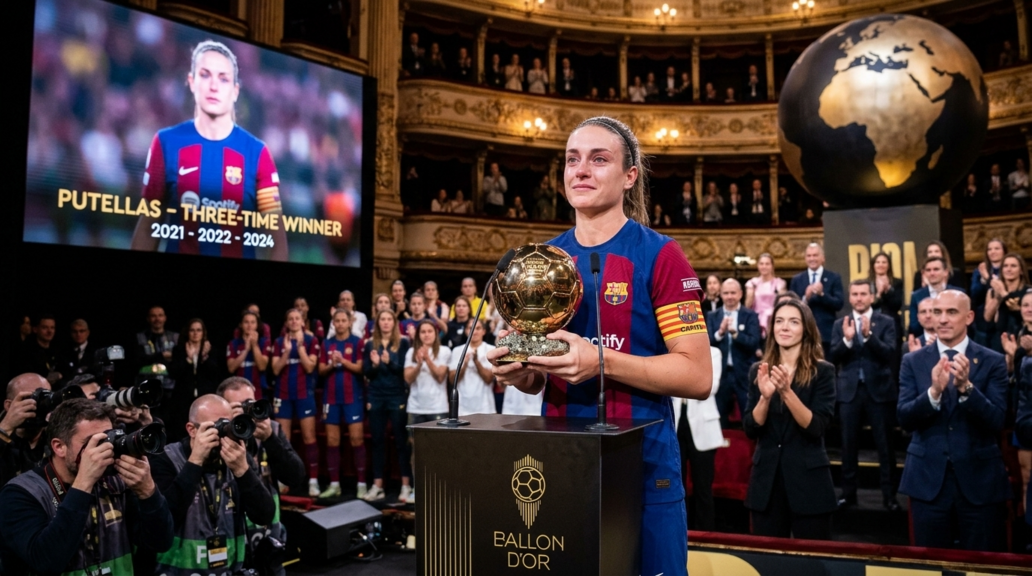
Alexia Putellas has reclaimed the Ballon d’Or, restoring her name to the summit of women’s football with a third triumph that ties the record. The Spain midfielder becomes only the second player, alongside compatriot Aitana Bonmatí, to win the award three times. Yet this latest honor is more than a statistical milestone: it is a comeback story, built through injury, uncertainty and a return to the game’s most demanding stage. Amid the celebration, the shortlist’s lack of African representation leaves an uncomfortable question hanging over the ceremony: whose excellence is being seen?
Putellas’s route back to the top began with a devastating knee injury that kept her away from the field and threatened to interrupt a career already rich in trophies. Recovery brought months of rehabilitation, careful rebuilding and the unfamiliar task of watching teammates carry on without her. For an elite player whose game depends on timing, balance and sharp changes of direction, returning is never simply a matter of being medically cleared. It means trusting the body again, then proving in public that ambition has survived the setback.
Her return has been framed not as a sentimental exception, but as a competitive achievement earned against the calendar and the expectations that follow a former winner. She has reasserted herself as a leader for club and country, bringing the authority of a captain together with the technical quality that made her a defining figure of Barcelona’s rise. Spain’s recent command of the women’s game has rested on a deep pool of talent, and Putellas and Bonmatí have become its most visible standard-bearers. Their shared place in the record book captures both individual brilliance and a wider Spanish era.
The award also gives Putellas a chance to reclaim a spotlight that Bonmatí had occupied, sharpening the friendly rivalry between two teammates who have helped shape the sport’s modern story. Their success is not a simple contest between stars: each represents the depth, cohesion and ambition that have made Spain a force at the highest level. For supporters, the third Ballon d’Or makes Putellas’s longevity impossible to overlook, while her comeback lends the achievement an added emotional charge. Greatness here is measured not only in trophies, but in the resolve to return and lead again.
Still, individual awards are built on choices, and the shortlist has renewed debate about how football recognizes talent beyond its established centers. The absence of African players is especially striking in a game whose reach and quality are growing across the continent. It does not diminish Putellas’s deserved accomplishment, nor does it prove that voters deliberately ignored any particular player. But it does invite scrutiny of the systems that shape visibility: access to major competitions, media attention, scouting networks and the pathways through which performances reach voters.
That question matters to fans because the Ballon d’Or is more than a medal; it is a global snapshot of who the sport considers its leading figures. A shortlist that fails to include African representation risks making the women’s game look narrower than it is, even as players and supporters expand its horizons. Recognition can influence investment, young athletes’ ambitions and the stories casual audiences hear about football. Organizers and voters should therefore explain how they assess candidates and consider whether the process gives talent from every region a fair chance to be noticed.
For now, Putellas can celebrate a rare achievement earned through resilience and elite performance, joining Bonmatí in a record book that reflects Spain’s remarkable influence. Her third crown is both personal vindication and a reminder that the game’s greatest honors are shaped by more than what happens on the pitch. Fans can applaud the comeback while asking who was missing from the conversation, and why. That tension does not diminish the winner; it gives the award a larger responsibility, to honor excellence while striving to see the whole game.