




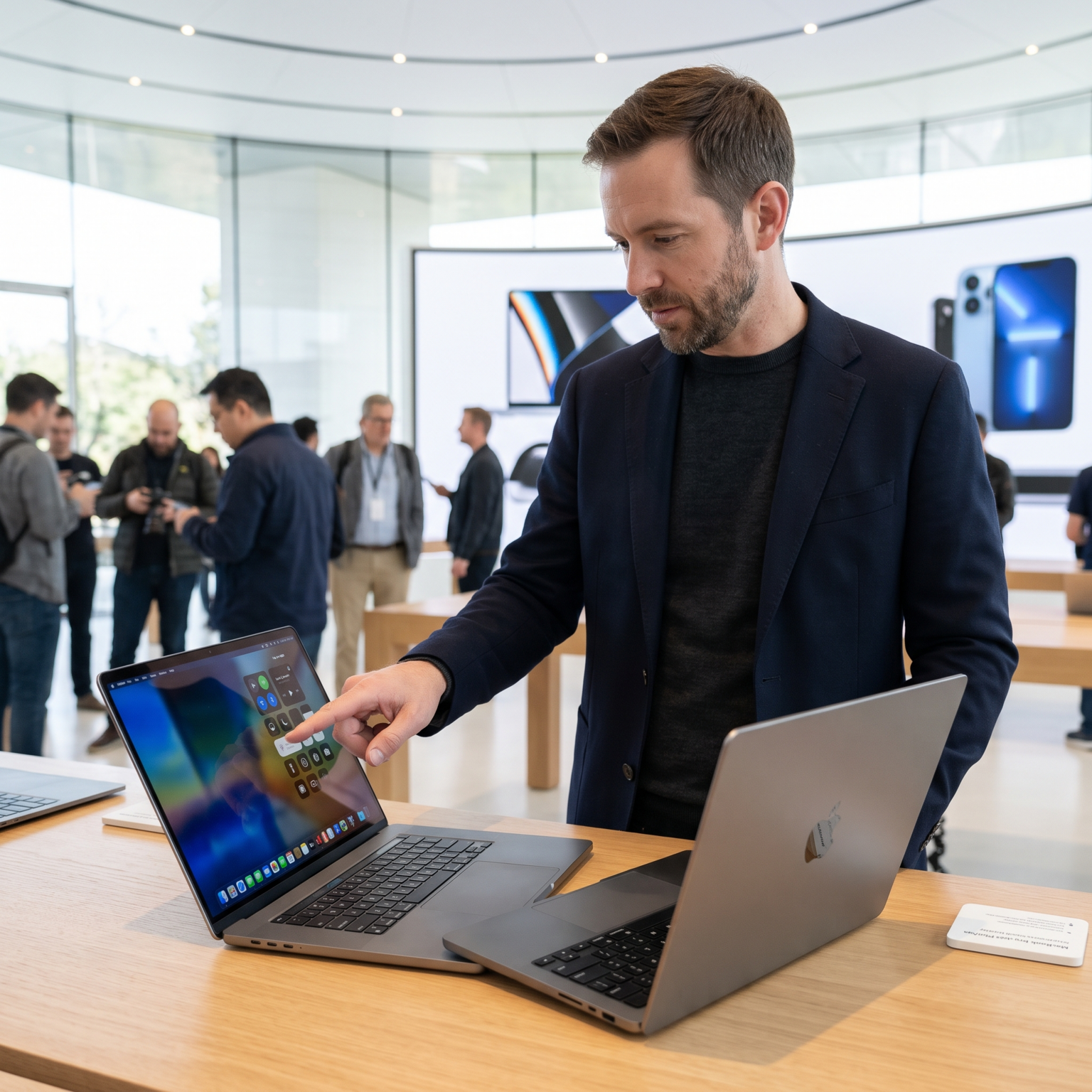
Apple has crossed a boundary it defended for years: its newest MacBook Pro models bring touchscreens to the laptop, pairing OLED displays with M5 Pro and M5 Max processors. The announcement puts touch controls on a flagship Mac for the first time, adapting interactions long familiar from the iPhone and iPad to a machine built for demanding professional work. Apple is also promising a thinner, lighter design, up to 24 hours of battery life and as much as 128 gigabytes of unified memory. Preorders began Wednesday, positioning the launch as more than a routine chip refresh: it is a test of how far the Mac’s established interface can change without losing its identity.
The screen is the most visible departure, and the most consequential. OLED pixels emit their own light, allowing deep blacks and vivid contrast without the backlighting used in conventional LCD panels; that can improve the viewing experience for video, photography and other work where detail matters. Touch adds a second way to navigate, letting users tap controls, manipulate content or reach familiar mobile-style features directly on the display. Apple has not suggested that touch replaces the keyboard and trackpad, however, and the practical question is whether it complements them or makes users reach awkwardly toward a vertical screen.
That question carries unusual historical weight. Steve Jobs famously argued that touchscreens did not belong on laptops because users’ arms would tire from holding them up, a view that helped distinguish Macs from touch-enabled Windows machines and Apple’s own tablets. The company’s new approach appears less like a conversion to an all-touch computer than a selective borrowing of gestures and controls from iOS. If macOS adapts intelligently to touch while preserving precise pointer-based work, Apple may soften a long-standing division between its platforms; if not, the feature risks feeling like an answer to a question many Mac users never asked.
The M5 Pro and M5 Max provide the other half of the pitch: performance for people whose workloads can use it. Apple describes them as its most powerful chips for a professional laptop, while unified memory lets the processor and graphics hardware share a common pool of data rather than copying it between separate memory systems. That design can help with large video timelines, complex visual effects, software development and on-device artificial-intelligence tasks, though real gains will depend on specific apps and configurations. Up to 128GB of memory gives demanding projects more room, but the top-end option is likely to come at a premium that puts it beyond ordinary buyers.
The combination matters because professionals rarely buy a laptop for a specification in isolation. OLED may make color-rich work more compelling, extra memory can keep large projects responsive, and longer battery life could reduce the search for an outlet during travel or shoots. Apple’s claim of up to 24 hours is a best-case figure, not a guarantee under every workload; sustained rendering, high brightness and intensive graphics can consume power far faster. Still, a thinner machine that lasts longer while carrying powerful components would address a practical trade-off that has defined mobile workstations for years.
For the wider market, Apple’s move could pressure laptop makers to rethink the difference between a computer and a tablet. Windows manufacturers have offered touch laptops for years, and hybrid designs have made folding screens and stylus input familiar, but Apple’s influence over software and hardware gives its choices particular reach. Developers will need to decide whether touch deserves new interface elements or whether existing Mac apps should simply accept taps. The best outcome would be thoughtful, optional controls that make creative and everyday tasks quicker; the worst would be a costly display feature that adds little beyond novelty.
Consumers should also consider which model and configuration actually match their needs. A student, office worker or casual editor may gain little from an M5 Max or enormous memory allocation, while filmmakers, designers and engineers could benefit from the added headroom if their software supports it. OLED introduces potential concerns such as long-term image retention, although modern display management can reduce that risk, and buyers will want independent testing of brightness, battery life and performance. Apple’s announcement signals a new direction, but reviews and real-world use will determine whether touch feels natural on a Mac. The larger question is whether Apple can blend its platforms without blurring what makes each useful.
In that sense, the launch is a strategic experiment as much as a product introduction. Apple is asking customers to accept a Mac that borrows from mobile devices while retaining the keyboard-centered workflow on which professional users depend. Success could encourage more seamless interaction across Macs, iPhones and iPads, and give software makers a reason to design interfaces that move fluidly between touch and pointer input. Failure would show that familiar gestures do not automatically translate to every form factor. Either way, the touchscreen MacBook Pro marks a meaningful change in Apple’s longstanding design philosophy, with consequences that will be measured not by the novelty of a fingertip on glass, but by whether the new option helps people do better work.