


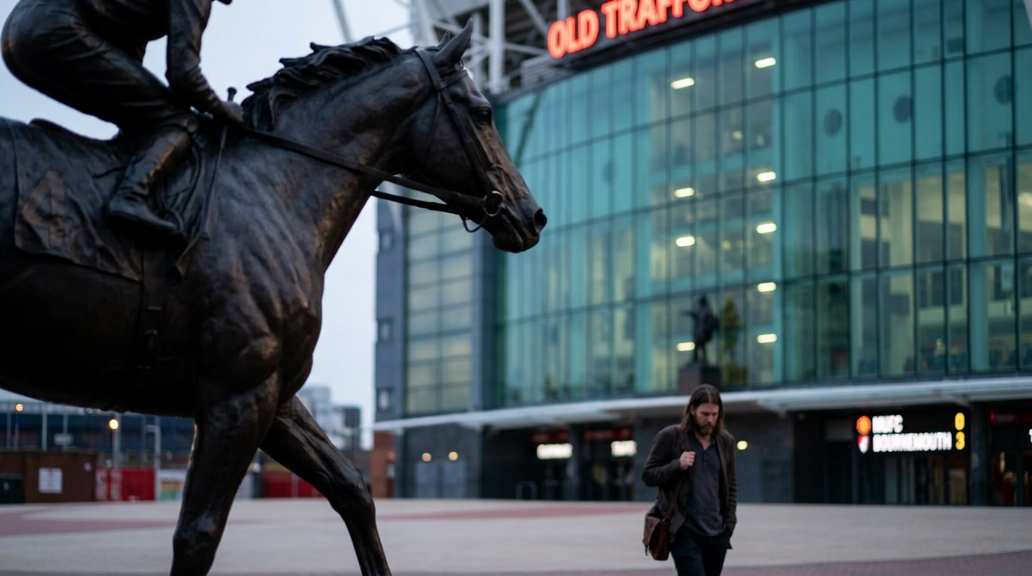
Manchester United’s latest crisis has the familiar shape of a club searching for a tactical fix while its deeper fault lines widen. A 3-0 home defeat to Bournemouth, followed by a 4-1 loss to Como, has intensified questions over Michael Carrick and the direction of a team that once defined standards across Europe. Yet Jonathan Wilson’s argument is more unsettling: United’s decline did not begin with this manager, or even with one bad transfer window. Its origins lie in a chain of choices—and in a horse.
The animal was Rock of Gibraltar, the champion racehorse whose ownership became a bitter dispute between Alex Ferguson and Irish businessmen John Magnier and J.P. McManus. Ferguson, then United’s commanding manager, believed he had a claim to part of the horse’s future stud earnings; the investors challenged that understanding. What might have remained a private disagreement instead exposed the club’s informal power structure, where trust and personal relationships mattered as much as written governance. The row turned a seemingly distant sporting sideshow into a test of who controlled United.
The conflict helped push Magnier and McManus, United’s major shareholders, toward selling their stake, opening a path for Malcolm Glazer’s 2005 takeover. That connection does not make the horse the sole cause of everything that followed; United’s decline cannot be reduced to one quarrel or one transaction. But the episode mattered because it weakened Ferguson’s influence over the ownership question and helped turn a stable institution into a leveraged private enterprise. The consequences would be measured in debt, strained supporters and years of arguments about investment and control.
For fans, the takeover marked a dividing line. United remained a sporting giant, and Ferguson continued to deliver extraordinary success, including the 2008 Champions League, but the club’s financial structure changed dramatically as debt was loaded onto the business. The manager’s brilliance could conceal weaknesses in recruitment and leadership; his retirement in 2013 removed the figure who had been the club’s strongest daily authority. The succession that followed exposed how little institutional planning had been done for life after him.
Since then, expensive signings and repeated managerial changes have promised quick renewal, only to produce brief surges followed by familiar frustration. United have spent heavily without assembling a consistently balanced squad, while executives have struggled to align recruitment, coaching and long-term identity. Every new appointment inherits the pressure to restore the old standard, but also a structure shaped by years of reactive decisions. Carrick may be responsible for results and performances, yet the scale of the problem is plainly larger than one coach’s touchline choices.
That is why defeats to Bournemouth and Como feel bigger than two ugly scorelines. They sharpen the sense that United can be outworked, exposed and unsettled even at Old Trafford, a ground once synonymous with late comebacks and fearsome home pressure. Supporters see a team short of coherence and a club still searching for credible leadership above it. For younger fans, the decline is not a sudden fall from memory but the normal condition of a giant that has lost its bearings.
Wilson’s horse is therefore a potent symbol, not a neat explanation. Rock of Gibraltar did not cause every poor signing, boardroom misjudgment or defensive collapse; rather, the dispute points toward a moment when ownership, authority and trust began to fracture. United’s route back will require more than replacing a manager or celebrating another transfer window. It will demand clear accountability, patient football decisions and a governing vision capable of matching the club’s ambitions. Until those foundations are restored, each new crisis will look less like an exception than another turn in the same long spiral.