





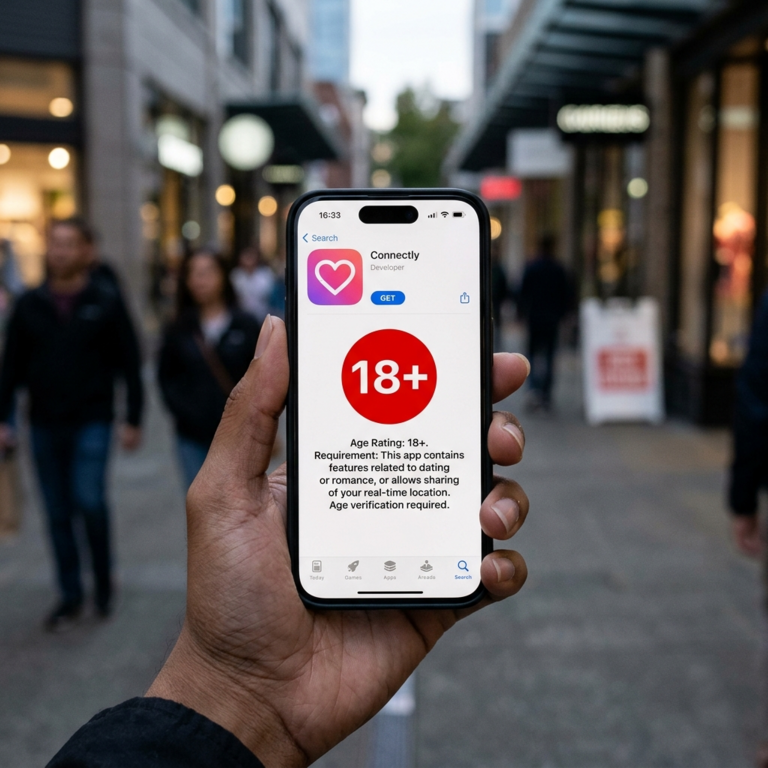
Apple is drawing a firmer boundary around intimacy in its digital storefront. Under new App Store age-rating guidance, dating apps and chatbots that users can pursue romantic relationships with must be rated for adults aged 18 and older. The change places AI companions in a category traditionally associated with dating services, rather than treating them simply as general-purpose conversational software. Apple is also asking developers to disclose whether their apps allow users to share real-world location, a consequential detail for services built around meeting people or simulating personal closeness. The policy is not a ban; it changes who can access certain experiences and what users can learn before downloading them. For Apple, it is a way to make age and privacy risks more visible without dictating how every product must work.
The immediate practical effect falls on developers, who will need to review their age-rating answers and how their products describe relationships with users. An app presented as entertainment or wellness may now face an adult rating if its chatbot is explicitly designed to flirt, court, or sustain a romantic bond. That distinction matters because AI products often blur familiar categories: a character can be a game companion, a writing partner, or a simulated partner, depending on its features and marketing. Developers will have to assess the experience itself, not just the label on the app. Apple’s classification gives creators a clearer signal, but questions about borderline cases are inevitable. A conversational assistant with affectionate language may not be the same as a service built to invite a user into an ongoing romance.
Age ratings are a blunt instrument, but they can shape who encounters a product and how parents make decisions. An 18-plus designation warns younger users away and gives families a more legible signal than a vague description or an easily missed disclaimer. It does not, by itself, verify every user’s age or prevent someone from accessing an app through another account or device. Enforcement and the reliability of age information remain important questions for platforms across the industry. Still, the label can influence search, downloads, and parental controls, while encouraging developers to think more carefully about audiences. For young people encountering emotionally persuasive software, that extra friction could matter, even if it cannot resolve every concern about exposure.
The location disclosure requirement addresses a different, concrete risk. Dating apps may use location to suggest nearby matches or arrange in-person meetings, while permission to share precise whereabouts can expose a person’s routines and movements. Users often grant permissions quickly, without considering how a feature works or whether location is essential to its main purpose. Requiring developers to state whether sharing is possible gives users and reviewers a clearer starting point, though it does not reveal every detail of data handling. People should still check an app’s privacy settings and decide whether approximate location is enough. The disclosure is most valuable when it prompts a choice before a user shares sensitive information, rather than after a surprise or unwanted encounter.
The policy arrives as AI companions move from novelty toward a recognizable consumer category. Products such as Replika and newer romance-focused chatbots invite users to build ongoing relationships with characters that respond conversationally and can seem attentive. Their appeal is understandable: they offer an available, nonjudgmental interaction, and some users find comfort or a safe space to rehearse difficult conversations. Yet these systems do not feel emotion or make mutual commitments; they generate responses shaped by software, design choices, and business incentives. When a product encourages attachment, the line between entertainment and emotional reliance becomes more than a marketing question. An adult rating cannot settle debates about loneliness, dependency, or responsible design, but it acknowledges that romantic interaction warrants distinct scrutiny.
Apple’s decision also reflects the power of app-store gatekeepers to set rules that reach far beyond their own software. Developers who want access to iPhone users must comply with Apple’s rating system, so a change in guidance can prompt companies to alter descriptions, onboarding, or features. That leverage can make safety standards more consistent, but it also places difficult judgments in the hands of a private platform. Competitors, regulators, and families may ask whether the rules are clear, consistently applied, and accompanied by meaningful appeals. The policy’s impact will depend on how Apple handles ambiguous cases and whether it explains its decisions. For businesses, age classification is not merely a compliance checkbox: it can affect a product’s audience, visibility, and commercial prospects.
For users, the practical lesson is to treat a chatbot’s romantic framing as a product feature, not proof of a real relationship, and to review permissions before sharing personal details. For developers, the new guidance is a prompt to design with age, privacy, and emotional expectations in mind from the outset. For the broader market, it signals that platforms may increasingly judge AI services by what people are encouraged to do with them, not only by the technology powering them. That approach could extend to companions designed for friendship, therapy-like support, or other intimate roles, though those categories raise their own challenges. Apple’s rules will not eliminate harmful interactions or settle who should police them. They do make one point unmistakable: as software becomes more personal, access controls and clear disclosures are becoming part of the product itself.