







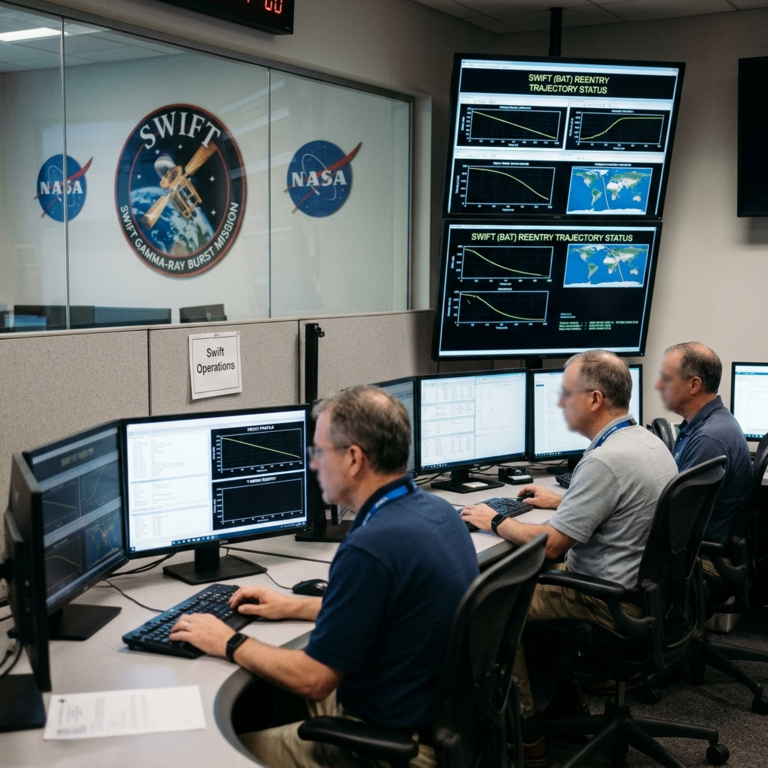
After nearly 22 years in orbit, NASA’s Neil Gehrels Swift Observatory is expected to fall back through Earth’s atmosphere Wednesday, after efforts to lift it into a safer orbit failed. NASA forecasts reentry at about 3:30 a.m. Eastern time, but the estimate carries an uncertainty window of roughly 11 hours. That broad range is a reminder that predicting a spacecraft’s path is difficult: small uncertainties in speed, orientation and the thinning upper atmosphere can shift the timing and location of descent. Swift’s end is more than a dramatic finale; it is a test of how space agencies manage useful machines when fuel, orbit and rescue options run out, and how responsibility for Earth’s increasingly crowded orbital environment is changing. Its scientific legacy, however, will continue in archived data and methods developed to respond quickly to cosmic explosions and other transient events.
Launched in November 2004, Swift was designed to spot gamma-ray bursts: powerful, fleeting explosions that can appear anywhere in the sky. Its instruments could detect a burst and rapidly turn the spacecraft toward it, allowing observations across gamma-ray, X-ray, ultraviolet and visible wavelengths. That speed made Swift a kind of cosmic alert system, helping scientists study events that might otherwise fade before ground-based telescopes could respond. Over more than two decades, the observatory also supported research into black holes, supernovae and other energetic phenomena, demonstrating the value of combining different kinds of astronomical measurement in one mission. For researchers, its descent closes an observing chapter, but not the scientific record: the data already collected can continue to inform analysis and discoveries for years.
The immediate concern is the uncontrolled nature of the reentry. Unlike a planned retirement, in which operators guide a spacecraft toward a remote ocean area, Swift’s operators cannot precisely choose where it will come down. NASA expects most of the observatory to burn up as it encounters the atmosphere, though some components may survive and reach the surface. The agency’s forecast identifies when reentry is likely, not a precise impact point, and the timing uncertainty means the potential ground track remains difficult to pin down until the final hours. Such estimates improve as tracking data arrive, but uncertainty is inherent in a high-speed object moving through an atmosphere that is itself variable.
For people on the ground, the practical risk from falling spacecraft debris is generally low, particularly when most of a vehicle is expected to disintegrate. Still, “low risk” is not the same as no risk, and an uncontrolled return prompts familiar questions about public warning, liability and who is responsible for managing an aging satellite. Swift is a large scientific spacecraft, but it is only one example of the hardware now approaching the end of its useful life in orbit. The number of satellites and spent rocket stages around Earth has grown alongside commercial communications, navigation and imaging services. Each object that remains aloft can become a collision hazard; each uncontrolled reentry is also a reminder that orbital operations have consequences beyond the mission team.
NASA and aerospace startup Katalyst Space Technologies had pursued an orbital servicing effort intended to raise Swift’s orbit, according to reports on the rescue attempt. The effort did not achieve the boost needed to prevent the observatory’s return. That failure should not obscure the significance of trying: servicing could eventually give operators a way to refuel, repair or reposition spacecraft rather than treating them as disposable once their original plans falter. But a rescue requires more than a promising idea. A servicer must rendezvous safely with a target, operate reliably in orbit and deliver enough thrust to change its trajectory; a late intervention may also face tight limits imposed by the target’s condition and remaining time.
The episode arrives as governments and companies debate how to make space operations more sustainable. New satellite constellations promise broader internet access and other services, while creating a need for dependable tracking, collision avoidance and end-of-life plans. Swift’s case illustrates why disposal strategies should be designed into missions from the beginning, rather than improvised when a spacecraft is already descending. That means reserving fuel or other capabilities for a controlled exit, improving forecasts of atmospheric drag and establishing clear standards for operators. It also means building a market for in-orbit servicing, while recognizing that complex, high-risk rescue missions cannot yet be assumed to work every time. Technical progress and regulation will have to advance together.
Swift’s retirement also shows the trade-off inherent in extending a space mission: an observatory that continues producing valuable science can justify years of operation, but its aging systems and changing orbit eventually narrow the choices. Ending the mission does not erase its contribution, and the prospect of debris should not diminish the accomplishments of the scientists and engineers who kept it working. Instead, the final descent offers a practical lesson for the next generation of spacecraft designers, operators and policymakers: success in space includes not only what a satellite discovers or delivers, but how it leaves orbit. For users, the connection is indirect but real. Reliable services and future exploration depend on keeping orbital pathways usable, limiting avoidable debris and making sure the benefits of space technology do not come with unmanaged risks for everyone below.